The right overhead camera rig can keep interview footage stable, clear, and professionally framed while freeing your hands for lighting, notes, or demonstrations. The best setup depends on your camera weight, available space, and whether you shoot at a desk or on location.
We compared 10 overhead camera rigs for interviews, including adjustable tripods, desk-mounted arms, super-clamp systems, and modular rigs designed for heavier production equipment. Use the guide below to narrow your choices by stability, reach, portability, and value.
Best 10 Overhead Camera Rigs for Interviews Picks for 2026
Best All-Around Height
K&F CONCEPT 90-Inch Overhead Tripod

- Reaches 90 inches
- 22-pound load capacity
- Folds to about 21 inches
Best For: Elevated interviews and flexible overhead shooting
Best Tabletop Studio Rig
NEEWER ST100 Overhead Camera Mount

- Steel frame supports 10 pounds
- 24–39-inch height range
- 12 accessory mounting points
Best For: Desk-based interviews and controlled studio setups
Best Heavy-Duty Tripod
SmallRig CT200 Horizontal Overhead Tripod

- 33-pound maximum load
- 180-degree tilt and 360-degree rotation
- Includes counterweight bag
Best For: Sturdy interview rigs with extra accessories
Best C-Stand Add-On
Glide Gear OH 75 Overhead Mount

- 15-pound payload
- Six-foot adjustable pole
- Includes clamps and camera sled
Best For: C-stand-based interview and overhead setups
Best for Modular Studio Coverage
PROAIM 12ft Modular Overhead Rig

- Configurable 4-, 8-, or 12-foot rail lengths
- Includes ball head, riser, and accessory spacers
- Supports stand or ceiling installation
Best For: Larger studios needing adjustable overhead coverage
Best for Compact Desk Interviews
SMALLRIG Adjustable Desk Mount

- Height adjusts from 30 to 73cm
- 360-degree arm adjustment with ball head
- Supports up to 2kg and two devices
Best For: Desk-based interviews and compact indoor setups
Best for Flexible Dual-Device Mounting

- Adjustable height and width for desk setups
- Includes dual ball heads and phone holder
- Supports cameras, phones, lights, and microphones
Best For: Tabletop interviews using multiple devices
Best Compact Pick
DImotliyor 3-Section Overhead Camera Mount
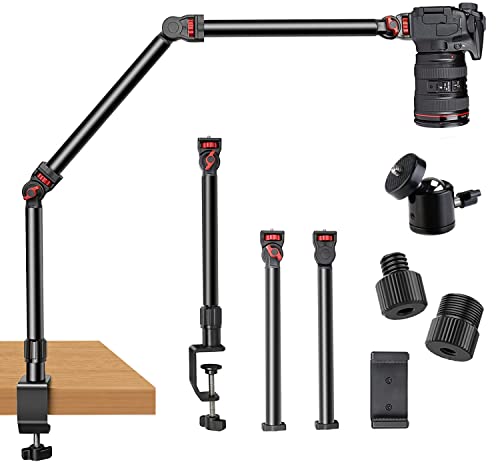
- Three adjustable sections with 360-degree base rotation
- Supports up to 6 pounds
- Includes multi-size screws and phone holder
Best For: Space-conscious desk setups using lighter cameras, phones, or webcams
Best Heavy-Duty Pick
JUSMO LS15 Pro Overhead Camera Rig

- Supports up to 22.05 pounds
- Segmented design adjusts length and height
- Includes super clamp and large desktop C-clamp
Best For: Expandable interview studios with multiple or heavier devices
Best Multi-Device Pick
NEEWER ST008 Dual-Arm Camera Mount

- Center column plus two adjustable arms
- Supports up to 11 pounds on the center column
- Includes adapters and cable ties for organized setups
Best For: Interviews requiring a camera, light, microphone, and accessories
Best All-Around Height – K&F CONCEPT 90-Inch Overhead Tripod
For creators comparing overhead camera rigs for interviews, the K&F CONCEPT offers generous height, flexible positioning, and a relatively portable design. Its horizontal setup reaches 90 inches and supports cameras, camcorders, and smartphones.
Best For: Interview setups that need elevated, adjustable angles or occasional overhead and panoramic shots.
Pros:
- Reaches up to 90 inches for elevated framing.
- Flexible legs and a gimbal head provide 180-degree tilt and 360-degree rotation.
- Supports up to 22 pounds and includes a detachable monopod.
- Folds to about 21 inches and weighs roughly 4.5 pounds.
Cons:
- Its maximum height and horizontal design may require careful balancing during setup.
- It is not water resistant.
The K&F CONCEPT is a versatile choice when one rig needs to handle interviews, overhead compositions, and travel. The large load rating and adjustable positioning make it particularly useful for creators who want flexibility without carrying a dedicated tabletop stand.
Best Tabletop Studio Rig – NEEWER ST100 Overhead Camera Mount
The NEEWER ST100 is a practical pick among overhead camera rigs for interviews when your filming happens at a desk or tabletop. Its steel frame, adjustable columns, and accessory mounting points make it suited to controlled studio-style setups.
Best For: Desk-based interviews, tutorials, demonstrations, and productions using lights, monitors, or backdrop accessories.
Pros:
- Steel construction supports up to 10 pounds.
- Height adjusts from 24 to 39 inches with spring-loaded positioning points.
- Twelve crossbar mounting points support additional accessories.
- Rubberized bases help stabilize the stand and protect desks.
Cons:
- Requires a flat desk at least 39.4 inches wide or floor space.
- Phone clamps, super clamps, lights, and backdrops are sold separately.
The ST100 is less portable than a conventional tripod, but its tabletop footprint and expansion-friendly crossbar are useful for repeatable interview scenes. Choose it when stability and accessory organization matter more than quick location changes.
Best Heavy-Duty Tripod – SmallRig CT200 Horizontal Overhead Tripod
The SmallRig CT200 combines a horizontal center column with a high stated load capacity, making it a strong option among overhead camera rigs for interviews. It also adds monopod conversion, accessory threads, and a counterweight bag for more adaptable production work.
Best For: Interview crews needing a sturdy tripod that can also support monitors, microphones, or other mounted accessories.
Pros:
- Supports up to 33 pounds, with a 10-pound head load rating.
- Offers 180-degree tilt and 360-degree horizontal rotation.
- Converts to a monopod and includes a counterweight bag.
- Provides 1/4-20 threaded holes for accessories.
Cons:
- The horizontal configuration may need a counterweight for maximum stability.
- Its larger 73-inch format is less compact than a tabletop rig.
With its 29 mm aluminum tubes, broad load rating, and included weight bag, the CT200 is built for demanding setups. It is a compelling choice when an interview rig must accommodate heavier equipment or transition between overhead, low-angle, and monopod shooting.
Best C-Stand Add-On – Glide Gear OH 75 Overhead Mount
The Glide Gear OH 75 is a lightweight overhead mount for creators who already use C-stands. For overhead camera rigs for interviews, its six-foot pole and adjustable clamps can help position a camera above a table, set, or demonstration area.
Best For: Portable studio and on-location setups built around existing C-stands or compatible one- to two-inch poles.
Pros:
- Supports up to 15 pounds while weighing only 2.3 pounds.
- Includes a six-foot pole, clamps, baby pin posts, and camera sled.
- Works with rails or poles from 1 to 2 inches in diameter.
- Simple assembly and a limited lifetime warranty.
Cons:
- C-stands are not included.
- It is a mount system rather than a complete freestanding tripod.
The OH 75 makes sense when your production kit already includes suitable stands and you want a lightweight horizontal extension. Its 15-pound capacity is useful, but buyers must account for the additional support hardware when planning the full interview setup.
Best for Modular Studio Coverage – PROAIM 12ft Modular Overhead Rig
For interview sets that need overhead camera rigs for interviews with adaptable coverage, the PROAIM Overhead 12ft Modular Rig offers configurable 4-, 8-, or 12-foot layouts. Its aluminum rails can support cameras, lights, microphones, and other accessories, with capacity varying by configuration.
Best For: Studio interview setups requiring configurable overhead, top-down, or bird’s-eye angles.
Pros:
- Configures to 4, 8, or 12 feet for different studio spaces and payload needs.
- Includes three accessory spacers, a ball head, quick-release plate, and 3-inch riser.
- Can mount to compatible C-stands, light stands, or directly to a ceiling.
Cons:
- Payload drops to 5kg/11lb at the full 12-foot length.
- Stands are sold separately.
- Its modular studio design is less compact than a simple desktop mount.
The PROAIM is the most adaptable option here for larger interview environments, especially when you want to reposition multiple accessories or change the rail length. Verify the intended support method and payload before building the rig.
Best for Compact Desk Interviews – SMALLRIG Adjustable Desk Mount
The SMALLRIG Camera Desk Mount is a practical choice among overhead camera rigs for interviews when your setup is based around a desk. It combines an adjustable main pole and secondary arm with a 360-degree ball head for cameras, phones, lights, or microphones.
Best For: Indoor desk-based interviews, video conferences, and compact streaming setups.
Pros:
- Adjusts from 30 to 73cm in height, with a secondary arm extending from 30 to 50cm.
- 360-degree arm adjustment and a detachable ball head support flexible framing.
- Supports up to 2kg and can accommodate two devices simultaneously.
Cons:
- Limited to a 2kg load capacity.
- Requires a compatible desk surface 1 to 6cm thick for mounting.
- Designed for indoor desktop use rather than large studio installations.
This mount suits interviewers who work from a fixed desk and value quick height and angle changes over a long overhead span. Check your desk thickness and the combined weight of the camera and accessories before mounting.
Best for Flexible Dual-Device Mounting – NEEWER NK002 Overhead Rig
The NEEWER NK002 is a versatile option for overhead camera rigs for interviews, combining a clamped crossbar, adjustable desktop stands, and dual ball-head mounting. It can hold cameras, phones, webcams, microphones, and lights while fitting into limited desk space.
Best For: Tabletop interviews, live streaming, unboxing-style presentations, and setups using multiple devices.
Pros:
- Height adjusts from 27.2 to 48 inches and width from 25.2 to 47.2 inches.
- Heavy-duty C clamps support up to 26.5lb/12kg for the stand assembly.
- Includes dual ball-head hardware, a phone holder, and multiple 1/4-inch mounting options.
Cons:
- The dual ball-head super clamp has a stated maximum load of 1.5kg/3.3lb.
- Additional telescopic crossarms and mounting accessories are sold separately.
- Its desktop clamp design needs suitable surfaces and available desk space.
The NK002 offers strong flexibility for compact interview stations, particularly when you need a camera plus phone, light, or microphone position. Pay attention to the lower load limit of the ball-head clamp when selecting a camera and accessory combination.
Best Compact Pick – DImotliyor 3-Section Overhead Camera Mount
For creators seeking compact overhead camera rigs for interviews, this DImotliyor mount offers a flexible desktop setup with three adjustable sections, a 360-degree ball head, and broad device compatibility. Its padded C-clamp is designed for desks up to 2.4 inches thick, while the lightweight aluminum construction makes it easier to move or travel with.
Best For: Desk-based interviews, webcams, phones, compact cameras, microphones, and lights where space is limited.
Pros:
- Three-section arm provides 180-degree adjustment at each rod and a 360-degree rotating base.
- Supports up to 4.5 pounds horizontally and up to 6 pounds maximum.
- Includes 1/4-inch, 3/8-inch, and 5/8-inch screw options, plus a phone holder and ball head.
- Padded C-clamp helps protect the desk and devices from scratches.
Cons:
- Its 6-pound maximum load is lower than the heavier-duty options in this roundup.
- The clamp accommodates desks up to 2.4 inches thick.
This is a practical choice when you want an adaptable overhead perspective without a large studio footprint. It is best suited to lighter interview equipment rather than a multi-device professional rig.
Best Heavy-Duty Pick – JUSMO LS15 Pro Overhead Camera Rig
The JUSMO LS15 Pro stands out among overhead camera rigs for interviews when you need substantial load capacity and room to expand. Its segmented aluminum design lets you adjust length and height, while the included super clamp and large C-clamp support a multi-device desktop studio.
Best For: Interview setups using a DSLR, lights, microphones, phones, or other equipment that benefit from a high-capacity overhead mount.
Pros:
- Rated for loads up to 22.05 pounds, or 10 kilograms.
- Segmented poles allow flexible adjustment of the rig’s length and height.
- Includes a super clamp for adding cameras, lights, or microphones.
- Large C-clamp extends to 3.54 inches and saves desktop space.
Cons:
- At 4 kilograms, it is considerably heavier than the more compact mounts.
- Its large, expandable design may be more setup than a simple webcam interview requires.
- The listed warranty is three months.
Choose the LS15 Pro if stability, capacity, and expansion matter more than portability. Its included components and optional extra poles make it the strongest fit for a growing interview or streaming workstation.
Best Multi-Device Pick – NEEWER ST008 Dual-Arm Camera Mount
For interviews that require a camera plus lighting or audio accessories, the NEEWER ST008 provides a tree-like desktop arrangement with a center column and two cross arms. It combines multiple mounting points, adjustable heights and angles, and cable ties for a more organized overhead camera rig.
Best For: Home-office or studio interviews using a camera, ring light, microphone, phone holder, or other accessories simultaneously.
Pros:
- Center column supports up to 11 pounds, while each arm supports up to 5.5 pounds.
- Center column adjusts from 13.2 to 37.6 inches, with two adjustable cross-arm configurations.
- Hinged, serrated joints help resist sagging and unwanted movement.
- Includes multiple adapters for 1/4-inch, 3/8-inch, and 5/8-inch accessories, plus cable ties.
Cons:
- Multiple components and joints may take more time to position than a single-arm mount.
- The 11-pound total limit still applies when multiple devices are mounted at the joints.
- The 3.5-inch clamp may not fit thicker desks.
The ST008 is a strong middle ground for creators who want more than one mounting position without moving to the heavier LS15 system. Its adjustable arms and included adapters make it especially useful for combining interview video, lighting, and audio gear.
How We Picked These Overhead Camera Rigs for Interviews
We focused on rigs that can position a camera above a subject, interview table, or demonstration area without relying on improvised supports. Our comparison considered stated weight capacity, height and reach, mounting flexibility, construction materials, adjustment options, portability, and compatibility with cameras, phones, lights, microphones, and other accessories.
Because interview environments vary widely, the list includes both full-size horizontal tripods and compact desk mounts. A heavy-duty system may be best for a studio camera and lighting setup, while an articulating arm can be more practical for a creator working from a small desk.
Quick Comparison
| Rig type | Best suited to | Main advantage | Potential trade-off |
|---|---|---|---|
| Horizontal overhead tripod | Studio interviews and top-down scenes | Broad reach and stable positioning | Requires more floor space |
| Heavy-duty modular rig | Cameras, gimbals, and lights | Higher capacity and expandability | Less portable and usually costlier |
| Desk-mounted arm | Podcasts, streaming, and small spaces | Compact setup with quick adjustments | Depends on desk strength and clamp clearance |
| Clamp or multi-head mount | Accessory-rich interview stations | Flexible attachment points | Needs careful tightening and balance |
Key Buying Factors for Overhead Camera Rigs for Interviews
Load Capacity and Balance
Check the rig’s rated capacity against the complete setup, not just the camera body. Include the lens, cage, monitor, microphone, cable strain, and any mounted light. Stay comfortably below the maximum rating so the arm or boom does not sag during a take.
Reach, Height, and Framing
Measure the distance from the mounting point to the intended camera position. Horizontal tripods and long booms offer more reach, while desk arms work best when the subject is close to the desk edge. Confirm that the adjustment range supports your preferred eye line and angle.
Mounting Surface and Stability
Desk clamps need a strong, suitably thick surface with enough clearance for the clamp jaw. Freestanding systems require a stable floor and a wide enough footprint. Avoid placing a loaded rig where accidental bumps, cable pulls, or moving furniture could shift it.
Adjustability and Accessories
Ball heads, articulating joints, multiple boom arms, and standard camera threads make it easier to fine-tune framing. If you plan to add a key light, phone, webcam, or microphone, verify the included mounting hardware and available attachment points.
Portability and Setup Time
Choose a collapsible tripod or detachable arm if you travel between interview locations. For a permanent studio, prioritize rigidity, cable management, and expansion over compact storage.
Who Should Buy Which Overhead Camera Rigs for Interviews?
Choose a horizontal overhead tripod if you need broad coverage, a stable studio position, or space for top-down demonstrations alongside interviews. Choose a modular heavy-duty rig for heavier cameras, gimbals, lights, or a more expandable production setup.
Choose a desk-mounted arm for streaming, podcasting, remote interviews, and compact workstations. Choose a clamp-based or multi-arm mount when you want to attach several smaller devices and adjust them independently. Before buying, confirm the load rating, desk or floor requirements, camera thread compatibility, and the exact reach needed for your interview framing.