A good monitor riser can raise your screen to a more comfortable viewing height while reclaiming valuable desk space. The right model can also add storage for a keyboard, laptop, stationery, or other everyday accessories.
We compared 10 desktop monitor risers across adjustability, weight capacity, organization, construction, and suitability for single- and dual-monitor setups.
Best 10 Desktop Monitor Risers Picks for 2026
Adjustable Metal Pick

- Three height settings from 3.9 to 5.5 inches
- Metal platform supports up to 44 pounds
- Open storage and vented shelf design
Best For: Adjustable monitor, laptop, or printer setups
Multi-Monitor Organizer

- Expands from 30.7 to 43.3 inches
- Supports two or three monitors up to 44 pounds
- Three under-shelf storage compartments
Best For: Wide multi-monitor workstations
White Workspace Pick

- Adjusts from 31.5 to 42.5 inches
- Swivel shelves support straight, angled, or corner layouts
- Three compartments plus phone and cable slots
Best For: Flexible white dual-monitor setups
Desk Organization Pick

- Two-tier carbon-steel design supports 44 pounds
- Includes drawer and two hanging pen holders
- Non-slip, height-adjustable protective pads
Best For: Compact desks needing organized accessory storage
Best Adjustable Value
Amazon Basics Height-Adjustable Riser

- Three adjustable height settings
- Supports up to 22 pounds
- Lightweight ABS with non-skid feet
Best For: Compact home-office setups and standard monitors
Best for Everyday Use

- Two-tier open storage design
- 66-pound load capacity
- Phone holder and cable management
Best For: Small desks needing screen elevation and organization
Best for Dual Monitors
WESTREE Wood and Steel Dual-Monitor Riser
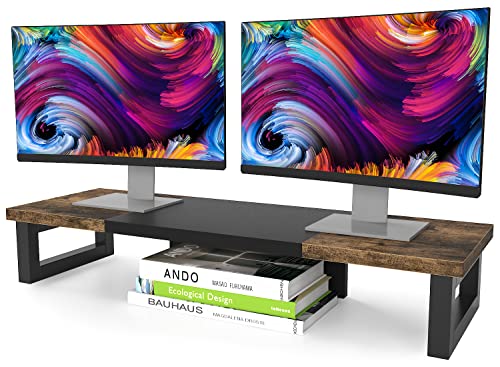
- Wide platform for two monitors
- 68-kilogram load capacity
- Under-shelf storage with steel legs
Best For: Spacious dual-monitor workstations
Best Heavy-Duty Pick

- 38.6-inch-wide desktop shelf
- Supports up to 100 pounds
- Steel legs with non-slip pads
Best For: Wide dual-monitor workstations
Best Simple Pick
OPNICE Dual Monitor Riser with Storage
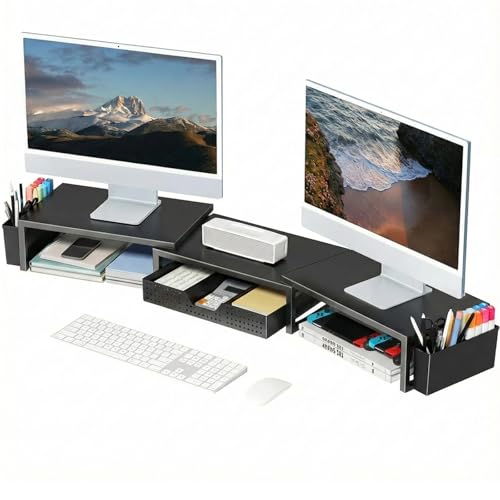
- Extends up to 39 inches wide
- Drawer and two pen holders
- No installation required
Best For: Organized dual-monitor home and office desks
Adjustable Metal Pick – WALI Monitor Stand Riser
For shoppers comparing desktop monitor risers, the WALI Computer Monitor Stand offers three height settings and a sturdy metal platform for monitors, laptops, or printers. Its open design also creates useful storage space beneath the stand.
Best For: Home or office users who want adjustable height, ventilation, and under-stand storage in a compact riser.
Pros:
- Adjusts to 3.9, 4.7, or 5.5 inches for a more comfortable viewing position.
- Supports up to 44 pounds on a 14.6-by-9.3-inch platform.
- Vented metal shelf helps promote airflow and includes rubber pads for surface protection.
- Open space underneath stores keyboards, notebooks, and desk accessories.
Cons:
- The platform dimensions may not suit larger displays or wide multi-monitor setups.
- Its single-level design offers less built-in organization than multi-tier risers.
This is a practical choice when adjustability and ventilation matter more than extensive desktop organization. The 44-pound capacity also gives it flexibility for several common desk devices.
Multi-Monitor Organizer – TAVR Adjustable Monitor Stand
The TAVR is one of the more adaptable desktop monitor risers for wide or multi-screen arrangements. Its length adjusts from 30.7 to 43.3 inches, while movable end pieces help accommodate straight, angled, or differently sized monitor layouts.
Best For: Users managing two or three monitors who need a long, adjustable shelf with storage underneath.
Pros:
- Adjustable length and end-piece angles support varied desk and monitor configurations.
- Designed to hold two or three monitors with a 44-pound capacity.
- Three storage spaces help organize keyboards, devices, and office supplies.
- Assembly is designed to take about two minutes with numbered parts and instructions.
Cons:
- The maximum 43.3-inch length requires substantial desk space.
- Its wood construction is less suitable for shoppers specifically seeking a metal riser.
Choose this model if flexibility is the priority. The adjustable width and angled sections make it especially useful for multi-monitor workstations that do not follow a simple straight layout.
White Workspace Pick – BONTEC Dual Monitor Riser
The BONTEC dual monitor riser combines adjustable width with swiveling side shelves, making it a flexible option among desktop monitor risers. Its white wooden design adds open storage, a phone slot, and a cable-management opening to a home office or gaming desk.
Best For: Dual-monitor users who want a white organizer with flexible shelf angles and dedicated phone and cable features.
Pros:
- Adjusts from 31.5 to 42.5 inches for smaller or larger desks.
- Swivel side shelves support straight, angled, or corner arrangements.
- Three open compartments provide room for keyboards, files, devices, and accessories.
- Includes a smartphone holder slot, cable opening, non-slip base, and approximately two-minute assembly.
Cons:
- The white lacquered wood finish may not match darker desk setups.
- It is positioned for dual-monitor use rather than a compact single-screen arrangement.
This riser is a strong fit for organized dual-screen desks where layout flexibility matters. Its storage and cable-management details make it more than a simple platform while retaining a relatively clean appearance.
Desk Organization Pick – OPNICE 2-Tier Monitor Riser
For buyers who want desktop monitor risers with built-in organization, the OPNICE 2-Tier model adds a drawer and two hanging pen holders. Its carbon-steel construction, non-slip pads, and 44-pound load capacity make it suited to monitors or laptops in home, dorm, and office spaces.
Best For: Users who need a compact monitor or laptop riser with enclosed drawer storage and dedicated pen holders.
Pros:
- Two-tier design adds storage without relying only on open shelf space.
- Drawer and two pen holders keep small office supplies accessible.
- Carbon-steel construction supports up to 44 pounds.
- Height-adjustable non-slip pads help protect the desk from scratches and improve stability.
Cons:
- The fixed 20.5-inch-wide platform offers less flexibility than adjustable-length risers.
- Its drawer and two-tier structure may provide less open clearance for a full-size keyboard.
This model makes the most sense when everyday desk organization is as important as monitor elevation. It offers a more structured storage approach than a basic riser, with a compact footprint for smaller work areas.
Best Adjustable Value – Amazon Basics Height-Adjustable Riser
For shoppers comparing desktop monitor risers, this Amazon Basics model offers three height options in a lightweight, stackable design. Its ABS construction, non-skid feet, and 22-pound capacity suit standard monitors, laptops, and small office equipment, provided the compact tapered surface fits your device.
Best For: Home offices and everyday setups needing simple height adjustment and light storage organization.
Pros:
- Three height settings: approximately 2.87, 4.2, and 4.8 inches.
- Supports up to 22 pounds for standard monitors and laptops.
- Non-skid feet help keep the stand stable on flat surfaces.
- Lightweight ABS construction is easy to move.
Cons:
- The tapered top measures approximately 11.6 by 11 inches, so compatibility should be checked carefully.
- ABS plastic may feel less substantial than wood or metal.
- The detachable-leg height system is designed for everyday use rather than fixed-lock adjustment.
This is a practical pick when portability and adjustable height matter more than a large platform or heavy-duty capacity.
Best for Everyday Use – BONTEC Wooden Monitor Riser
This BONTEC model stands out among desktop monitor risers for its two-tier layout and built-in organization features. The 5.6-inch lift creates room for a keyboard, mouse, notebook, or other essentials underneath, while the 66-pound MDF platform can support a monitor, laptop, small printer, or similar office device.
Best For: Organized home offices, dorm rooms, and small desks that need open storage below the screen.
Pros:
- Two-tier design provides useful open storage space.
- Supports up to 66 pounds for monitors, laptops, and small printers.
- Built-in phone slots and cable-management openings help reduce clutter.
- Anti-slip pads improve stability and protect the tabletop.
Cons:
- The fixed 5.6-inch height offers less adjustment flexibility.
- Engineered wood is heavier than a lightweight plastic riser.
- Assembly is required.
Choose this stand if storage and desk organization are priorities; its fixed height and 16.54-inch width are worth checking against your workspace before purchase.
Best for Dual Monitors – WESTREE Wood and Steel Dual-Monitor Riser
For dual-screen workspaces, this WESTREE stand offers a wide 35.8-inch platform with wood-and-steel construction. It is designed to hold two monitors while also accommodating a laptop, printer, or TV, with open space underneath for office supplies and anti-slip pads for added stability.
Best For: Dual-monitor users who want a wide desktop shelf with a rustic brown finish and under-platform storage.
Pros:
- Wide platform is designed for two monitors.
- Thick steel legs provide a strong 68-kilogram load capacity.
- Open storage space helps organize supplies beneath the stand.
- Pre-drilled parts, tools, and instructions are included for assembly.
Cons:
- Its 35.8-inch width requires substantial desk space.
- The stand has one fixed level rather than adjustable height.
- At approximately 4.09 kilograms, it is less convenient to move than lighter risers.
This is the strongest fit for a spacious workstation with two displays, especially if you prefer a sturdy steel frame and rustic wood styling over compact portability.
Best Adjustable Pick – Klearlook Foldable Monitor Riser
For shoppers comparing desktop monitor risers, the Klearlook stands out for its adjustable width, foldable design, and built-in organization. It raises a monitor for a more comfortable viewing position while creating useful storage space on a desk.
Best For: Flexible home-office, gaming, or study setups that need storage and adjustable sizing.
Pros:
- Three width settings: 16.5, 18.5, or 20.5 inches.
- Supports up to 55 pounds with non-slip legs and an internal metal plate.
- Includes a hidden phone/tablet holder and storage drawer.
- Foldable design leaves room for a full-sized keyboard when needed.
Cons:
- Its 20.47-inch overall length may be limiting for some ultrawide or multi-monitor arrangements.
- Made primarily from ABS rather than wood or all-metal construction.
This is a practical choice when adjustability and desk organization matter more than maximizing width. It arrives assembled, making it especially convenient for a compact workstation.
Best Heavy-Duty Pick – YAOHUOO 39-Inch Monitor Riser
Among desktop monitor risers, this YAOHUOO model is designed for broad workstations and two-monitor arrangements. Its 38.6-inch shelf provides room for dual displays, a laptop, or a TV while leaving storage space underneath.
Best For: Dual-monitor desks and users who need a wide shelf with substantial weight capacity.
Pros:
- Generous 38.6-by-10.2-inch surface accommodates two monitors, a laptop, or a TV.
- Heavy-duty steel legs support up to 100 pounds.
- Open space underneath can hold a keyboard and other accessories.
- Non-slip leg pads help protect the desktop from scratches.
Cons:
- Requires assembly, although the manufacturer estimates about 10 minutes.
- The wide 39-inch footprint may not suit smaller desks.
This riser favors capacity and stability over portability. It is a strong fit for a permanent, spacious workstation where two screens and under-shelf storage are priorities.
Best Simple Pick – OPNICE Dual Monitor Riser with Storage
This OPNICE option combines a dual-monitor shelf with built-in desk organization. For anyone evaluating desktop monitor risers, its drawer, two hanging pen holders, and extendable width make it useful for clearing everyday office supplies from the work surface.
Best For: Home offices, dorms, and workspaces where monitor elevation and accessory storage are equally important.
Pros:
- Designed to rise two monitors and extend up to 39 inches wide.
- Includes a drawer and two pen holders for small supplies.
- Creates space underneath for a keyboard, mouse, files, printer, or gaming items.
- Metal construction and a powder-coated finish provide a sturdy, streamlined design.
Cons:
- Its listed dimensions may require checking available desk depth and width before purchase.
- The supplied notes do not specify a maximum load capacity.
Choose this model when built-in organization is more valuable than a minimalist riser. Its no-installation design also makes it easy to place into an existing workspace immediately.
How We Picked the Best Desktop Monitor Risers
We focused on practical features that affect everyday use rather than appearance alone. Our selection includes adjustable, stackable, wooden, plastic, and dual-monitor designs to suit different desks and working styles.
Key considerations included stated weight capacity, platform dimensions, height options, stability, storage features, assembly requirements, and whether each riser can accommodate one monitor, two monitors, a laptop, or a printer. Models with drawers, shelves, pen holders, and cable-friendly layouts earned consideration for organization, while wide platforms were prioritized for larger displays and dual-screen setups.
Quick Comparison
| Best For | Look For |
|---|---|
| Adjustable height | Multiple height settings or stackable sections |
| Two monitors | A wide, reinforced platform with a suitable weight rating |
| Small desks | Compact dimensions and under-platform storage |
| Desk organization | Drawers, shelves, pen holders, or accessory compartments |
| Decor-focused setups | Wood or wood-look construction that matches existing furniture |
Key Buying Factors for Desktop Monitor Risers
Height and Ergonomics
The ideal riser places the top of the display near eye level, helping you avoid prolonged downward neck tilt. Measure your current screen height and desk space before choosing a fixed or adjustable model. Adjustable and stackable designs are especially useful if more than one person uses the desk or if you switch between a monitor and laptop.
Size, Capacity, and Stability
Check the platform width and depth against your monitor base. Dual-screen users need enough room for both stands or a setup that supports monitor arms. Never rely only on the shelf size: confirm the stated weight capacity and keep heavy equipment centered. Non-slip feet, steel supports, and a broad base can reduce wobble.
Storage and Cable Management
Open space beneath a riser is useful for a keyboard, while drawers and side compartments keep smaller accessories contained. If you use several cables, prioritize an open design that leaves room for routing and access to ports.
Materials and Maintenance
ABS plastic is lightweight and easy to clean, while wood and steel generally provide a more substantial look and feel. Consider the finish, assembly hardware, and how easily the surface can be wiped when selecting a riser for a busy workspace.
Who Should Buy Which Desktop Monitor Risers?
Choose an adjustable or stackable riser if ergonomics and flexibility are your priorities. Select a wide dual-monitor model if you need one platform for two screens or a screen plus laptop. A drawer-equipped organizer is best for users who want to reduce desktop clutter, while a simple open riser works well for storing a keyboard without adding visual bulk. For a coordinated home office, wooden options offer a warmer appearance; for maximum portability, a lightweight plastic model is easier to move.