Smart smoke alarms can provide earlier alerts, app notifications, voice warnings, and connected protection beyond a traditional detector. The right choice depends on your home’s wiring, smart-home platform, and whether you need carbon monoxide monitoring.
We selected 10 leading options for different installation needs, including battery-powered and hardwired models, interconnected systems, Ring-compatible alarms, and a Matter over Thread device.
Best 10 Smart Smoke Alarms for Homes Picks for 2026
Best Ring-Connected Option
Kidde Smart Smoke & CO Detector
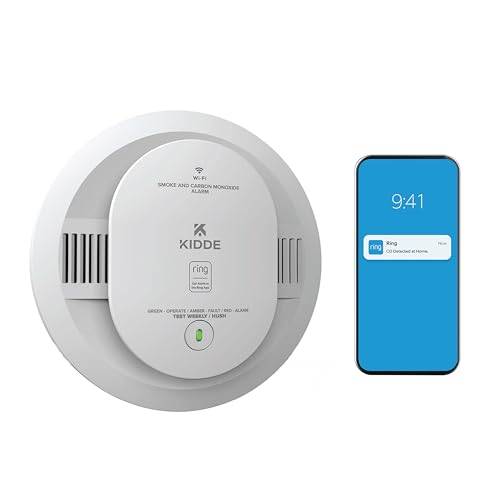
- Smoke and CO detection with Ring app alerts
- Wireless Kidde interconnectivity
- Battery-powered, Alexa-compatible design
Best For: Ring and Alexa households wanting no-wiring installation
Best Hardwired Multi-Pack
First Alert Precision Detection Alarm

- Six smoke and CO alarms in one package
- Battery backup for power outages
- Hardwired interconnection with compatible alarms
Best For: Whole-home hardwired alarm replacements
Best Whole-Home Wireless Kit
Heiman Smart Smoke Detector System

- Six detectors plus a smart gateway
- Local and app-based wireless alerts
- Ten-year batteries with photoelectric sensing
Best For: Large homes and properties needing wireless coverage
Best Voice-Alert Battery Model

- Smoke and CO alerts through the First Alert app
- Voice warnings identify danger type and location
- Battery-powered with compatible alarm interconnection
Best For: Homes wanting clearer voice and phone alerts
Best Matter-Ready Pick
Heiman S1-TM Smart Smoke Alarm

- Matter over Thread support across major smart-home platforms
- Photoelectric sensing for smoldering fires
- Temperature and humidity monitoring included
Best For: Matter and Thread smart-home users
Best Hardwired Option
First Alert SC5 Smart Smoke & CO Alarm

- Smoke and carbon monoxide detection in one alarm
- Phone alerts through the First Alert app
- Battery backup and interconnect capability
Best For: Homes replacing compatible hardwired alarms
Best Ring-Compatible Pick

- Ring app alerts without a required subscription
- Battery-powered installation with no wiring
- Wire-free whole-home interconnectivity
Best For: Ring and Alexa households
Best Whole-Home Coverage
Kidde App-Enabled Smoke & CO Detector
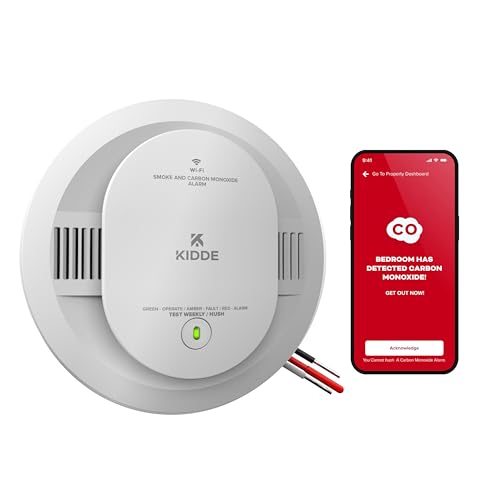
- Smoke and CO detection in one alarm
- Mobile alerts and phone-based hush control
- Hardwired with AA battery backup
Best For: Connected whole-home protection
Best for Ring Users
Kidde Smart Smoke & CO Detector
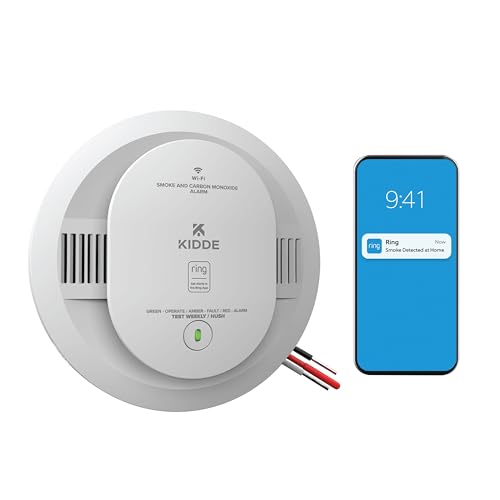
- Ring app smoke, CO, and battery alerts
- No subscription required for core notifications
- Alexa connectivity and optional monitoring
Best For: Ring-connected homes
Best Smoke-Only Ring Option
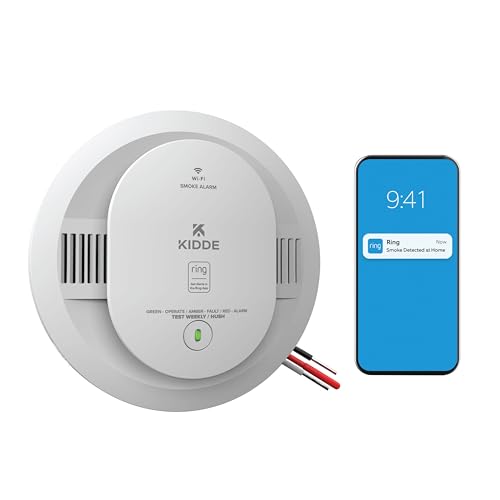
- Ring app smoke and low-battery alerts
- No subscription for core notifications
- Alexa compatible and hardwired
Best For: Smoke-only Ring-connected protection
Best Ring-Connected Option – Kidde Smart Smoke & CO Detector
For shoppers comparing smart smoke alarms for homes, this Kidde detector combines smoke and carbon monoxide protection with Ring app notifications. It runs on two included AA batteries, requires no wiring, and can wirelessly connect with other Kidde alarms.
Best For: Homes that use Ring or Alexa and want app alerts without hardwiring or a required subscription.
Pros:
- Detects both smoke and carbon monoxide, including low-level CO alerts.
- Sends real-time smoke, CO, and low-battery notifications through the Ring app with no subscription required.
- Wirelessly interconnects compatible Kidde alarms so all linked units sound together.
- Uses included AA alkaline batteries and offers Alexa compatibility.
Cons:
- Optional 24/7 monitoring requires a separate Ring subscription.
- Wireless interconnectivity is limited to compatible Kidde alarms and requires checking the user guide.
This is a flexible choice for households prioritizing remote notifications and simple battery installation. Its smoke and CO coverage, reduced nuisance-alarm design, and smart-home integration make it particularly practical for connected homes.
Best Hardwired Multi-Pack – First Alert Precision Detection Alarm
First Alert Hardwire Combination Smoke & Carbon Monoxide Alarm | SMICO100-AC, 9V Battery Backup
Check Price On AmazonFor larger installations, this six-count First Alert combination alarm provides hardwired smoke and carbon monoxide protection with battery backup. Its Precision Detection sensing is designed to reduce cooking-related nuisance alarms, while compatible interconnection lets one alarm activate the others.
Best For: Homeowners replacing multiple hardwired alarms or outfitting a property with a six-unit installation.
Pros:
- Six combination smoke and CO alarms are included.
- Battery backup maintains protection during power outages.
- Interconnects with most compatible First Alert and BRK alarms.
- Mounting bracket supports alignment, and the latching indicator identifies the initiating alarm.
Cons:
- Hardwired installation is less convenient than a fully battery-powered model.
- The supplied details identify an ionization sensor, which may not suit shoppers specifically seeking photoelectric sensing.
This pack is best suited to planned replacements or new installations where compatible wiring is already available. It offers broad coverage and backup power, but buyers should confirm electrical compatibility and interconnect requirements before installation.
Best Whole-Home Wireless Kit – Heiman Smart Smoke Detector System
This Heiman six-detector kit is a strong option among smart smoke alarms for homes that need broad wireless coverage. It includes a gateway for remote app or email notifications, while the detectors can also interconnect locally without Wi-Fi.
Best For: Multi-story homes, apartments, landlords, and contractors seeking a complete wireless interconnected system.
Pros:
- Includes six smoke detectors and one smart gateway.
- Local wireless interconnection works without Wi-Fi, while the gateway enables remote notifications.
- Ten-year CR123A lithium batteries reduce routine battery changes.
- Dual-beam photoelectric sensing is designed to reduce cooking and dust-related false alarms.
Cons:
- The gateway requires a 2.4GHz Wi-Fi network and is not compatible with 5GHz Wi-Fi.
- The kit is smoke-focused; a separate Heiman CO detector is listed as a compatible device.
- Setting up the app and grouping devices requires following the product manual.
With six units, a gateway, long-life batteries, and UL 217 10th Edition certification, this system is designed for comprehensive wireless deployment. It is especially appealing when avoiding hardwiring and annual battery replacement matters.
Best Voice-Alert Battery Model – First Alert SC5 Smart Alarm
The First Alert SC5 is a battery-powered combination alarm that sends smoke and CO alerts to your phone through the First Alert app. It also provides voice warnings that identify the type and location of danger, making it a practical choice for households that want clearer alerts.
Best For: Homes wanting app notifications, voice guidance, and compatibility with Google Nest Protect alarms.
Pros:
- Detects smoke and carbon monoxide and sends alerts through the First Alert app.
- Voice alerts identify the danger type and location.
- Interconnects with compatible alarms so they sound together.
- Notifies users when batteries are low and uses included 3V CR123 lithium batteries.
Cons:
- The supplied listing is for one alarm rather than a multi-pack.
- Interconnection depends on compatibility with other alarms.
- Phone alerts require use of the First Alert app.
The SC5 stands out for translating an alarm into more actionable information through voice prompts and phone notifications. It is a sensible single-unit upgrade for buyers who value smart alerts without choosing a hardwired model.
Best Matter-Ready Pick – Heiman S1-TM Smart Smoke Alarm
For homes building around Matter and Thread, the Heiman S1-TM is a flexible choice among smart smoke alarms for homes. It uses a photoelectric sensor for smoldering fires, adds temperature and humidity monitoring, and works locally through a compatible Thread Border Router.
Best For: Smart-home users who want battery-powered smoke protection plus indoor climate monitoring.
Pros:
- Matter over Thread compatibility with Apple Home, Google Home, Alexa, SmartThings, Homey, and Home Assistant through a Thread Border Router.
- Dual-beam photoelectric sensing is designed to detect fine smoke and reduce nuisance alarms from cooking and steam.
- Includes temperature and humidity sensors, an 85 dB alarm, one-touch test/silence, and simple magnetic-and-screw mounting.
- UL 217 10th Edition and FCC certified, with a UL94 V-0 flame-retardant housing.
Cons:
- Smart features require a compatible Matter hub with a Thread Border Router.
- Home Assistant setup may require IPv6, router advertisement, and mDNS network support.
The S1-TM stands out when connected-home compatibility and environmental monitoring matter as much as smoke detection. Confirm that your current hub supports Matter over Thread before buying.
Best Hardwired Option – First Alert SC5 Smart Smoke & CO Alarm
The First Alert SC5 is a practical choice for homes with existing hardwired alarm wiring. This smart smoke alarm for homes also detects carbon monoxide, sends app alerts, supports interconnection, and includes battery backup for outages.
Best For: Homeowners replacing compatible hardwired alarms who want smoke and CO alerts on their phones.
Pros:
- Detects both smoke and carbon monoxide and sends alerts through the First Alert app.
- Interconnect capability lets compatible alarms sound together when one detects danger.
- Battery backup provides protection during power outages.
- Voice alerts identify the type and location of danger, while Precision Detection Technology helps reduce nuisance alarms.
Cons:
- Hardwired installation is less flexible than a battery-only alarm.
- Compatibility should be checked when replacing existing alarms or connecting with Nest Protect alarms.
- The product date indicates manufacture date rather than an expiration date.
Choose the SC5 when you want a connected smoke-and-CO system without giving up hardwired installation. Its Quick Connect Plug can simplify replacements without rewiring, provided the existing setup is compatible.
Best Ring-Compatible Pick – Kidde Smart Smoke Detector
The Kidde Smart Smoke Detector is a convenient battery-powered option for households using Ring or Alexa. Among smart smoke alarms for homes, it offers app notifications without a required subscription, wire-free whole-home interconnectivity, and reduced nuisance alarms compared with prior Kidde generations.
Best For: Ring and Alexa households seeking simple, no-wiring installation and mobile smoke alerts.
Pros:
- Runs on two included AA alkaline batteries, so no wiring is needed.
- Ring app notifications cover smoke and low-battery warnings, including when you are away.
- Wire-free interconnectivity can send alerts for every connected Kidde alarm in the home.
- Connects with Alexa-enabled devices and is tested and certified to UL 217 and FCC requirements.
Cons:
- Optional 24/7 Ring smoke monitoring requires a separate subscription.
- Interconnectivity depends on compatible Kidde alarms and setup according to the user guide.
- It uses AA batteries that will require periodic replacement.
This Kidde model makes sense for renters or homeowners who want a straightforward smart alarm without hardwiring. Its strongest advantage is the combination of Ring notifications, Alexa support, and wire-free installation.
Best Whole-Home Coverage – Kidde App-Enabled Smoke & CO Detector
For shoppers comparing smart smoke alarms for homes, this hardwired Kidde model combines smoke and carbon monoxide detection with app connectivity. It sends alerts for smoke, CO, and low battery, while its interconnected design can help extend mobile notifications across compatible hardwired alarms.
Best For: Homeowners who want app alerts, voice notifications, and combined smoke-and-CO protection from a hardwired alarm.
Pros:
- Detects both smoke and carbon monoxide.
- Sends real-time mobile alerts, including low-battery warnings.
- Supports phone-based hush control and interconnected whole-home coverage.
- Includes AA battery backup and meets listed UL and FCC requirements.
Cons:
- Requires hardwired installation and 2.4 GHz Wi-Fi for smart features.
- It is a single-alarm package, so expanding coverage requires additional compatible units.
This is a well-rounded choice when remote notifications and combined smoke/CO detection matter more than a battery-only setup. Its 2.4 GHz Wi-Fi requirement is worth confirming before purchase.
Best for Ring Users – Kidde Smart Smoke & CO Detector
This Kidde model is a practical option among smart smoke alarms for homes already using Ring. It provides hardwired smoke and CO detection, real-time Ring app notifications without a subscription, and optional access to Ring’s separate 24/7 monitoring service.
Best For: Ring households seeking app alerts, Alexa connectivity, and combined smoke-and-CO coverage.
Pros:
- Alerts you to both smoke and carbon monoxide.
- Provides Ring app notifications for smoke, CO, and low battery without a subscription.
- Can connect with Alexa-enabled devices.
- Offers whole-home connectivity when compatible hardwired alarms are added.
Cons:
- Requires hardwire installation and a compatible Ring-connected setup for its ecosystem features.
- Optional 24/7 monitoring costs extra at the listed $5-per-month price.
Choose this version if Ring integration is central to your home-security setup. The no-subscription app alerts cover core notifications, while the optional monitoring plan is an added service rather than a requirement.
Best Smoke-Only Ring Option – Kidde Smart Smoke Detector
For homes that need smoke detection rather than combined CO protection, this Kidde model adds Ring app connectivity to a hardwired alarm. It delivers real-time smoke and low-battery notifications without a subscription and can also send alerts through Alexa-enabled devices.
Best For: Ring users looking for a connected, smoke-only alarm with hardwired power and battery backup.
Pros:
- Sends real-time smoke and low-battery alerts through the Ring app.
- Core app notifications do not require a subscription.
- Connects with Alexa-enabled devices.
- Enhanced sensing is designed to reduce nuisance alarms from cooking compared with prior Kidde generations.
Cons:
- It detects smoke but not carbon monoxide.
- Requires hardwired installation; optional 24/7 smoke monitoring costs extra.
This is the focused choice for buyers who already have separate CO protection or specifically want a smoke-only Ring-compatible alarm. If you need both types of detection in one unit, the combined smoke-and-CO model is the better fit.
How We Picked the Best Smart Smoke Alarms for Homes
We focused on the features that matter most in a real home: smoke and carbon monoxide coverage, power source, installation requirements, connectivity, interoperability, alert methods, and expansion potential. The roundup includes both single-device options and multi-alarm systems so you can compare solutions for apartments, existing homes, and new installations.
We also considered whether an alarm supports hardwired connections, battery backup, wireless interconnection, mobile alerts, voice announcements, or smart-home standards such as Matter. Always confirm local code requirements and verify compatibility with your existing wiring before replacing an installed alarm.
Quick Comparison
| Best For | Look For |
|---|---|
| Simple retrofit | Battery power and app-connected alerts |
| Existing wired systems | Hardwire compatibility and battery backup |
| Whole-home coverage | Interconnected alarms or multi-packs |
| Ring households | Ring-compatible notifications and integrations |
| Flexible smart homes | Matter, Thread, or broad platform support |
| Complete hazard monitoring | Combined smoke and carbon monoxide detection |
Key Buying Factors for Smart Smoke Alarms for Homes
Power and Installation
Battery models are usually easiest for renters and retrofit projects, while hardwired alarms can be a better replacement for existing wired units. A battery backup is especially useful on hardwired models because it maintains protection during outages. Check connector types, mounting hardware, and whether professional installation is required.
Smoke and Carbon Monoxide Coverage
Choose combination alarms for rooms or areas where both hazards need monitoring. Smoke-only units may be suitable when carbon monoxide protection is already provided elsewhere, but whole-home coverage should be planned deliberately rather than assumed.
Connectivity and Alerts
Look beyond app access. Consider phone notifications, voice alerts, alarm interconnection, gateway requirements, and how the device behaves if Wi-Fi or internet access fails. A local alarm must still sound even when smart-home services are unavailable.
Platform Compatibility
Ring users may prefer compatible Kidde or First Alert options, while Matter over Thread can offer a more flexible approach in a supported smart home. Confirm that your hub, router, phone, and preferred automation platform support the required standard.
Who Should Buy Which Smart Smoke Alarms for Homes?
Renters and uncomplicated retrofits: Choose a battery-powered smart alarm that can be installed without changing household wiring. Homeowners replacing wired detectors: Select a hardwired model with battery backup and verify interconnect compatibility. Larger homes: Consider an interconnected set or multi-pack so an alarm in one area can alert occupants elsewhere. Ring users: Prioritize models designed for Ring integration and confirm the required account or hub setup. Smart-home enthusiasts: A Matter over Thread option may provide more ecosystem flexibility, provided your controller supports it.
Whichever model you choose, install alarms according to the manufacturer’s instructions, test them regularly, keep sensors clear of dust, and replace units at the end of their rated service life.