Steep, uneven lawns need more than a standard automated mower. The right machine must maintain traction, navigate reliably, handle changing slopes, and cut safely without constant intervention.
This roundup compares 10 options ranging from wire-free robotic mowers with RTK or vision navigation to tracked, remote-controlled machines built for demanding terrain. Use the guide below to match the mower’s drive system, coverage, controls, and slope capability to your property.
Best 10 Robotic Lawn Mowers for Steep Terrain Picks for 2026
Best Wire-Free 4WD Pick

- Handles slopes up to 80% with 4WD
- Wire-free RTK and quad-vision navigation
- Covers up to 0.37 acre
Best For: Steep, complex residential lawns needing wire-free automation
Best Heavy-Duty Remote-Controlled Mower
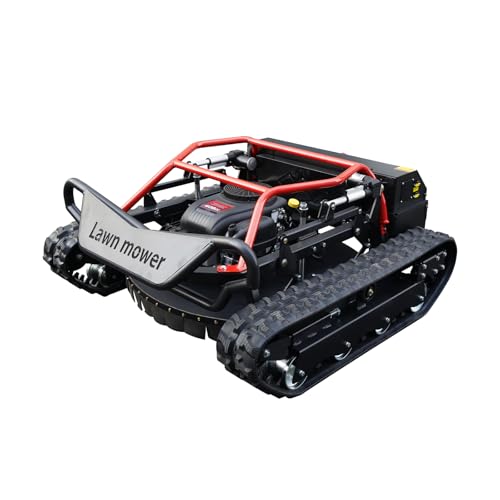
- Tracked design climbs slopes up to 65°
- 22-horsepower gas engine
- 35.43-inch cutting width
Best For: Large, rugged properties and extreme slopes
Best Smart AWD Mower

- AWD handles slopes up to 80%
- LiDAR and AI vision enable wire-free mapping
- Fast 45-minute charging
Best For: Connected mowing across hilly, multi-zone lawns
Best Commercial-Size Crawler Mower
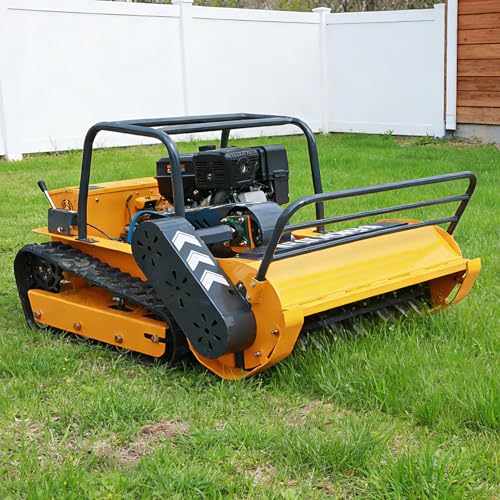
- 459cc engine for rugged terrain
- Crawler design targets steep, difficult ground
- Wide 39.4-inch-class cutting deck
Best For: Large commercial properties and thick, challenging grass
Best for Easy Setup
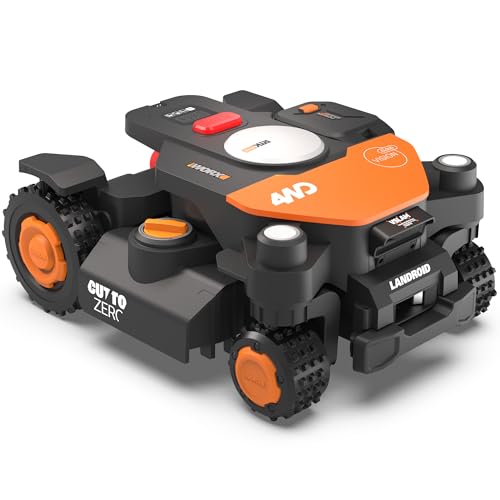
- 4WD handles slopes up to 84% (about 40°).
- Wire-free RTK Cloud and Vision AI mapping.
- Unlimited zones with app-based control.
Best For: Steep residential lawns up to 1/2 acre
Best Heavy-Duty Remote-Controlled Pick

- Tracked design claims 55° slope climbing.
- 20-inch deck handles tall and varied grass.
- Remote control with enclosed design and warning lights.
Best For: Large, rough, and steep properties
Best Compact Smart Mower

- Wire-free mapping can be ready in about five minutes.
- RTK, Vision, and 3D ToF navigation.
- Handles slopes up to 45% (about 24°).
Best For: Small, complex lawns up to 1/4 acre
Best Heavy-Duty Choice

- Handles slopes up to 50° under suitable conditions
- 9HP gas engine with a 21.7-inch cutting deck
- Remote control and tracked all-terrain drive
Best For: Large rural properties and steep, overgrown terrain
Best for Steep Autonomous Mowing
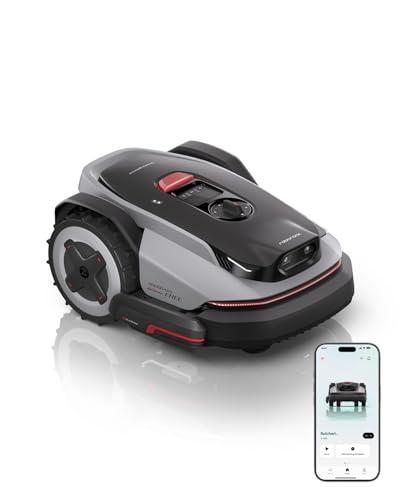
- RTK and VSLAM support wire-free autonomous navigation
- Handles slopes up to 45% with a floating deck
- AI vision detects and avoids common obstacles
Best For: Complex residential lawns up to 1/4 acre
Best for Large Lawns

- Covers up to 1.5 acres with scheduled mowing
- Self-charges and resumes automatically
- RTK mapping, four-eye vision, and app control
Best For: Large lawns with moderate slopes and a need for quiet automation
Best Wire-Free 4WD Pick – RockMow X115H
For homeowners comparing robotic lawn mowers for steep terrain, the Roborock RockMow X115H stands out with wire-free mapping, 4WD traction, and support for slopes up to 80% (38.7°). Its RTK and quad-vision navigation are designed for complex lawns, shaded areas, and narrow passages.
Best For: Homeowners with steep, uneven lawns up to 0.37 acre who want automated mowing without perimeter-wire installation.
Pros:
- 4WD system handles slopes up to 80% and obstacles up to 3.15 inches.
- Full-band RTK and quad-camera navigation support precise mapping under tree cover and near fences.
- Wire-free setup, multi-zone scheduling, obstacle avoidance, GPS tracking, and anti-theft features.
- Wide 9.49-inch cutting width with a 1.57- to 3.54-inch cutting-height range.
Cons:
- Its stated coverage is limited to 0.37 acre.
- At 50 pounds, it may be more substantial to handle manually than lighter robotic mowers.
The RockMow X115H is a strong fit when slope capability and navigation reliability matter more than maximum property size. Its combination of active steering, suspension, and multiple navigation technologies makes it particularly suited to challenging residential layouts.
Best Heavy-Duty Remote-Controlled Mower – SKD-608B-FZR
Among robotic lawn mowers for steep terrain, this remote-controlled off-road mower is built for exceptionally demanding slopes. Its tracked walking structure is rated for climbs up to 65°, while the gas engine, wide cutting deck, and long-range remote control favor large or rugged properties.
Best For: Owners of steep mountainsides, rough land, and large areas who need a remote-operated mower rather than a compact autonomous lawn robot.
Pros:
- Tracked structure is designed to climb slopes up to 65°.
- 22-horsepower Loncin gasoline engine and 48V brushless motor provide heavy-duty power.
- Remote-control range extends up to 1,968 feet, with remote cutting-height adjustment.
- Wide 35.43-inch cutting path and cutting-height adjustment up to 7.87 inches.
Cons:
- At 948 pounds, it is much larger and heavier than typical robotic mowers.
- It uses gasoline and requires remote operation, so it is not a set-it-and-forget-it autonomous mower.
- The supplied notes do not specify wire-free mapping, automatic docking, or app control.
This mower is better understood as a remotely controlled tracked machine than a conventional robotic lawn mower. Its size, gas power, and extreme slope rating make it appropriate for demanding terrain, but less practical for typical residential lawns.
Best Smart AWD Mower – DREAME A3 AWD 1000
The DREAME A3 AWD 1000 is a strong option for shoppers seeking robotic lawn mowers for steep terrain with smart, wire-free operation. Its all-wheel-drive hub motors are designed for slopes up to 80%, while 360° LiDAR and binocular vision handle mapping and obstacle detection.
Best For: Homeowners with rolling hills, multi-zone lawns, and complex layouts who want automated mowing, smart controls, and fast recharging.
Pros:
- AWD traction is rated for slopes up to 80% (38.7°) and obstacles up to 2.17 inches.
- Wire-free 360° LiDAR and binocular AI vision map lawns and detect more than 300 objects.
- 45-minute fast charging with stated coverage of approximately 0.25 to 0.50 acre.
- App control, 4G connectivity, HDR camera monitoring, theft protection, and animal-friendly modes.
Cons:
- The optional trimmer module is sold separately for a narrower edge gap.
- The supplied details do not provide the mower’s full cutting-width or cutting-height specifications.
The A3 AWD 1000 combines steep-slope traction with advanced mapping and connected features. It is especially appealing for homeowners who want hands-off scheduling and monitoring across irregular, multi-zone lawns.
Best Commercial-Size Crawler Mower – AWY-1000-S
For very large properties and rugged slopes, the AWY-1000-S offers a commercial-size alternative to compact robotic lawn mowers for steep terrain. Its crawler-style gas-electric design, 459cc EPA engine, and 39.4-inch-class cutting deck are intended to move through thick grass and challenging landscapes.
Best For: Commercial users and owners of expansive, rough properties who prioritize cutting width, traction, and engine power.
Pros:
- 459cc EPA engine is designed for steep slopes, thick grass, and large properties.
- Crawler platform is intended to provide traction on rugged terrain.
- Wide 39.4-inch-class cutting deck supports faster coverage of extensive areas.
- Includes a stated 12-month warranty covering parts and labor.
Cons:
- At 904 pounds, this is a very large and heavy machine.
- The supplied information does not state a specific maximum slope angle.
- The notes list the power source as manual, so buyers should verify the exact operating and remote-control setup.
The AWY-1000-S is aimed at scale and rugged performance rather than quiet, autonomous residential mowing. Its broad deck and crawler-style construction could suit demanding commercial work, but its size and unspecified slope rating warrant careful fit checks.
Best for Easy Setup – WORX WR342 Vision Cloud
For shoppers comparing robotic lawn mowers for steep terrain, the WORX WR342 stands out with four-wheel drive, a terrain-adaptive chassis, and a claimed ability to handle slopes up to 84% (about 40°). Its wire-free RTK Cloud and Vision AI navigation are designed for mapped, automated mowing across uneven lawns.
Best For: Homeowners with lawns up to 1/2 acre who want app-controlled, wire-free mowing on steep and uneven terrain.
Pros:
- 4WD traction and a terrain-adaptive chassis support slopes up to 84%.
- RTK Cloud, V-SLAM sensor fusion, and Vision AI provide wire-free navigation and mapping.
- Supports unlimited mowing zones, custom pathways, no-go areas, and remote app control.
- Cut-to-Zero edge trimming and selectable mowing patterns can reduce finishing work.
Cons:
- Battery average life is listed at 41 minutes.
- Its 8.7-inch cutting width may require more passes on larger lawns.
- Advanced navigation and cellular features may be more than simple yards need.
The WR342 is the strongest fit here for steep residential terrain when wire-free setup, smart obstacle handling, and precise app-based control matter more than cutting width or runtime.
Best Heavy-Duty Remote-Controlled Pick – Infront 55° Slope Mower
Among robotic lawn mowers for steep terrain, the Infront takes a heavy-duty approach: it is a 384-pound, fuel-powered tracked mower operated by remote control. Its enclosed design, warning lights, and claimed 55° climbing capability suit demanding slopes, tall grass, and rough ground where a compact autonomous mower may not be appropriate.
Best For: Large, rough, or difficult-to-access properties requiring remote-controlled mowing and strong slope traction.
Pros:
- Tracked drive system is designed for steep, uneven, wet, and muddy terrain.
- Claims climbing capability on slopes up to 55°.
- 20-inch cutting width and adjustable 0.79- to 5.9-inch cutting height handle varied grass conditions.
- Enclosed cabin, warning lights, and industrial-grade remote control support controlled operation.
Cons:
- At 384 pounds, it is substantially heavier and less portable than residential robotic mowers.
- Fuel-powered operation does not offer the quiet, autonomous battery setup of the other options.
- The supplied notes do not indicate smartphone app control or automatic scheduling.
The Infront is better viewed as a remotely operated slope machine than a set-and-forget lawn robot. Its tracked build and wide height range make it compelling for demanding terrain, but its size and fuel power require more hands-on management.
Best Compact Smart Mower – ECOVACS GOAT O1000 RTK
The ECOVACS GOAT O1000 RTK is a compact wire-free option for shoppers seeking robotic lawn mowers for steep terrain on smaller properties. It combines RTK, Vision, and 3D ToF navigation with automatic mapping, app controls, and obstacle avoidance, while handling slopes up to 45% (about 24°).
Best For: Owners of lawns up to 1/4 acre who want quick setup, scheduled mowing, and smart obstacle avoidance.
Pros:
- Wire-free setup and automatic mapping are designed to be ready in about five minutes.
- RTK, Vision, and 3D ToF navigation support centimeter-level positioning and route planning.
- AIVI 3D obstacle avoidance detects common objects such as furniture, toys, trees, and pets.
- App supports multiple zones, no-go areas, schedules, cutting-height adjustments, and progress monitoring.
Cons:
- Its 45% slope rating, approximately 24°, is lower than the WORX and Infront claims.
- Coverage is limited to lawns up to 1/4 acre.
- The 8.66-inch cutting width is relatively narrow for larger areas.
The GOAT O1000 RTK is a practical choice for smaller, complex yards where convenience and obstacle detection are priorities. For especially steep slopes, verify that the 24° capability matches your terrain before buying.
Best Heavy-Duty Choice – 9HP Tracked RC Mower
For buyers comparing robotic lawn mowers for steep terrain, this remote-controlled tracked mower takes a more powerful, hands-on approach. Its 9HP gas engine, 21.7-inch cutting deck, and crawler tracks are designed for tall grass, weeds, and demanding hillside work.
Best For: Large rural properties, orchards, farms, and steep or overgrown terrain where traction and cutting power matter more than autonomous scheduling.
Pros:
- Tracked drive system is designed to handle slopes up to 50° under suitable conditions.
- 9HP gas engine and wide 21.7-inch deck suit dense vegetation and large areas.
- Remote control works from up to 800 meters in open, unobstructed areas.
- Electric cutting-height adjustment ranges from about 0.8 to 5.9 inches.
Cons:
- At 309 pounds, it is substantially heavier than battery-powered robotic mowers.
- Remote operation requires active user control rather than fully automatic mowing.
- Gas power may require more routine maintenance than a battery mower.
This is the strongest fit when steep-slope capability and heavy-duty brush cutting take priority. It is not a conventional autonomous robot, but its low-center-of-gravity tracked design offers a practical option for challenging ground.
Best for Steep Autonomous Mowing – Roborock RockNeo Q110H
Among robotic lawn mowers for steep terrain, the Roborock RockNeo Q110H stands out for combining wire-free mapping with autonomous navigation. Full-band RTK, VSLAM, and AI vision help it cover complex yards while its floating deck and large wheels support slopes up to 45%.
Best For: Homeowners who want automatic mowing, wire-free setup, app scheduling, and navigation for complex lawns with narrow passages, shaded areas, and moderate-to-steep slopes.
Pros:
- Full-band RTK and VSLAM provide continuous positioning in challenging yard areas.
- Wire-free AI or manual app mapping simplifies boundary setup.
- AI vision helps avoid people, pets, and common garden obstacles.
- Floating cutting deck and large wheels handle slopes up to 45% and obstacles up to 1.57 inches.
Cons:
- Its 8.7-inch cutting width is narrower than the tracked gas mower in this roundup.
- Coverage is listed for up to 1/4 acre, limiting suitability for larger properties.
- Optional edge-cutting and 4G anti-theft features cost extra.
The Q110H is the most balanced choice for automated care on a compact, complicated lawn. Its 130-minute battery life, app control, and dual-navigation system favor convenience, while the 45% slope rating makes it better suited to hills than many standard robotic mowers.
Best for Large Lawns – 1.5-Acre RTK Robot Mower
For shoppers seeking robotic lawn mowers for steep terrain on a larger property, this self-charging model pairs RTK mapping with four-eye vision and app control. It is rated for moderate slopes of about 25–30% depending on conditions and can mow for up to four hours on a set plan.
Best For: Owners of lawns up to 1.5 acres who want scheduled, quiet, self-charging mowing with obstacle detection and remote monitoring.
Pros:
- Rated for coverage of up to 1.5 acres.
- RTK mapping and four-eye vision support route planning and obstacle detection.
- Returns to its charging station automatically and resumes after charging.
- Quiet operation, app control, and cutting-height adjustment up to 4 inches.
Cons:
- Its stated 25–30% incline capability is lower than the other slope-focused options here.
- At 8.6 inches, the cutting width is relatively narrow for a large property.
- A one-time activation code is required before first use.
This mower makes the most sense when broad coverage, quiet operation, and automation are more important than maximum hill-climbing ability. For truly steep or highly uneven ground, its moderate-slope rating deserves careful comparison with your yard’s conditions.
How We Picked the Best Robotic Lawn Mowers for Steep Terrain
We focused on the features that matter most on sloped and irregular properties: traction, drive configuration, navigation, cutting performance, operating range, safety controls, charging behavior, and claimed slope capability. The selection includes autonomous robotic mowers as well as remote-controlled gas or hybrid machines, because the best choice depends on whether you prioritize quiet unattended mowing or maximum power and direct control.
Specifications such as acreage, cutting width, runtime, and slope angle should be treated as starting points. Real-world performance can vary with grass moisture, loose soil, ruts, obstacles, surface transitions, and the mower’s direction across a slope.
Quick Comparison
| Type | Best suited to | Main advantage | Important trade-off |
|---|---|---|---|
| Wire-free RTK or vision robot | Maintained residential lawns | Automated mapping and scheduled cutting | Needs reliable positioning and suitable yard conditions |
| AWD robotic mower | Slopes, uneven grass, and mixed terrain | Improved traction and obstacle handling | Usually costs more than basic two-wheel-drive models |
| Remote-controlled tracked mower | Very steep, rough, or overgrown areas | High torque and precise operator control | Requires active supervision and maintenance |
| Gas or hybrid remote mower | Large acreage and heavy vegetation | Longer cutting capability and stronger clearing power | Louder, heavier, and less autonomous |
Key Buying Factors for Robotic Lawn Mowers for Steep Terrain
Traction and Slope Control
Look for all-wheel drive, wide tires, aggressive tread, or tracked undercarriages. A mower’s claimed maximum grade is not the same as its recommended everyday operating limit, especially on wet grass. Choose a machine with a margin above your steepest section and consider whether it can stop, turn, and recover safely on a slope.
Navigation and Boundary Setup
RTK positioning can reduce the need for perimeter wire, while vision, LiDAR, or camera systems help identify obstacles and map lawn edges. Dense tree cover, buildings, narrow passages, and poor satellite visibility can affect wire-free navigation. Confirm that the mower supports the boundary method and correction signal your yard can accommodate.
Cutting Capacity and Battery Performance
Match the mower’s stated coverage to your usable grass area rather than the total property size. Check cutting width, height range, runtime, charging time, rain handling, and whether the system returns automatically to charge. For long slopes, consistent traction and battery reserve can matter more than headline acreage.
Safety and Maintenance
Prioritize obstacle detection, lift and tilt shutoff, emergency stop controls, theft protection, and app alerts. Remote-controlled models require a clear line of sight and active supervision. Also check blade availability, tire or track replacement, cleaning requirements, storage, fuel service, and local rules for unmanned equipment.
Who Should Buy Which Robotic Lawn Mowers for Steep Terrain?
Choose a wire-free RTK or vision-based model if you want scheduled, low-noise mowing on a mapped residential lawn with dependable positioning. An AWD robotic mower is the better fit when traction, uneven ground, and moderate slopes are recurring concerns. For very steep banks, rough growth, brush, or terrain that an autonomous mower may not safely map, a tracked remote-controlled mower offers more direct control and power. Buyers with large acreage or heavy grass should prioritize engine output, cutting width, fuel capacity, and serviceability over quiet operation.
Before ordering, measure the actual mowable area, identify the steepest grade, test satellite or app connectivity, and verify the manufacturer’s installation and safety requirements. Those checks will narrow the field more reliably than comparing price alone.