When it comes to music production in 2025, the right MIDI keyboard can make all the difference. You’ll want a controller that suits your style and workflow, whether you’re just starting out or honing your craft. Each option on the list has unique features that can inspire your creativity. Curious about which models stand out and why they’re essential for your setup? Let’s explore the top contenders together.
Akai Professional MPK Mini MK3 USB MIDI Keyboard Controller

If you’re a beginner or a mobile producer looking for an affordable yet powerful MIDI controller, the Akai Professional MPK Mini MK3 is an excellent choice. It features 25 velocity-sensitive keys, 8 backlit drum pads, and 8 assignable knobs, making it versatile for various music production tasks. With its USB-powered design and universal compatibility, you can easily plug it into any DAW on Windows or Mac. The built-in arpeggiator and customizable settings enhance your creativity, while the included music production software guarantees you have everything you need to start making music right away. Its compact size makes it perfect for travel, too.
Best For: beginners and mobile producers seeking an affordable yet powerful MIDI controller for music production.
Pros:
- Compact and lightweight design ideal for travel.
- User-friendly interface with responsive pads and keys.
- Comes with a comprehensive software package to kickstart music production.
Cons:
- Some users report slight responsiveness issues with certain programs.
- Documentation regarding MIDI messages and programming setup could be improved.
- Limited number of keys may not suit advanced users needing more range.
Akai Professional MPK Mini Plus USB MIDI Keyboard Controller

The Akai Professional MPK Mini Plus USB MIDI Keyboard Controller is perfect for music producers who crave versatility and portability in their setup. With 37 mini keys, you get a full three octaves for melodic exploration. The 8 RGB MPC pads add a responsive touch, making your performances dynamic and engaging. Its built-in 64-step sequencer allows you to create intricate drum tracks and melodies effortlessly. Plus, you’ll love the advanced connectivity options, including MIDI and CV/Gate I/O. Integrating seamlessly with your DAW, it offers intuitive control, ensuring your music production process is both efficient and enjoyable.
Best For: Music producers seeking a portable and versatile MIDI keyboard controller for composing and performing.
Pros:
- Compact design with 37 mini keys offers portability without sacrificing playability.
- 8 RGB MPC pads provide a responsive and durable surface for dynamic performance.
- Advanced connectivity options, including MIDI and CV/Gate I/O, enhance compatibility with various sound sources.
Cons:
- Mini keys may not be suitable for those who prefer full-sized keys for playing.
- Limited to 8 pads, which may not be enough for more complex performances.
- The built-in sequencer supports only one track for drums and one for melodies or chords, which may restrict creativity.
Akai Professional MPK Mini MK3 USB MIDI Keyboard Controller

With its 25 mini velocity-sensitive keys and 8 backlit drum pads, the Akai Professional MPK Mini MK3 USB MIDI Keyboard Controller is perfect for music producers looking to enhance their studio setup. This USB-powered controller offers dynamic control with its innovative 4-way thumbstick for pitch and modulation. The built-in arpeggiator boosts your creativity, allowing for customizable patterns. Plus, with NKS integration, you can easily access Native Instruments’ presets and sound libraries. You’ll also get to choose one of three curated Komplete 15 Select bundles, making this keyboard a fantastic addition to your music production arsenal.
Best For: The Akai Professional MPK Mini MK3 is best for music producers and musicians seeking a compact, versatile MIDI controller for studio production and live performance.
Pros:
- Compact design makes it easy to transport and fit into any studio setup.
- Velocity-sensitive keys and pads provide expressive control for dynamic performances.
- NKS integration allows seamless access to Native Instruments’ sound libraries and presets.
Cons:
- Mini keys may not be suitable for those who prefer full-sized keys for playing.
- Limited number of pads and knobs compared to larger MIDI controllers, which may restrict functionality.
- USB-powered only, requiring a computer or USB power source for operation.
Novation Launchkey 61 MK4 MIDI Keyboard Controller

For musicians seeking a versatile and intuitive tool, the Novation Launchkey 61 MK4 MIDI Keyboard Controller stands out with its seamless DAW integration, particularly with Ableton Live. With 61 semi-weighted keys and 16 responsive FSR drum pads, you’ll enjoy expressive playability. The Chord and Scale Modes help you craft quick musical ideas, while the editable Arpeggiator offers creative sequencing possibilities. Weighing only 10.5 pounds, it’s portable and USB-powered for easy setup. Included software like Ableton Live Lite and sound packs enhance your experience, making the Launchkey 61 MK4 a fantastic choice for both novice and experienced producers.
Best For: Musicians and producers looking for a portable and intuitive MIDI keyboard that integrates seamlessly with major DAWs, especially Ableton Live.
Pros:
- Excellent build quality and responsive semi-weighted keys for enhanced playability.
- Versatile features like Chord and Scale Modes, plus an editable Arpeggiator for creative music production.
- Compact and USB-powered design makes it ideal for mobile setups and quick plug-and-play use.
Cons:
- Some users report concerns regarding velocity sensitivity, which may affect performance for certain playing styles.
- Key feel may not meet the preferences of all musicians, particularly those accustomed to fully weighted keys.
- Requires separate accounts for software activation, which could be a hassle for some users.
Akai Professional MPK Mini Play MK3 MIDI Keyboard Controller

Designed for aspiring musicians and seasoned producers alike, the Akai Professional MPK Mini Play MK3 MIDI Keyboard Controller stands out with its built-in speaker, making it an ideal choice for on-the-go music creation. This compact keyboard features 25 dynamic keys, 8 velocity-sensitive MPC drum pads, and an OLED display for easy navigation. You’ll love its arpeggiator and note repeat functions, enhancing your creative flow. With over 100 internal sounds and seamless integration with Native Instruments, you can immerse yourself in music production right away. Plus, it’s battery-operated, so you can play anywhere without the hassle of finding a power source.
Best For: The Akai Professional MPK Mini Play MK3 is best for aspiring musicians, beat makers, and songwriters looking for a portable and versatile music production tool.
Pros:
- Compact design with a built-in speaker for easy portability and on-the-go music creation.
- Includes over 100 internal sounds and seamless integration with popular software for enhanced creativity.
- Features like an arpeggiator and velocity-sensitive pads provide versatility in performance.
Cons:
- Battery operation requires additional batteries, which are not included with the product.
- Limited number of keys (25) may not be sufficient for complex compositions.
- Some users may find the small size less comfortable for extended play.
Arturia MiniLab 3 Universal MIDI Controller

The Arturia MiniLab 3 Universal MIDI Controller stands out as an exceptional choice for musicians and producers who need portability without sacrificing functionality. Weighing just 2.2 pounds, it features 25 velocity-sensitive keys and 8 responsive RGB pads, perfect for triggering sounds. You’ll appreciate the 8 rotary encoders and 4 sliders for precise control during production. Its built-in arpeggiator and touch-sensitive pitch bend enhance your creativity. With included software like Analog Lab V and seamless DAW integration, you’ll immerse yourself in music-making effortlessly. Eco-designed with a sleek look, the MiniLab 3 combines style and performance, making it a must-have for your setup.
Best For: Musicians and producers seeking a portable and versatile MIDI controller for music production.
Pros:
- Lightweight and compact design makes it easy to transport and set up anywhere.
- High-quality key response and responsive pads provide excellent playability and trigger performance.
- Comprehensive software bundle enhances creativity and productivity with thousands of presets and DAW integration.
Cons:
- Pad layout may be cramped for users with larger hands or for complex performances.
- Minimal labeling on controls can lead to a learning curve for new users.
- Limited physical controls compared to larger MIDI controllers may restrict advanced users.
M-VAVE 25 Key USB MIDI Keyboard Controller

Ideal for songwriters and beat makers, the M-VAVE 25 Key USB MIDI Keyboard Controller delivers an impressive blend of portability and functionality. With 25 mini velocity-sensitive keys and 8 RGB backlit drum pads, you can easily create engaging beats and melodies. Its wireless Bluetooth capability and 2,000 mAh battery provide around 16 hours of use, making it perfect for on-the-go music production. You’ll appreciate the 8 assignable rotary encoders for tweaking sounds, as well as compatibility with major DAWs. With smart chord functions and a one-year warranty, this controller is a must-have for your music creation toolkit.
Best For: The M-VAVE 25 Key USB MIDI Keyboard Controller is best for songwriters and beat makers looking for a portable and versatile music production tool.
Pros:
- Compact and Portable: Lightweight design with wireless Bluetooth capability allows for easy transport and use in various locations.
- Versatile Features: Equipped with velocity-sensitive keys, RGB backlit pads, and assignable rotary encoders for enhanced music production.
- Wide Compatibility: Works seamlessly with multiple operating systems and major digital audio workstations.
Cons:
- Mini Keys: The 25 mini keys may not be suitable for musicians who prefer full-sized keys.
- Limited Battery Life: While it offers around 16 hours of use, frequent users may need to recharge often.
- Learning Curve: Users unfamiliar with MIDI controllers may require time to fully utilize all features effectively.
Arturia KeyLab Essential mk3 49 Key USB MIDI Keyboard Controller

For musicians looking to enhance their creative workflow, the Arturia KeyLab Essential mk3 49 Key USB MIDI Keyboard Controller offers a wealth of features that make it an exceptional choice. With its Fatar keybed, you’ll experience responsive playability, while the RGB-backlit pads provide intuitive controls. The included software bundle, valued at over $400, includes Analog Lab V and more, ensuring you have a vast sound palette. Its seamless DAW integration and creative modes, like Scale and Chord, empower your songwriting. Weighing just 6.07 pounds, it’s portable, making it ideal for both beginners and pros alike.
Best For: Musicians and producers seeking a versatile MIDI keyboard controller that combines portability with advanced features for both creative and professional use.
Pros:
- Excellent build quality with a responsive Fatar keybed.
- Comprehensive software bundle valued at over $400 included.
- Intuitive controls with RGB-backlit pads and seamless DAW integration.
Cons:
- Aesthetic concerns regarding the design of the wooden sides.
- Some users desire the inclusion of polyphonic aftertouch.
- Limited user programmability with only 6 banks available.
Novation FLkey 61 MIDI Keyboard for Music Production
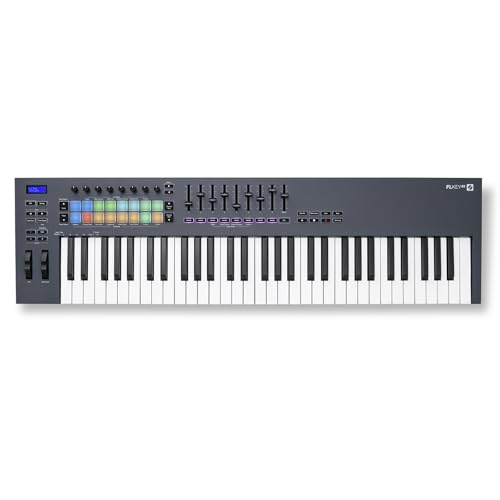
Designed specifically for FL Studio users, the Novation FLkey 61 MIDI Keyboard offers seamless integration that removes the hassle of manual control assignments. With eight pots and nine faders, you gain hands-on control over your mixer and channel rack, allowing you to record automation on the fly. The sequencer mode maps pads to FL Studio’s step sequencer, making it easy to create or modify beat patterns. Its chord and scale functionality guarantees correct note selection, while three chord modes let you play rich harmonies effortlessly. Trigger FPC and SliceX with pads for dynamic beats, enhancing your music production experience.
Best For: The Novation FLkey 61 MIDI Keyboard is best for FL Studio users looking for a fully integrated, hands-on music production experience.
Pros:
- Seamless integration with FL Studio, eliminating the need for manual control assignments.
- Hands-on control with eight pots and nine faders for efficient mixing and automation recording.
- Chord and scale functionality that allows for easy chord play and correct note selection.
Cons:
- Limited compatibility with software other than FL Studio, which may deter users of other DAWs.
- The keyboard may be bulky for users with limited space.
- Some users may find the learning curve steep if they are new to MIDI controllers or music production.
M-AUDIO, 49-Key Midi Controller, (Keystation MK3)

The M-Audio Keystation 49 MK3 stands out as an excellent choice for musicians and producers seeking a reliable, user-friendly MIDI controller. With 49 full-size, velocity-sensitive keys, you’ll enjoy a natural playing experience. Its compact design makes it perfect for any desk or stage setup, and it weighs just 4.8 pounds for easy portability. You can connect effortlessly to your Mac or PC without drivers, and it’s also compatible with iOS devices. Plus, you’ll benefit from a suite of software, including Ableton Live Lite and MPC Beats, enhancing your creative potential in music production.
Best For: Musicians and producers looking for a portable and user-friendly MIDI controller with a natural playing experience.
Pros:
- Compact and lightweight design makes it easy to transport and fit into small spaces.
- Plug-and-play connectivity with Mac and PC allows for quick setup without the need for additional drivers.
- Includes a premium software suite that enhances music production capabilities and offers various creative tools.
Cons:
- Some users experience difficulty achieving a good dynamic range with the keys.
- The octave indicator lights may be too bright for some users.
- Limited advanced features compared to more expensive MIDI controllers.
Factors to Consider When Choosing Midi Keyboards for Production
When choosing a MIDI keyboard for production, you’ll want to contemplate several key factors. Think about the key count and size that best fits your style, the available connectivity options, and how well it integrates with your software. Don’t forget to assess portability, weight, and the features like pads and controls that can enhance your workflow.
Key Count and Size
Choosing the right key count and size for your MIDI keyboard is essential for optimizing your music production experience. Key counts range from 25 to 88, with smaller keyboards being portable and ideal for mobile setups. If you’re focused on complex compositions or live performance, a larger keyboard with 49 to 88 keys provides a full range without constant octave shifting. While mini keys save space and weight, they can limit expression and comfort for those used to full-sized keys. A standard 49-key MIDI keyboard offers versatility across styles and techniques. Ultimately, your choice should match your intended use—whether it’s studio production, live gigs, or travel—since each aspect impacts your overall usability and comfort in creating music.
Connectivity Options Available
While exploring MIDI keyboards for music production, you’ll quickly notice that connectivity options play an essential role in how well the keyboard integrates with your existing setup. Look for USB-powered models that offer plug-and-play functionality, making it easy to connect to your computer or DAW without extra power sources. Some keyboards even feature wireless connectivity, like Bluetooth, which gives you a clutter-free workspace and enhances portability. Verify compatibility with multiple operating systems, including Windows, Mac OS, Android, and iOS, for seamless use across devices. Additionally, advanced connectivity options like MIDI In/Out and CV/Gate outputs allow you to connect to modular gear and synthesizers, expanding your music production capabilities considerably.
Software Integration Capabilities
How can you guarantee that your MIDI keyboard seamlessly fits into your music production workflow? Look for MIDI keyboards with Native Kontrol Standard (NKS) integration, which allows direct control of Native Instruments software, enhancing your creative process. Bundled software packages add value, providing essential tools right out of the box. Make sure your keyboard has robust DAW integration; many are designed for intuitive use with popular platforms like Ableton Live and FL Studio, making function access effortless. Also, check compatibility with both Windows and Mac OS to avoid technical issues. Finally, user-programmable controls let you customize your setup, tailoring it to your unique needs and preferences, ultimately streamlining your workflow for maximum music production.
Portability and Weight
Incorporating a MIDI keyboard into your setup is just the beginning; considering its portability and weight can greatly enhance your music production experience. If you’re a producer who travels or works in various locations, lightweight and compact models, weighing around 2 pounds or less, will be your best bet. Look for keyboards measuring about 7.1 x 12.5 x 1.9 inches, making them easy to slip into your bag. Battery-operated options let you create without needing a power outlet, while USB-powered designs streamline setup in different environments. Plus, durable materials guarantee that these lightweight controllers can withstand the rigors of travel, allowing you to focus on your creativity wherever inspiration strikes.
Pad and Control Features
When you’re choosing a MIDI keyboard for music production, the pad and control features can make a significant difference in your creative process. Look for velocity-sensitive pads, as they enhance your dynamic performance when programming drums or triggering samples. The number of pads matters too; having at least eight can help you create complex rhythms and patterns effortlessly. Assignable knobs or encoders are essential for hands-on control over software parameters, streamlining your workflow. Features like note repeat and arpeggiators can spark creativity and help generate rhythmic and melodic ideas quickly. Finally, don’t overlook the build quality and responsiveness of pads and knobs, as these factors greatly influence your overall user experience and performance reliability.