Choosing the right mixer can make a radio studio sound more polished, more consistent, and easier to manage live. The best options balance clean audio, flexible inputs, and dependable controls.
Below, we focus on broadcast audio mixers for radio stations that suit modern on-air workflows, streaming, and production without adding unnecessary complexity.
Best 10 Broadcast Audio Mixers for Radio Stations Picks for 2026
Studio-Ready Budget Pick
Pyle 8 Channel Bluetooth Mixer

- 4 XLR/1/4" combo inputs plus RCA and stereo channels
- Bluetooth, USB, and direct-to-computer recording
- 48V phantom power with 16-bit DSP effects
Best For: Small radio booths and beginner-friendly multi-input mixing
Flexible Live-Sound Option
8 Channel Mixer with USB Interface

- Eight channels with XLR and 1/4" inputs on all channels
- USB, Bluetooth, and flash-drive recording support
- 3-band EQ with reverb, delay, and PFL monitoring
Best For: Small studios and mixed-use radio or event setups
Rack-Friendly Streaming Board

- Bluetooth streaming for cable-free playback
- XLR and 1/4" inputs with 48V phantom power
- 3-band EQ, LED metering, and steel chassis
Best For: Radio-style studios and portable live sound rigs
Effects-Heavy Compact Choice
5 Channel Mixer with 99 DSP Effects

- Five channels with combo and stereo input options
- Bluetooth, USB, and flash-drive playback/recording
- 99 DSP effects, compressor, and independent phantom power
Best For: Podcast rooms and small radio booths needing lots of effects
Compact 8-Channel USB Mixer for Simple Radio Workflows

- 8 channels with USB, Bluetooth, and MP3/flash support
- XLR and 1/4" inputs with +48V phantom power
- 3-band EQ plus LED output metering
Best For: Small radio stations and simple voice-plus-music mixing
Feature-Rich 12-Channel Console for Flexible Station Routing
12-Channel Mixer with DSP Effects

- 12 channels with independent gain, EQ, AUX, pan, and mute
- 99 DSP effects plus a 7-band main output EQ
- Bluetooth, USB, and built-in recording support
Best For: Stations that need more channels and more sound-shaping control
Portable 4-Channel Board for Mobile Broadcast Setups

- Ultra-compact 4-channel design for travel
- USB, Bluetooth, XLR, and RCA connectivity
- Includes +48V phantom power and echo delay
Best For: Mobile broadcasters and compact voice setup
Budget-Friendly Compact Option
Pyle 4-Channel Bluetooth USB Mixer

- USB, flash drive, and Bluetooth playback support
- 48V phantom power with XLR/1/4" inputs
- Rugged steel chassis with 3-band EQ
Best For: Small stations and starter studios
Most Versatile Midrange Pick
Aveek 4-Channel Mixer with Recording

- Built-in HD recording chip with Type-C PC recording
- 99 DSP effects plus 3-band EQ and gain control
- USB playback/recording, Bluetooth, and phantom power
Best For: Small studios and live broadcasters
Expanded Input Choice
Pyle 6-Channel Bluetooth USB Mixer
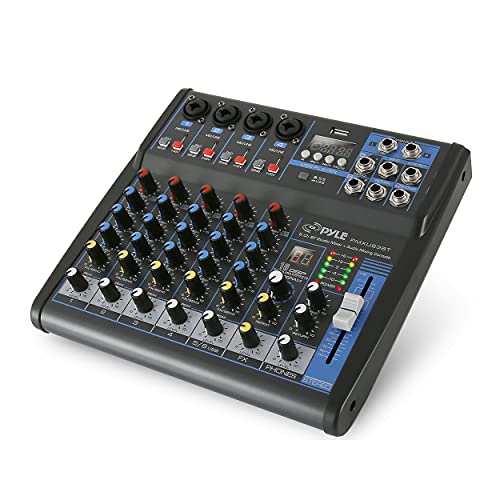
- 6 channels for more input flexibility
- USB, MP3, and Bluetooth playback support
- 48V phantom power with 3-band EQ
Best For: Small to midsize stations needing extra inputs
Studio-Ready Budget Pick – Pyle 8 Channel Bluetooth Mixer
If you need broadcast audio mixers for radio stations on a budget, this Pyle 8-channel board covers the basics well: multiple mic/line inputs, Bluetooth streaming, USB playback, and direct-to-computer recording. It is aimed at small studios, live streaming, and simple radio workflows where you want practical control without a steep learning curve.
Best For: Small radio booths, streaming setups, and beginner-friendly multi-input mixing.
Pros:
- 4 XLR/1/4″ combo inputs plus RCA and stereo channels for flexible source routing.
- Bluetooth 4.0, USB, and direct-to-computer recording support simple playback and capture.
- 48V phantom power and 16-bit DSP FX add useful studio features for voice work.
- Compact layout with LED meters, LCD display, and main/headphone outputs for quick monitoring.
Cons:
- Best suited to smaller setups rather than larger broadcast operations.
- Feature set is broad, but the controls are still positioned as easy to learn rather than advanced.
Overall, this is a practical entry-level mixer for radio-style content where you need reliable input options and straightforward operation. It favors convenience and versatility over premium broadcast specialization.
Flexible Live-Sound Option – 8 Channel Mixer with USB Interface
For broadcast audio mixers for radio stations that also need live-show flexibility, this 8-channel console offers XLR and 1/4″ inputs on all channels, USB audio, Bluetooth streaming, and onboard reverb or delay. It is a strong fit when your studio setup doubles as a recording, streaming, or event board.
Best For: Small studios, live streaming, and mixed-use radio or event setups.
Pros:
- Eight mic-capable channels with XLR and unbalanced 1/4″ support on all inputs.
- USB connectivity, Bluetooth streaming, and USB flash-drive recording expand source options.
- 3-band EQ, gain controls, and reverb/delay effects help shape spoken word and music.
- PFL/AFL monitoring and headphone output support more precise cueing and checking.
Cons:
- Product emphasis is broad live-use versatility rather than a dedicated broadcast workflow.
- Feature-heavy control surface may be more than needed for very simple voice-only work.
As a general-purpose mixing board, it gives radio stations useful routing, monitoring, and effect options in a slim chassis. If you want one console for studio sessions, streaming, and small events, it covers a lot of ground.
Rack-Friendly Streaming Board – Pyle PMXU83BT DJ Mixer
This Pyle 8-channel mixer suits broadcast audio mixers for radio stations when you want wireless streaming, USB playback, and dependable analog input handling in one compact board. Its XLR and 1/4″ mic/stereo line support, plus 48V phantom power, make it a straightforward option for voice, music, and guest sources.
Best For: Radio-style studios, karaoke, and portable live sound rigs.
Pros:
- Bluetooth wireless streaming makes it easy to send audio from a phone without cables.
- XLR and unbalanced 1/4″ inputs with 48V phantom power support common mic setups.
- 3-band EQ and LED peak metering help manage tone and levels.
- Rugged steel chassis and sealed rotary controls are built for regular use.
Cons:
- It is positioned as a DJ/audio mixer rather than a dedicated broadcast console.
- Control layout is compact, so hands-on operation may feel less spacious than larger boards.
For smaller radio workflows, this model offers the useful essentials: wireless playback, mic support, and simple tone shaping. It is a practical pick when durability and easy input handling matter more than advanced studio routing.
Effects-Heavy Compact Choice – 5 Channel Mixer with 99 DSP Effects
Among broadcast audio mixers for radio stations, this 5-channel model stands out if you want compact size plus a deep effects section. It combines Bluetooth, USB recording, independent phantom power on the first three XLR inputs, and zero-latency monitoring for small studios that need a lot from a small footprint.
Best For: Podcast rooms, small radio booths, church audio, and karaoke setups.
Pros:
- Five channels with combo inputs and stereo options for multiple mics and playback sources.
- Bluetooth, USB, and flash-drive playback/recording make it easy to capture and play sessions.
- 99 DSP effects, 3-band EQ, and compressor controls offer more sound shaping than many compact mixers.
- Independent 48V phantom power on the first three XLR inputs and hardware monitoring add flexibility.
Cons:
- Only five channels, so it is less suitable for larger routing needs.
- Best suited to small-scale production rather than full broadcast rooms with many sources.
This is a good pick if you want easy effects processing and modern connectivity in a small format. It is especially appealing for voice-focused work where fast setup, monitoring, and clean recording matter.
Compact 8-Channel USB Mixer for Simple Radio Workflows – Depusheng DX8 8-Channel Mixer
If you’re comparing broadcast audio mixers for radio stations and need a compact board for straightforward voice, music, and device routing, the Depusheng DX8 is built around easy connectivity. It supports USB, flash media, MP3 playback, and Bluetooth streaming, plus XLR and 1/4″ inputs with +48V phantom power for mic work. That makes it a practical fit for small studio setups, live talk segments, or basic production rooms.
Best For: Small radio stations, community broadcasters, and entry-level studio setups that want simple multi-source mixing.
Pros:
- 8 channels with USB, Bluetooth, and MP3/flash reader support
- XLR and 1/4″ mic/line inputs with +48V phantom power
- 3-band EQ on all channels for quick tone shaping
- LED peak indicators and stereo output metering
Cons:
- 8 channels may be limiting for larger broadcast routing needs
- Designed as an analog mixer, so it lacks advanced digital workflow tools
- Better suited to basic operation than complex station automation
Overall, the DX8 is a sensible low-complexity option when you want dependable source mixing without a lot of setup overhead. Its strong point is practical connectivity rather than deep broadcast features.
Feature-Rich 12-Channel Console for Flexible Station Routing – 12-Channel Mixer with DSP Effects
For buyers looking at broadcast audio mixers for radio stations, this 12-channel console offers more routing flexibility than compact entry-level boards. It includes XLR and stereo line inputs, independent gain/EQ/AUX/pan controls, a mute button on each channel, and a 7-band EQ on the main output. The built-in 99 DSP effects, Bluetooth, USB, and MP3/recording functions make it adaptable for talk, music, and production tasks.
Best For: Small to mid-size stations that want more channels, more control, and built-in effects.
Pros:
- 12 channels with independent gain, EQ, AUX, pan, and mute controls
- 99 DSP effects for adding variety to live or produced content
- 7-band EQ on the main output for broader system shaping
- Bluetooth, USB, MP3 playback, and recording support
Cons:
- More complex than a basic mixer, so setup may take longer
- Designed for general pro audio use rather than dedicated broadcast automation
- Feature set may be more than needed for very small stations
This model stands out if you want extra channel count and more fine-tuning options in one box. It is a strong all-rounder for stations that need flexibility without moving to a full broadcast system.
Portable 4-Channel Board for Mobile Broadcast Setups – 4-Channel Bluetooth DJ Mixer
If you need broadcast audio mixers for radio stations that can travel easily, this 4-channel mixer is the most portable option in the group. It includes USB audio interface support, XLR and 6.35mm inputs, +48V phantom power, Bluetooth input, and echo delay effects. The compact size makes it useful for mobile interviews, small live streams, and lightweight production kits.
Best For: Mobile broadcasters, small home studios, and lightweight podcast or live-stream setups.
Pros:
- Very compact and easy to carry in a backpack
- USB, Bluetooth, XLR, RCA, and 6.35mm connectivity
- +48V phantom power for condenser microphones
- Echo delay effect and simple channel equalization
Cons:
- Only 4 channels, so it is not ideal for larger routing needs
- Bluetooth is input only, not output
- Limited size means less headroom for expanding a station setup
As a mobile-friendly mixer, it favors convenience and portability over big-studio flexibility. That makes it a good fit when your radio workflow needs to move quickly and stay simple.
Budget-Friendly Compact Option – Pyle 4-Channel Bluetooth USB Mixer
If you’re comparing broadcast audio mixers for radio stations on a tighter budget, this 4-channel Pyle board covers the basic studio needs without adding a lot of complexity. It supports USB, flash drives, computer input, Bluetooth streaming, 48V phantom power, and 3-band EQ, so it can handle simple voice, music, and playback duties in a compact footprint.
Best For: Small stations, starter studios, and host setups that need an affordable all-in-one mixer.
Pros:
- USB, flash reader, computer, and Bluetooth playback support
- XLR and 1/4″ mic/line inputs with 48V phantom power
- 3-band EQ and LED peak level indication for basic control
- Rugged steel chassis with sealed rotary controls
Cons:
- Only 4 channels, so it may feel limited in larger workflows
- Feature set is more basic than higher-channel broadcast mixers
This is a practical entry-level mixer if you want core connectivity and simple operation in a durable build. It’s best suited to smaller radio tasks where flexibility matters more than advanced routing.
Most Versatile Midrange Pick – Aveek 4-Channel Mixer with Recording
For broadcast audio mixers for radio stations that need recording and monitoring in one compact unit, the Aveek 4-channel mixer stands out with a built-in HD recording chip, USB playback, Bluetooth, and 99 DSP effects. It also includes 48V phantom power, balanced outputs, headphone monitoring, and a Type-C connection for direct PC recording, making it useful for on-air voice work, podcast-style shows, and live stream production.
Best For: Small studios, live broadcasts, and creators who want built-in recording plus effects.
Pros:
- Built-in HD recording chip with plug-and-play Type-C PC recording
- USB drive playback/recording and Bluetooth music playback
- 99 DSP effects plus 3-band EQ and gain controls
- Balanced XLR/TRS outputs and headphone monitoring
Cons:
- Still limited to 4 channels for larger multi-source setups
- Bluetooth is for playback, not output-device connection
This model offers the broadest feature mix in the group if your station workflow includes recording, playback, and live monitoring. It’s a strong fit when you want broadcast flexibility without stepping up to a larger console.
Expanded Input Choice – Pyle 6-Channel Bluetooth USB Mixer
If your radio workflow needs a little more room to grow, this 6-channel Pyle mixer adds extra input capacity while keeping the same straightforward USB, flash, MP3, and Bluetooth playback support. It also includes 48V phantom power, 3-band EQ, LED peak metering, and a rugged steel chassis, so it’s a practical step up for stations handling more sources.
Best For: Small to midsize radio stations that need more inputs and simple playback options.
Pros:
- 6 channels provide more flexibility than compact 4-channel boards
- USB, flash, MP3, computer, and Bluetooth compatibility
- 48V phantom power with XLR mic support
- 3-band EQ and LED peak level indication
Cons:
- No built-in recording chip is listed
- More basic than mixers with dedicated broadcast workflow features
This is the best option here if your priority is simply more channels without giving up easy connectivity. It’s a solid fit for stations that want dependable input flexibility and familiar controls.
How We Picked the Best Broadcast Audio Mixers for Radio Stations
We looked for Broadcast Audio Mixers for Radio Stations that offer practical channel counts, usable microphone support, USB recording or computer connectivity, and straightforward hands-on control. Priority also went to models with phantom power, EQ shaping, and effects that can help in small studios or hybrid broadcast setups.
Quick Comparison
If you need a compact setup, 4- to 5-channel mixers are usually best for smaller stations, podcasts, or volunteer-run studios. Mid-size 6- to 8-channel models give more room for mics, phone feeds, playback devices, and backup sources. A 12-channel mixer makes more sense when you need extra routing flexibility or a busier production environment.
Key Buying Factors for Broadcast Audio Mixers for Radio Stations
Input Count and Channel Layout
Match the channel count to your actual workflow, not just your current mic count. Leave room for telephone hybrids, guest sources, computers, and external players.
Mic Support and Phantom Power
Broadcast microphones often need clean gain and, in some cases, 48V phantom power. Check whether phantom power is global or switchable, especially if you use a mix of dynamic and condenser mics.
USB and Computer Integration
Many stations now record, stream, or patch audio through a computer. A mixer with USB audio interface support can simplify content capture and live streaming, but verify whether it supports multitrack or only stereo output.
EQ, Routing, and Monitoring
EQ helps tame voice harshness and improve clarity. Simple monitoring and clear level metering matter just as much, because a broadcast mistake is harder to fix live than in post-production.
Build Quality and Noise Performance
For radio use, low-noise operation and dependable faders or knobs are more important than flashy effects. A mixer should feel stable during long sessions and maintain consistent levels over time.
Who Should Buy Which Broadcast Audio Mixers for Radio Stations?
Choose a compact 4-channel mixer if you are building a small studio, podcast room, or backup on-air position. Go with a 5- to 8-channel model if you need more mic and source flexibility for daily broadcasting. Step up to a 12-channel mixer if you manage more complex productions, multiple guests, or a station environment that benefits from extra routing headroom.
If your priority is simple live control, focus on clean inputs, phantom power, and easy USB connectivity before extras like DSP effects. If you want maximum versatility for Broadcast Audio Mixers for Radio Stations, choose the model that best matches your source count and workflow today, with a little room to grow.