Choosing the right scanner matters when preservation quality, speed, and page safety all count. For book scanners for archival projects, the best models balance sharp imaging, reliable flattening tools, and accurate OCR.
Below, we’ve focused on scanners that can handle everything from rare books to large-format materials, so you can find a practical fit for your archive workflow.
Best 10 Book Scanners for Archival Projects Picks for 2026
Large-format archival scanning
VIISAN S48 Duo Overhead Book Scanner
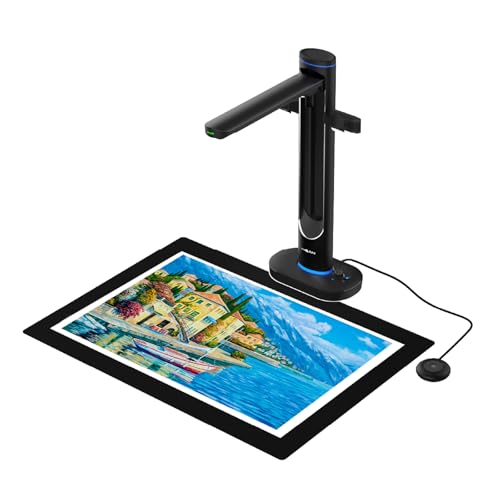
- Overhead design scans A2 books and documents without flattening
- Dual 48MP cameras with up to 600 DPI for detailed capture
- AI page correction plus OCR and text-to-speech support
Best For: Libraries and archives digitizing oversized or fragile materials
Fast A3 digitization
CZUR ET18 Pro Professional Document Scanner

- Auto-flatten and deskew tech reduces manual cleanup
- ABBYY OCR converts scans to searchable and editable files
- 18MP camera captures A3 documents at 4896 x 3672 resolution
Best For: Fast searchable scanning of A3 books and documents
Reliable overhead scanning
ScanSnap SV600 Overhead Book and Document Scanner

- Scans books, newspapers, and magazines without cutting them apart
- Auto Book Correction helps flatten curved pages
- Point Retouch and page-turning detection streamline cleanup
Best For: General archival scanning with simple overhead handling
Compact flatbed with book support
Epson Perfection V19 II Color Photo and Document Flatbed Scanner

- 4800 dpi optical resolution for detailed scans
- High-rise removable lid helps with books and photo albums
- ScanSmart software creates searchable PDFs and editable files
Best For: Small spaces and mixed book, photo, and document scanning
Auto-Flatten Speed for Books
CZUR Aura Pro Portable Book Scanner

- Three-laser page flattening for curved books
- About 2 seconds per page scanning speed
- OCR for 180+ languages
Best For: Archiving bound books and fast document digitization
High-Detail Archiving Camera

- 48MP capture with up to 600 DPI
- AI page flattening and automatic splitting
- OCR for searchable PDFs and editable files
Best For: Detailed archival scanning and overhead document capture
Portable Handheld Archiver

- Handheld, rechargeable, and travel-friendly
- Up to 1050 DPI scanning resolution
- OCR plus PDF editing software included
Best For: Portable book and document scanning on the go
Premium High-Resolution Archiving Choice
CZUR ET MAX Professional Book Scanner

- 38MP sensor with 410 DPI and A3 capture
- Curve-flattening for bound books
- OCR to searchable PDFs and editable files
Best For: Large archival jobs and fast, high-detail book digitizing
Practical A3 Archiving Scanner

- A3 overhead scanner for books and large docs
- 16MP capture with up to 300 DPI
- Anti-glare LED lighting for cleaner pages
Best For: Libraries, offices, and home archiving with A3-sized materials
Large-Format Archival Powerhouse

- A2/A3 overhead scanner for oversized materials
- 26MP capture with software-enhanced 600 DPI
- Auto-flattening plus OCR to multiple formats
Best For: Oversized archival materials like maps, manuscripts, and newspapers
Large-format archival scanning – VIISAN S48 Duo Overhead Book Scanner
For book scanners for archival projects, the VIISAN S48 Duo is built for oversized materials that you do not want to flatten or damage. Its overhead design handles A2-size books, maps, bound materials, and documents, while the dual 48MP cameras and up to 600 DPI resolution aim to preserve fine text and detail for long-term digitization.
Best For: Libraries, schools, offices, and archive workflows that need high-resolution overhead capture for fragile or oversized materials.
Pros:
- Overhead scanning captures books and documents up to A2 without pressing on fragile pages or bindings
- Dual 48MP sensors provide detailed scans with accurate color and fine line reproduction
- Built-in AI helps flatten curved pages, remove finger marks, and correct edge distortion in real time
- OCR and text-to-speech support searchable and more accessible digital files
Cons:
- Requires a USB connection and compatible Windows or macOS system
- More of a specialty archive tool than a simple portable scanner
Overall, the S48 Duo is the most archive-focused option here for large and delicate materials, especially if you want speed, image cleanup, and accessibility features in one overhead unit.
Fast A3 digitization – CZUR ET18 Pro Professional Document Scanner
If you are comparing book scanners for archival projects, the CZUR ET18 Pro is a strong overhead choice for fast digitization of A3 materials. It uses auto-flatten and deskew technology, plus ABBYY OCR, to turn bound pages into searchable files with relatively little manual cleanup once you get used to it.
Best For: Users who want a quick, cable-connected overhead scanner for searchable PDFs and office-ready output.
Pros:
- Auto-flatten technology helps correct curved book pages after capture
- ABBYY OCR supports editable PDF, Word, Excel, and other searchable formats
- 18MP camera and 4896 x 3672 resolution provide detailed image capture
- Can scan A3-size documents and works with Windows and MacOS
Cons:
- USB cable connection only; no Wi-Fi support
- Very glossy papers are not recommended
- OCR language support has a few limitations depending on system and language
For archival work where speed and searchable output matter more than maximum resolution, the ET18 Pro balances solid image quality with useful page-flattening automation.
Reliable overhead scanning – ScanSnap SV600 Overhead Book and Document Scanner
The ScanSnap SV600 is a practical overhead option for book scanners for archival projects when you want simple non-contact scanning. It can scan books, newspapers, and magazines directly without cutting them apart, and its auto book correction and point retouch features help clean up curve distortion and fingers in the frame.
Best For: General-purpose archival scanning of books, newspapers, magazines, and mixed paper materials.
Pros:
- Overhead design scans books and documents without damaging them
- Auto Book Correction helps flatten and correct page curvature
- Point Retouch removes captured fingers from scans
- Multi Document Detection and page-turning detection make batch work easier
Cons:
- Lower stated resolution than higher-end overhead scanners
- Heavier than some compact USB-powered models
SV600 is a dependable choice if your archival workflow needs broad media support and convenient correction tools more than maximum technical specs.
Compact flatbed with book support – Epson Perfection V19 II Color Photo and Document Flatbed Scanner
The Epson Perfection V19 II is a compact flatbed scanner that can still work well for book scanners for archival projects when you need a straightforward, space-saving setup. Its high-rise, removable lid makes it easier to scan books and photo albums, while the 4800 dpi optical resolution supports detailed capture for documents and images.
Best For: Small workspaces and users who need a compact flatbed for books, photos, and document digitization.
Pros:
- 4800 dpi optical resolution delivers strong image detail
- High-rise, removable lid helps with books and photo albums
- ScanSmart software supports searchable PDFs and editable Office files with OCR
- USB-powered design keeps the scanner portable and easy to place
Cons:
- Flatbed design is less ideal for fragile bindings than an overhead scanner
- Standard sheet capacity is only 1, so larger jobs are more manual
This is the most desk-friendly option in the group, especially if your archive work includes books mixed with photos and documents and you prefer a compact flatbed over an overhead rig.
Auto-Flatten Speed for Books – CZUR Aura Pro Portable Book Scanner
If you need book scanners for archival projects that can handle curved pages and move quickly through stacks, the CZUR Aura Pro is built around speed and cleanup reduction. Its three-laser page-flattening system, auto-detect page turning, and OCR support make it a practical choice for digitizing books and documents without spending extra time on manual correction.
Best For: Archiving bound books and mixed documents with fast page capture and built-in flattening.
Pros:
- Three laser lines help flatten curved book pages for clearer captures.
- Fast scanning at about 2 seconds per page for single sheets and double-page books.
- OCR supports 180+ languages for searchable text output.
- Includes supplemental side lights to reduce reflection on glossy paper.
Cons:
- Thai, Hebrew, and Arabic are not currently supported in OCR.
- Best results depend on a quiet environment for the sound-controlled lamp feature.
- Requires compatible Windows or Mac systems for use.
Overall, the Aura Pro is a strong fit when you want faster archival digitizing with less page cleanup after the scan. It leans toward productivity and convenience, especially for book-heavy projects.
High-Detail Archiving Camera – VIISAN K48 Book Scanner
For book scanners for archival projects that need high detail and a flexible overhead workflow, the VIISAN K48 is designed to capture books, reports, and archive files clearly. Its 48MP imaging, 600 DPI support, and AI-assisted page flattening are aimed at making large digitization jobs easier to manage while keeping text and diagrams readable.
Best For: Detailed archival scanning of books, reports, and reference materials.
Pros:
- 48MP capture with up to 600 DPI for fine text and diagrams.
- AI-assisted page flattening and page splitting reduce manual cleanup.
- OCR can create searchable PDFs and editable documents.
- Also works as a 4K@30fps USB document camera.
Cons:
- It is an overhead desktop setup rather than a portable handheld scanner.
- Text-to-speech is listed, but the main value is still scanning and OCR.
- Best suited to Windows and Mac desktop workflows with USB connection.
The K48 is a good pick if your archival work prioritizes clarity, searchable output, and a more presentation-friendly overhead design. It feels especially useful for mixed scanning and teaching tasks in the same workspace.
Portable Handheld Archiver – IRIScan Book 7 White
If you want book scanners for archival projects that are easy to carry and don’t require a traditional flatbed setup, the IRIScan Book 7 White is built for portable scanning. It can save directly to SD card or connect by USB, and its included OCR and PDF software make it a convenient option for turning important pages into usable digital files while traveling or working away from a desk.
Best For: Portable scanning of books and documents when space and mobility matter.
Pros:
- Handheld and battery-powered design is highly portable.
- Scans at 300, 600, or 1050 DPI depending on the job.
- Includes unlimited OCR and Readiris PDF software.
- Can scan to SD card or directly to a computer via USB.
Cons:
- It does not support Wi-Fi connectivity.
- As a handheld scanner, it depends more on user movement than overhead models.
- AC adapter is not provided.
This model makes the most sense when portability is the priority and you need a scanner that can travel with you. It is less of a studio archiving tool, but very practical for quick capture and flexible storage options.
Premium High-Resolution Archiving Choice – CZUR ET MAX Professional Book Scanner
If you need book scanners for archival projects that can move quickly without sacrificing detail, the CZUR ET MAX is built for high-volume digitizing. Its 38MP sensor, curve-flattening technology, and A3 capture make it well suited to bound books and oversized pages that need clean, searchable scans.
Best For: Large archival jobs, bound books, and users who want high resolution plus fast throughput.
Pros:
- 38MP sensor delivers detailed 7168 × 5376 captures at 410 DPI.
- Patented curve-flattening helps reduce distortion on bound pages.
- Supports OCR into searchable PDFs and editable Word/Excel files in 180+ languages.
- Scans A3 documents and can capture a page in about 1.5 seconds with practice.
Cons:
- Not recommended for glossy or highly reflective materials.
- Some OCR language limitations apply, including Thai and Hebrew not being supported.
- Arabic OCR support is limited to ET Series scanners on Windows.
For archival workflows that prioritize speed, page correction, and strong OCR support, this is one of the more capable overhead options in the group. It stands out when you need to process books and large documents efficiently while keeping files organized and searchable.
Practical A3 Archiving Scanner – VIISAN DL16 Book Scanner
For book scanners for archival projects where simplicity and clean overhead capture matter more than ultra-high resolution, the VIISAN DL16 is a solid desktop choice. It combines an A3 scanning area with anti-glare LED lighting and page-flattening features to help digitize books, archives, artwork, and other large documents.
Best For: Libraries, offices, and home archiving setups that need a straightforward A3 overhead scanner.
Pros:
- A3 overhead design handles bound books, oversized pages, and large documents.
- 16MP camera with up to 300 DPI for clear capture and reference workflows.
- Anti-glare LED lighting helps reduce shadows and page shine.
- Compatible with Windows and Mac for common desktop scanning setups.
Cons:
- Lower resolution than some higher-end archival scanners.
- Best suited to desktop use rather than portable scanning.
- Duplicate anti-glare bullet removed from the comparison, but lighting remains a core feature.
The DL16 makes sense when you want a dependable overhead scanner for organized digitization without overcomplicating the workflow. It’s a practical option for collections, records, and study materials that fit within A3 capture needs.
Large-Format Archival Powerhouse – VIISAN S21 A2/A3 Book Scanner
If your archival projects involve oversized materials, this VIISAN overhead scanner is built for broader capture than a standard book scanner. With A2/A3 support, 26MP imaging, auto-flattening, and multi-language OCR, it is aimed at manuscripts, newspapers, maps, and similar large-format work.
Best For: Large-format archives, manuscripts, newspapers, and users who need A2 capture.
Pros:
- A2 scanning area handles large journals, manuscripts, newspapers, and maps.
- 26MP resolution with software-enhanced up to 600 DPI.
- Auto-flattening, finger removal, and double-page splitting support archival cleanup.
- OCR output includes PDF, Word, Excel, EPUB, and text formats.
Cons:
- Bundled software is not compatible with ARM-based Windows devices.
- Glossy papers are not recommended.
- Built-in LEDs are not ideal for bright light conditions.
For institutions or serious collectors dealing with oversized source material, the S21 offers more capture space and more file-format flexibility than many entry-level overhead scanners. Its feature set is especially useful when archival work extends beyond ordinary books into large documents and mixed-format collections.
How We Picked the Best Book Scanners for Archival Projects
We prioritized scan quality, optical resolution, OCR reliability, ease of page correction, and handling features that reduce stress on bindings and delicate pages. We also looked for models that make sense for real archival work, including overhead designs, large capture areas, and workflows that speed up repeated digitization.
Quick Comparison
If you want the fastest non-contact workflow, overhead scanners are usually the best choice. If you need the cleanest image fidelity for flat materials, a good flatbed scanner can still be useful. Portable handheld options are better for occasional capture than for high-volume archival runs.
Key Buying Factors for Book Scanners for Archival Projects
Capture Style
Overhead scanners are ideal for fragile books because they avoid pressing the spine flat. Flatbeds can deliver strong image quality, but they are slower and less suitable for bound volumes. Handheld scanners offer flexibility, though consistency depends more on the operator.
Resolution and Detail
For archival use, look for enough resolution to preserve small text, marginal notes, and illustrations. Higher megapixel counts and 300 to 600 DPI targets are especially helpful when you need readable records and future reusability.
Auto-Flattening and Deskew
Features like auto-flatten, deskew, and curve correction help make curved pages more usable without heavy manual editing. These tools are especially valuable when digitizing older books with tight bindings.
OCR Language Support
If your collection includes multiple languages, choose scanners with broad OCR support. Strong OCR can turn images into searchable text, which is a major advantage for archives, libraries, and researchers.
Lighting and Glare Control
Good lighting matters when pages are glossy, faded, or unevenly colored. Anti-glare systems and fingerprint removal features can reduce retakes and cleanup time.
Who Should Buy Which Book Scanners for Archival Projects?
Choose an overhead model if you’re scanning bound books, rare materials, or mixed-format collections. Pick a flatbed if your work is mostly photos, single sheets, or items that need maximum image consistency. A portable scanner makes sense for field work, travel, or light-duty digitization. For most buyers comparing Book Scanners for Archival Projects, the best option is the one that combines safe handling with the least post-scan cleanup.