Choosing beginner-friendly digital sheet music pedals can make practice more comfortable, especially when you need hands-free page control while playing. The right option should be simple to operate, stable near your instrument, and compatible with your sheet music or digital device.
We reviewed the selected products with beginner needs in mind, including ease of setup, pedal functionality, keyboard compatibility, portability, and value. Use the guide below to narrow down the best fit for your practice space and playing style.
Best 10 Beginner-Friendly Digital Sheet Music Pedals Picks for 2026
Beginner Piano Starter

- 88 full-size keys with sustain pedal
- Includes stand, headphones, and lessons
- USB-MIDI and quiet headphone practice
Best For: New piano learners building a home practice setup
Pedal Fundamentals Guide

- Explains common guitar pedal types
- Covers pedal combinations and tone choices
- Compact 69-page beginner reference
Best For: New guitarists learning pedal fundamentals
Expressive Learning Setup

- Weighted hammer-action keys
- Includes stand and triple pedals
- Bluetooth, MIDI, headphones, and sheet holder
Best For: Learners pursuing realistic technique and pedal control
Easy Effects Introduction
Beginner's Guide to Guitar Pedals

- Introduces stompboxes and sound shaping
- Covers overdrive and reverb basics
- Digital format with accessibility features
Best For: Young or first-time guitarists exploring effects
Weighted-Key Foundation

- 88 full-weighted keys for acoustic-style practice
- Includes sheet music stand and triple pedal
- USB-MIDI supports apps and music software
Best For: Home learners wanting a traditional full-size digital piano setup
Pedaling Technique Guide

- Explains damper-pedal fundamentals
- Uses piano-literature examples
- Compact 64-page illustrated manual
Best For: Students learning how pedal use shapes tone and musical phrasing
Portable Practice Pick
61-Key Electronic Piano Keyboard

- Semi-weighted touch-sensitive keys
- Includes sustain pedal and sheet stand
- Teaching, recording, and battery-power options
Best For: Beginners needing a lightweight, flexible practice keyboard
Best Beginner Setup
AMPUS 88-Key Semi-Weighted Keyboard

- Approachable semi-weighted 88-key layout
- Includes stand, sustain pedal, and music rest
- MIDI-USB and Bluetooth connectivity
Best For: Beginners wanting a versatile full-size keyboard for home practice
Best Complete Package
UISCOM 88-Key Semi-Weighted Digital Piano

- Includes stand, triple pedal, and headphones
- Semi-weighted keys suit developing players
- Bluetooth audio and USB-MIDI connectivity
Best For: Beginners wanting an all-in-one home piano package
Best Weighted-Key Upgrade
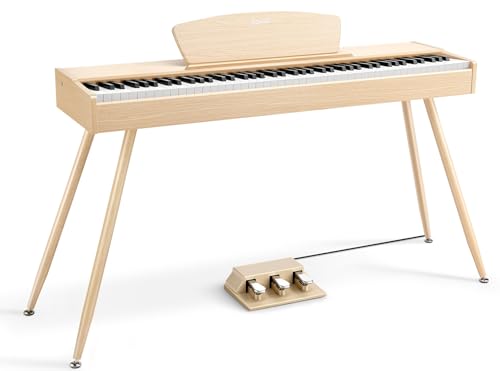
- 88 heavy hammer-action weighted keys
- Includes triple pedal and sheet music stand
- USB-MIDI supports teaching and editing software
Best For: Beginners and learners seeking a more acoustic-style playing feel
Beginner Piano Starter – AODSK 88-Key Digital Piano
For shoppers comparing beginner-friendly digital sheet music pedals, this AODSK piano is a practical starter setup with an included sustain pedal, sheet music stand, headphones, and USB-MIDI connectivity. Its full-size 88-key layout and included 30-day teaching course support structured learning at home.
Best For: Beginners who want a complete digital piano package for lessons, sheet music practice, and quiet headphone sessions.
Pros:
- Full-size 88-key keyboard designed to simulate an acoustic piano.
- Includes a sustain pedal, sheet music stand, headphones, and power adapter.
- Headphone mode supports quiet practice, while USB-MIDI works with compatible devices and music apps.
- 128-note maximum polyphony and built-in recording add useful practice flexibility.
Cons:
- The supplied information identifies a sustain pedal rather than a full multi-pedal unit.
- Its large 53.15-inch dimensions require dedicated floor space.
This is a sensible entry-level choice for learners who need the basics in one package. The included accessories reduce setup decisions, while the sustain pedal and sheet music stand make traditional lesson and repertoire practice straightforward.
Pedal Fundamentals Guide – Guitar Pedal Basics
Guitar Pedal Basics: Your guide to getting into pedals while saving time, frustration, and money.
Check Price On AmazonAlthough it is not a physical pedal, this compact guide can help beginners make more informed choices when exploring beginner-friendly digital sheet music pedals and other music gear. It explains pedal types, effects, combinations, and tone-shaping decisions in a straightforward 69-page format.
Best For: Guitarists who are new to effects pedals and want help avoiding confusing or costly trial and error.
Pros:
- Introduces different pedal types and explains how they work.
- Offers guidance on combining pedals for desired guitar sounds.
- Its 69-page length and 10 illustrations make it a relatively compact starting resource.
Cons:
- It is an instructional book, not a digital sheet music pedal or hardware accessory.
- The supplied edition is in English only.
This title is best treated as a learning aid rather than a purchase in the pedal-hardware category. It may be useful before assembling a pedal setup, particularly for beginners who want a basic vocabulary for comparing effects.
Expressive Learning Setup – Rhymo 88-Key Weighted Piano
For learners who want beginner-friendly digital sheet music pedals alongside a more realistic piano feel, the Rhymo combines 88 weighted hammer-action keys with a matching stand and triple pedals. Its music stand, sheet holder, headphones, Bluetooth, and MIDI features create a well-equipped practice station.
Best For: Beginners and developing players who want weighted-key technique, sheet music support, and sustain, soft, and sostenuto pedal control.
Pros:
- Weighted hammer-action keys support realistic touch, rebound, and dynamic control.
- Includes a furniture stand and triple-pedal unit with sustain, soft, and sostenuto pedals.
- Comes with a music stand, sheet holder, headphones, key stickers, and power adapter.
- Bluetooth supports mobile learning and accompaniment, while MIDI supports computers and arranging software.
Cons:
- The weighted design and furniture stand may be more setup than a casual beginner needs.
- Its 127 cm width still requires a dedicated space at home.
The Rhymo is the most feature-rich piano option here for learners who expect to practice seriously. Its triple pedals are particularly useful for developing expressive control while following sheet music, and headphone support makes extended practice more convenient.
Easy Effects Introduction – Beginner's Guide to Guitar Pedals
This beginner-focused digital guide is useful for understanding pedal terminology before shopping for beginner-friendly digital sheet music pedals or related music equipment. It introduces stompboxes, overdrive, reverb, and other effects while connecting pedal choices with personal sound and musical expression.
Best For: First-time guitarists and younger readers who want an accessible introduction to effects pedals.
Pros:
- Explains the role of guitar pedals as tools for shaping sound.
- Introduces familiar effects such as overdrive and reverb.
- Available as a digital file with screen-reader support, enhanced typesetting, and Word Wise.
Cons:
- It is a guidebook rather than a physical pedal or sheet music device.
- The listed reading age is 8–18 years, so advanced players may want more depth.
This is a low-commitment starting point for readers who want to understand effects before buying hardware. Its accessible digital format and introductory scope make it more suitable for orientation than detailed pedalboard design.
Weighted-Key Foundation – Donner DDP-80 Digital Piano
The Donner DDP-80 is a practical choice for beginners seeking a beginner-friendly digital sheet music pedals setup at home. Its full-size weighted keyboard, included sheet music stand, and triple pedal provide a more traditional piano-style learning experience, while USB-MIDI support allows connection to compatible apps and computer software.
Best For: Beginners and learners who want a full-size digital piano with weighted keys, a built-in sheet music stand, and three pedals for practice and expression.
Pros:
- 88 full-weighted keys simulate acoustic-piano hammer action.
- Includes a sheet music stand and triple pedal.
- USB-MIDI connectivity supports teaching apps, MIDI editors, and DAWs.
- Headphone mode supports quieter practice.
Cons:
- At 23.8 kg, it is substantially less portable than a compact keyboard.
- Its corded-electric design is intended primarily for a fixed setup.
The DDP-80 stands out when realistic key feel and a stable sheet-music-friendly arrangement matter more than portability. Its retro wood finish also lets it function comfortably as part of a room’s furnishings.
Pedaling Technique Guide – The Art of Pedaling
The Art of Pedaling: A Manual for the Use of the Piano Pedals (Dover Books On Music: Piano)
Check Price On AmazonAlthough it is a book rather than hardware, The Art of Pedaling can help beginners build confidence with beginner-friendly digital sheet music pedals. It explains important pedal uses, especially damper-pedal technique, and uses musical examples to connect pedal choices with tone, phrasing, dynamics, and interpretation.
Best For: Piano students who already have access to a pedal-equipped keyboard or digital piano and want structured guidance on tasteful pedaling.
Pros:
- Focuses specifically on piano-pedal technique and musical application.
- Includes examples from piano literature.
- Its illustrated 64-page format is compact and approachable.
Cons:
- It does not include a digital piano, pedal, or sheet music stand.
- It is available in English only according to the supplied details.
This is a useful companion for learners who want to understand why and when to use a pedal, rather than simply adding hardware. Pair it with a compatible digital piano for a more complete practice setup.
Portable Practice Pick – 61-Key Electronic Piano Keyboard
This 61-key keyboard is a flexible option for beginners comparing beginner-friendly digital sheet music pedals and portable practice instruments. It includes a sustain pedal and sheet stand, while simplified controls, teaching modes, recording, and playback features make it easy to explore lessons and practice routines.
Best For: Beginners who want an affordable, lightweight keyboard setup with a sheet stand, included pedal, built-in lessons, and travel-friendly power options.
Pros:
- Semi-weighted, touch-sensitive keys provide responsive playing.
- Includes a sustain pedal, sheet stand, power adapter, and carrying bag.
- Offers step-by-step teaching modes plus recording and playback.
- Can run from an adapter or AA batteries.
Cons:
- The 61-key layout is not full-size piano range.
- Its 30-day manufacturer warranty is relatively short.
- The supplied details describe a sustain or modulation pedal, so buyers should verify the exact pedal function.
For learners who value portability and guided features, this keyboard offers more flexibility than a fixed digital piano. Its included stand and pedal make it a convenient starting package for home, lessons, or travel.
Best Beginner Setup – AMPUS 88-Key Semi-Weighted Keyboard
The AMPUS AM-105 is a practical starting point for anyone comparing beginner-friendly digital sheet music pedals and keyboard setups. Its semi-weighted 88-key layout offers gentle resistance, while the included sustain pedal and music rest support straightforward practice with sheet music.
Best For: Beginners who want a full-size, compact keyboard with learning features and media connectivity.
Pros:
- Semi-weighted keys encourage finger control while remaining approachable for beginners.
- Includes a stand, sustain pedal, music rest, sticker notes, and a simple songbook.
- MIDI-USB, Bluetooth, headphone, and MP3 connectivity support app-based and quiet practice.
- Offers 110 demo songs, 700 tones, 900 rhythms, recording, playback, and a metronome.
Cons:
- The keys are semi-weighted rather than fully weighted.
- Its many tones and rhythms may be more features than a beginner needs initially.
Choose this model if you want an approachable full-size keyboard with useful accessories and multiple ways to connect learning devices. It is especially convenient for home practice where compactness and headphone use matter.
Best Complete Package – UISCOM 88-Key Semi-Weighted Digital Piano
The UISCOM RS25TP-AP is a convenient choice for shoppers seeking beginner-friendly digital sheet music pedals and a ready-to-play piano package. It combines an 88-key semi-weighted keyboard with a wooden stand, triple pedal, music stand, headphones, and key stickers.
Best For: Beginners, teens, and adults who want a complete home practice setup with included accessories.
Pros:
- Complete set includes a wooden stand, triple pedal, music stand, headphones, cover, clips, and key stickers.
- Semi-weighted keys provide lighter resistance and quicker return for developing players.
- USB-MIDI and Bluetooth audio support compatible learning apps and play-along practice.
- Includes 600 tones, 800 rhythms, 80 demo songs, recording, playback, and a metronome.
Cons:
- The supplied connectivity details specify USB, so compatibility should be checked for each device.
- At 31.9 pounds, it is less portable than a basic keyboard-only setup.
This is a strong value-oriented option when you prefer not to purchase a stand, pedals, headphones, and practice accessories separately. Its furniture-style design also suits a dedicated home music corner.
Best Weighted-Key Upgrade – Donner DDP-80 Digital Piano
The Donner DDP-80 is aimed at players who want a more acoustic-style feel while exploring beginner-friendly digital sheet music pedals and connected learning. Its 88 heavy hammer-action keys, sheet music stand, and triple pedal provide a traditional practice-oriented setup.
Best For: Beginners and developing players who prioritize weighted keys, a full-size layout, and app connectivity.
Pros:
- Heavy hammer action simulates the feel and response of an acoustic piano.
- Includes a sheet music stand, triple pedal, and power adapter.
- USB-MIDI works with compatible teaching and music-editing software across multiple platforms.
- Features 128-note polyphony, a French DREAM sound source, stereo speakers, and headphone practice.
Cons:
- Weighted keys may feel more demanding to absolute beginners than semi-weighted alternatives.
- The supplied notes do not list built-in demo songs, rhythms, or recording functions.
- Its furniture-style design is less convenient to move frequently.
Consider the DDP-80 if realistic key resistance matters more than maximum portability or a large selection of accompaniment features. The included pedals and sheet music stand make it well suited to structured lessons and traditional repertoire.
How We Picked These Beginner-Friendly Digital Sheet Music Pedals
We focused on products and learning resources that support new players using digital pianos, keyboards, or electronic sheet music. Because the selection includes complete keyboards, pedal-equipped piano packages, and instructional books, we assessed how each item contributes to a practical beginner setup rather than treating every product as a standalone page-turning pedal.
Key considerations included straightforward controls, included accessories, keyboard size, pedal support, build practicality, and how well the product helps beginners develop consistent practice habits. Products with a music stand, sustain pedal, triple-pedal unit, or clear instruction may be especially useful for players starting from scratch.
Quick Comparison
Full-size 88-key digital pianos are best for learners who want a traditional layout and room to progress. Semi-weighted and 61-key keyboards are generally easier to move and may suit casual practice or smaller spaces. Bundles that include a stand, power adapter, headphones, or pedals can reduce the need to buy accessories separately.
Instructional books serve a different purpose: they can help beginners understand pedal technique, sound shaping, and practice methods, but they do not replace a compatible hardware pedal or keyboard. Check the product description carefully to confirm whether a pedal is included and whether it is a sustain, soft, sostenuto, or multi-pedal unit.
Key Buying Factors for Beginner-Friendly Digital Sheet Music Pedals
Compatibility and Connections
Before buying, confirm the pedal’s connector type and the input supported by your keyboard or digital piano. Universal-looking pedals are not always compatible with every instrument. For digital sheet music control, also check whether the pedal connects by USB, Bluetooth, or a device-specific app.
Ease of Use
Beginners benefit from simple plug-and-play operation, clearly labeled controls, and dependable response. A pedal that requires complicated mapping or frequent troubleshooting may distract from practice.
Stability and Comfort
Look for a non-slip base, a comfortable activation angle, and enough cable length for your setup. If you play for long sessions, a stable pedal can be more useful than a compact model that shifts across the floor.
Keyboard Feel and Included Accessories
Weighted keys and full-size layouts provide a more piano-like experience, while lighter keyboards are easier to transport. A bundled stand, headphones, or sustain pedal can improve value, particularly for first-time buyers.
Who Should Buy Which Beginner-Friendly Digital Sheet Music Pedals?
Choose an 88-key weighted model if you want realistic practice, classical technique development, and a setup that can grow with you. Choose a semi-weighted or 61-key keyboard if portability, budget, or limited space matters most. Choose a pedal-inclusive bundle if you want to begin practicing immediately without sourcing accessories separately. Choose an instructional book if you already own a keyboard and need help learning effective pedal technique.
For the best match, prioritize compatibility first, then decide whether you value realistic key action, portability, bundled accessories, or dedicated instruction. That approach makes it easier to choose among these Beginner-Friendly Digital Sheet Music Pedals without paying for features you will not use.