Keeping water conditions stable is one of the easiest ways to protect fish, shrimp, and plants. The right monitoring setup helps you spot problems early, before they turn into stress or losses.
Below, we cover the best aquarium monitoring systems for 2026, with options for real-time app alerts, multi-parameter testing, and simple at-a-glance water checks.
Best 10 Aquarium Monitoring Systems Picks for 2026
Smart 8-in-1 WiFi Tracker

- Tracks 8 key water parameters continuously.
- Connects to Tuya Smart for phone-based monitoring.
- Exports daily, weekly, and monthly reports.
Best For: Aquariums, hydroponics, and lab users needing continuous multi-parameter monitoring.
Ammonia Safety Sentinel

- Continuously monitors free ammonia levels.
- No chemicals or test procedures needed.
- Designed to last over a year.
Best For: Low-maintenance ammonia monitoring in fish tanks.
App-Alert Smart Monitor
Wireless WiFi Multi-Parameter Meter

- Tracks pH, salinity, temp, TDS, EC, SG, and ORP.
- Sends custom app alerts for unsafe readings.
- Includes multiple probe mounting options.
Best For: Reef, nano, planted, and pond setups needing connected alerts.
Quick-Read Strip Tester
AAwipes 8-in-1 Aquarium Test Kit

- Tests 8 common water parameters quickly.
- Works for freshwater, saltwater, ponds, and shrimp tanks.
- Sealed bottle helps protect strip shelf life.
Best For: Routine at-home spot testing across multiple tank types.
Smart Multi-Parameter Monitor
Kactoily All-in-One pH/ORP/Salt/S.G/TDS/EC/Temp Monitor
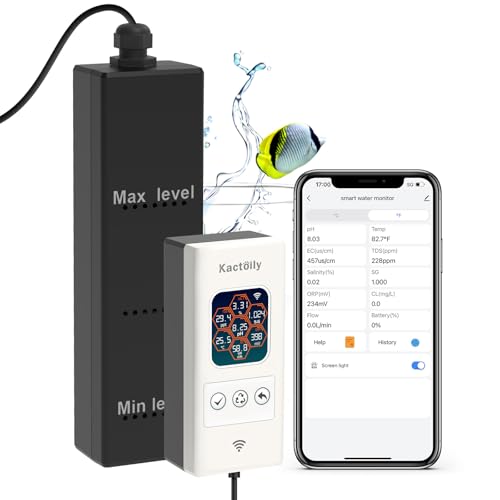
- 7-in-1 readings in one unit
- Tuya app alerts with custom ranges
- Works for freshwater, saltwater, and hydroponics
Best For: Continuous app-based monitoring across multiple water parameters
Manual Strip Testing Kit
11 in 1 Aquarium Test Strips with Ammonia

- Tests 11 water parameters
- 150 strips for frequent checking
- Easy dip-and-read color charts
Best For: Quick manual testing with lots of strips included
App-Connected Real-Time Monitor
Smart Aquarium Water Quality Monitor 7-in-1 with Replaceable Probe

- Real-time 7-parameter tracking
- Tuya app alerts over 2.4GHz Wi-Fi
- Color screen with replaceable probe
Best For: Real-time monitoring with app alerts and onboard display
App-Enabled Test Kit
Digital 10-in-1 Aquarium Water Testing

- App-scanned strips reduce color-matching errors.
- Tests ammonia, nitrate, nitrite, pH, GH, KH, and chlorine.
- Works with freshwater, saltwater, reef, shrimp, and betta tanks.
Best For: Routine multi-parameter water testing with app-assisted results
Real-Time Alert Monitor
Smart Aquarium Water Monitor with App Alerts

- Tracks pH, salinity, temp, TDS, EC, SG, and ORP.
- Sends instant SMS/app alerts when readings drift.
- Offers fixed-mount, suction, or floating installation.
Best For: Continuous monitoring with smartphone alerts
WiFi Remote Monitor
Digital Aquarium Water Tester with Alerts

- Continuously tracks pH, ORP, EC, TDS, salinity, SG, and temp.
- WiFi alerts warn you when readings move outside preset limits.
- Built for both freshwater and marine tanks.
Best For: Remote, app-based tank oversight with continuous readings
Smart 8-in-1 WiFi Tracker – Tuya WiFi Water Quality Meter
If you want aquarium monitoring systems that show more than just one or two readings, this Tuya WiFi meter covers the core water parameters in one wall-mounted unit. It tracks pH, specific gravity, EC, salt, ORP, TDS, CF, and temperature, with app-based monitoring and exportable reports for ongoing review.
Best For: Aquarists, hydroponics users, and lab setups that need continuous multi-parameter tracking with app access.
Pros:
- Monitors 8 parameters, including pH, S.G, EC, salt, ORP, TDS, CF, and temperature.
- Tuya Smart app connection enables real-time monitoring from your phone.
- Includes data logs and email export for daily, weekly, and monthly reports.
- Wall-mount design keeps the display easy to access during routine checks.
Cons:
- The tester is not waterproof, so it must stay protected from moisture.
- Requires setup and calibration for users who want the listed precision.
This is a feature-rich pick for buyers who want detailed, always-on water monitoring rather than occasional spot checks. It makes the most sense when you value app visibility, trend tracking, and a broader test range in one device.
Ammonia Safety Sentinel – Seachem Ammonia Alert 3-Pack
For aquarium monitoring systems focused on a single critical risk, this Seachem alert gives constant visibility into free ammonia without test tubes or reagents. The sensor is designed for ongoing use and is intended to last over a year, making it a simple add-on for everyday tank safety.
Best For: Fish keepers who want a low-maintenance ammonia warning tool for continuous tank monitoring.
Pros:
- Continuously detects and monitors free ammonia.
- No test kits, chemicals, or procedures are needed.
- Simple constant-reading design is easy to check at a glance.
- Intended to last over a year.
Cons:
- Only monitors free ammonia, not broader water chemistry.
- Does not provide digital app tracking or logging.
This is a straightforward safety monitor rather than a full water testing system. It works best as a permanent warning device when ammonia is your main concern and you want the least amount of upkeep possible.
App-Alert Smart Monitor – Wireless WiFi Multi-Parameter Meter
This smart option stands out among aquarium monitoring systems because it combines real-time app alerts with a modular probe setup for different tank styles. It tracks pH, salinity, temperature, TDS, conductivity, SG, and ORP through the Tuya Smart app, giving you continuous visibility and warning notifications when readings leave your safe range.
Best For: Reef tanks, nano aquariums, planted tanks, and ponds that need app-connected alerting and flexible probe placement.
Pros:
- Tracks 7 parameters in real time through the Tuya Smart app.
- Sends custom alerts when readings exceed your safe ranges.
- Includes clip, suction cup, and free-floating probe installation options.
- Comes ready to use with calibration powders and mounting accessories.
Cons:
- Requires WiFi connection on 2.4GHz networks for app features.
- Multi-part setup may be more involved than basic test strips.
Buyers who want a connected monitor with immediate notifications will find this a strong fit. Its mix of flexible mounting, replaceable probe design, and broad parameter coverage makes it a practical choice for active tank management.
Quick-Read Strip Tester – AAwipes 8-in-1 Aquarium Test Kit
If you prefer a simple, budget-friendly approach to aquarium monitoring systems, this AAwipes strip kit makes routine water checks fast and easy. It tests eight common parameters, including free chlorine, nitrate, nitrite, hardness, sodium chloride, total alkalinity, pH, and ammonia nitrogen, so you can spot issues without sending samples to a lab.
Best For: Fish keepers who want quick at-home testing for routine freshwater, saltwater, pond, or shrimp tank checks.
Pros:
- 8-in-1 strip testing covers a wide set of common water parameters.
- Results are read in minutes using a simple dip-and-compare process.
- Packaged in a sealed bottle to help extend shelf life.
- Suitable for freshwater, saltwater, ponds, pools, and shrimp tanks.
Cons:
- Requires manual testing rather than continuous monitoring.
- Ammonia nitrogen is read separately from the other pads.
This kit is best for regular spot checks when you need speed and convenience more than constant digital tracking. It offers broad coverage for everyday maintenance and is especially useful as a quick troubleshooting tool.
Smart Multi-Parameter Monitor – Kactoily All-in-One pH/ORP/Salt/S.G/TDS/EC/Temp Monitor
If you want aquarium monitoring systems that track more than just basic pH, this Kactoily unit is built for hands-off, 24/7 oversight. It combines multiple water-quality readings in one Wi‑Fi-connected monitor, so you can watch freshwater, saltwater, or hydroponic setups from your phone and set alerts around your own target ranges.
Best For: Aquarists who want app-based, continuous monitoring with broad parameter coverage.
Pros:
- Measures 7 parameters: pH, ORP, salinity, specific gravity, TDS, EC, and temperature.
- Tuya Smart app support with custom min/max alerts by app, phone, or SMS.
- Includes three-point pH calibration powders and ORP calibration powders.
- Designed for freshwater, saltwater, fish tanks, aquariums, and hydroponic systems.
Cons:
- EC calibration solution is not included and must be purchased separately.
- Saltwater use depends on proper probe placement in consistent flow.
- Requires attention to the probe protective cap before use.
This is a strong fit if you want a single smart monitor to replace multiple testers and prioritize continuous data over manual checks.
Manual Strip Testing Kit – 11 in 1 Aquarium Test Strips with Ammonia
For buyers comparing aquarium monitoring systems on simplicity and coverage, this strip-based kit gives you fast water checks without any electronics. It covers 11 key parameters and includes a large strip count, making it practical for regular testing in freshwater or saltwater tanks.
Best For: Hobbyists who want an inexpensive, easy-to-use testing kit for frequent manual checks.
Pros:
- Tests 11 parameters, including ammonia, pH, nitrate, nitrite, GH, chlorine, copper, and temperature.
- Includes 150 strips for up to 950 tests, with extra ammonia strips.
- Uses simple dip-and-read color charts for quick results.
- Suitable for freshwater tanks, saltwater aquariums, bettas, and fish ponds.
Cons:
- Requires manual color matching rather than continuous monitoring.
- Opened strips should be used within 3 months for best accuracy.
- Less convenient if you want app alerts or live tracking.
This kit is a practical choice when you want broad water testing coverage and a large supply of strips more than smart, always-on monitoring.
App-Connected Real-Time Monitor – Smart Aquarium Water Quality Monitor 7-in-1 with Replaceable Probe
If you’re shopping aquarium monitoring systems for real-time oversight, this 7-in-1 monitor focuses on live readings and remote alerts. It tracks core water conditions through the Tuya Smart app, making it a useful option for freshwater, saltwater, reef tanks, and ponds where stable readings matter.
Best For: Aquarists who want real-time app alerts and a compact monitor for multiple tank types.
Pros:
- Monitors pH, temperature, TDS, conductivity, salinity, specific gravity, and ORP in real time.
- Tuya Smart app control with 24/7 monitoring and alerts over 2.4GHz Wi-Fi.
- Includes a color screen, 3-point pH calibration, and ATC for temperature-related accuracy.
- Compact design with a replaceable platinum probe, long cable, suction cups, and floater rings.
Cons:
- Uses 2.4GHz Wi-Fi only.
- Requires probe installation and calibration for best performance.
- Not a strip kit, so it’s geared toward committed monitoring rather than occasional spot checks.
Overall, this monitor stands out for users who want app-driven alerts plus a more traditional onboard display in one compact system.
App-Enabled Test Kit – Digital 10-in-1 Aquarium Water Testing
If you want aquarium monitoring systems that focus on fast, repeatable water checks, this app-enabled test kit is built for routine testing across freshwater and saltwater setups. It measures ammonia, nitrate, nitrite, pH, GH, KH, chlorine, and more, then lets you scan strips in the DROPLYTIX app instead of matching colors by eye.
Best For: Hobbyists who want a versatile, app-assisted aquarium test kit for regular water-quality checks in multiple tank types.
Pros:
- App-based strip scanning removes color-chart guessing.
- Tests a wide range of parameters, including ammonia, nitrate, nitrite, pH, GH, KH, and chlorine.
- Works with freshwater, saltwater, reef, shrimp, betta, turtle, axolotl, and planted tanks.
- Useful for aquarium cycling, water changes, and general maintenance.
Cons:
- It is a test kit, not a continuous monitoring sensor.
- Results still depend on proper dipping and scanning steps.
This is a practical pick if you want broad parameter coverage without juggling separate test kits. It fits well into a maintenance routine for beginners and experienced aquarists who prefer digital reading support.
Real-Time Alert Monitor – Smart Aquarium Water Monitor with App Alerts
For aquarium monitoring systems that keep watch around the clock, this smart water monitor is designed for real-time tracking of key water conditions. It monitors pH, salinity, temperature, TDS, EC, and more through an app, and can send SMS or app alerts when values move outside your set range.
Best For: Fish keepers who want continuous, app-connected monitoring with alerts for freshwater or saltwater tanks.
Pros:
- 24/7 real-time monitoring with instant SMS/app alerts.
- Measures pH, salinity, temperature, TDS, EC, specific gravity, and ORP.
- Multiple mounting options: fixed-mount, suction cup, or free-floating.
- Upgraded smaller probe is designed for more stable data.
Cons:
- EC solution is sold separately.
- Calibration requires handling multiple pH buffer powders.
This model stands out when you want a true monitoring-first setup instead of periodic spot checks. The alerting features and broad parameter support make it a strong fit for tanks where stability matters day and night.
WiFi Remote Monitor – Digital Aquarium Water Tester with Alerts
If you are comparing aquarium monitoring systems for remote oversight, this Kactoily digital tester focuses on constant parameter tracking and smartphone notifications. It continuously monitors pH, ORP, EC, TDS, salinity, specific gravity, and temperature for freshwater and marine tanks, helping you catch shifts before they become a problem.
Best For: Aquarists who want WiFi-connected monitoring for freshwater or marine tanks and value early warning alerts.
Pros:
- Continuously monitors multiple water parameters through the app.
- WiFi remote alerts help you respond when values leave your preset range.
- Industrial sensors are designed for both freshwater and high-salinity marine tanks.
- Compact design is aimed at reducing drift and improving stability.
Cons:
- It does not replace ammonia or nitrite testing directly.
- Best suited to users comfortable managing probe-based monitoring.
This is a strong choice if you want ongoing visibility into tank conditions rather than occasional manual checks. Its focus on ORP, salinity, and temperature makes it especially useful for keeping stable systems on track.
How We Picked These Aquarium Monitoring Systems
We focused on tools that make routine water management easier, not harder. That means prioritizing measurement range, alert features, ease of use, and whether the system fits freshwater, saltwater, or both. We also considered whether a product is better for continuous monitoring or occasional manual testing, since Aquarium Monitoring Systems serve different needs.
Quick Comparison
In general, smart monitors are best if you want real-time tracking of pH, temperature, TDS, salinity, ORP, or specific gravity. Test strips and color-based kits are better for quick spot checks, backup verification, or hobbyists who prefer lower-cost, low-maintenance options. Ammonia-focused alert products fill an important gap because ammonia is one of the most critical parameters to watch in stocked tanks.
Key Buying Factors for Aquarium Monitoring Systems
Monitoring Style
Decide whether you want continuous app-based monitoring or periodic manual testing. Continuous systems can send alerts and track trends, while strips and handheld testers are often faster to set up and cheaper to run.
Parameters Covered
Match the sensor set to your tank. Freshwater aquariums may only need pH, ammonia, and temperature, while reef and brackish setups often benefit from salinity, ORP, specific gravity, EC, and TDS readings.
Alerts and Connectivity
If you travel or simply want peace of mind, app notifications and WiFi connectivity are major advantages. Look for clear alert thresholds and a companion app that is easy to read and adjust.
Accuracy and Calibration
More parameters are useful only if the readings are dependable. Check whether the device supports calibration, how often sensors need maintenance, and whether test strips or backup checks are recommended by the manufacturer.
Tank Compatibility
Some Aquarium Monitoring Systems work best for freshwater, while others are designed for saltwater or hydroponics as well. Confirm that the product matches your tank size, water type, and mounting preferences before buying.
Who Should Buy Which Aquarium Monitoring Systems?
If you want constant oversight and instant alerts, choose a smart multi-parameter monitor. If you mainly want a simple way to check water quality between water changes, a strip-based kit is usually enough. For newer hobbyists, ammonia-specific alerts and broad test kits offer a practical starting point. Advanced saltwater keepers will usually get the most value from systems that monitor salinity, ORP, temperature, and specific gravity together.
For most buyers, the best choice is the one that fits your routine. The right Aquarium Monitoring Systems save time, reduce guesswork, and make it easier to keep water conditions stable long term.