If you’re digitizing a home collection, the right scanner can save hours and preserve fragile pages with far less hassle. This roundup of flatbed book scanners for home libraries focuses on models that balance image quality, usability, and book-safe handling.
Whether you need a simple compact scanner for occasional projects or a more advanced overhead model for larger volumes, the best choice depends on your space, your budget, and how many books you plan to scan.
Best 10 Flatbed Book Scanners for Home Libraries Picks for 2026
Compact Overhead Pick
CZUR Aura Pro Portable Book Scanner

- Auto-flattening helps curved book pages look cleaner.
- Scans in about 2 seconds per page.
- Foldable design with OCR for 180+ languages.
Best For: Home users who want a portable overhead scanner for books and documents.
Archive-Friendly Book Scanner

- BookMaker software helps organize scanned files.
- OCR supports full-text search across notes and chapters.
- Works with Windows and Mac systems.
Best For: Home archivists who want searchable, organized book scans.
High-Resolution Overhead Choice
VIISAN S48 Duo Overhead Book Scanner
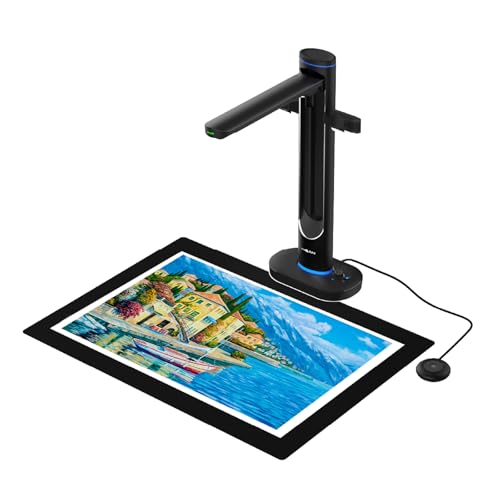
- Scans A2-size materials without pressing bindings.
- Dual 48MP cameras deliver detailed high-resolution output.
- OCR and text-to-speech add accessibility and searchability.
Best For: Users scanning large or fragile books, maps, and teaching materials.
Large-Format Flatbed Option
Plustek OpticPro A320E Large-Format Flatbed
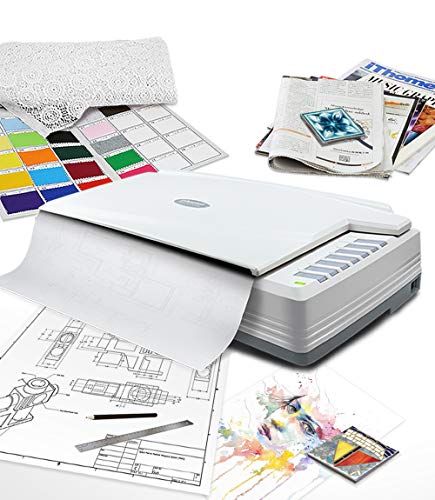
- 12" x 17" flatbed handles A3 and oversized books.
- OCR and batch scanning support searchable files.
- Compatible with Windows, Mac, and Linux via drivers.
Best For: Home users needing a large flatbed for oversized books and documents.
Compact Everyday Flatbed

- 4800 x 4800 dpi for detailed scans
- As fast as 8-second scan times
- USB Type-C power and data in one cable
Best For: Light home library scanning of books, photos, and documents
Dedicated Book Scanner

- 38MP sensor with 7168 × 5376 resolution
- Curve-flatten technology for bound books
- OCR for searchable and editable files
Best For: Digitizing bound books quickly with cleaner page correction
Portable Flatbed Option

- 4800 dpi optical resolution
- High-rise, removable lid for books
- USB powered and easy to carry
Best For: Portable home scanning of books, albums, and documents
Premium A3 Book Digitizer

- Auto-flatten and deskew support for curved pages.
- 18MP camera with A3 capture and fast page turnaround.
- OCR converts scans to searchable PDF, Word, Excel, and TIFF.
Best For: Home library users who need quick A3 book digitizing with OCR.
Practical A3 Overhead Scanner

- A3 overhead scanner for books, archives, and large pages.
- 16MP capture with up to 300 DPI output.
- Anti-glare LED lighting helps reduce shadows and reflections.
Best For: Home archiving and library scanning with glare reduction.
Fast OCR Book Scanner

- Auto-flatten and deskew help with curved book pages.
- 16MP camera scans fast, about 1.5 seconds per page.
- OCR supports 180+ languages and multiple export formats.
Best For: Fast home library digitizing with searchable file output.
Compact Overhead Pick – CZUR Aura Pro Portable Book Scanner
If you want flatbed book scanners for home libraries but need something portable, the CZUR Aura Pro is built around fast overhead scanning with page-flattening support. It uses three laser lines to improve accuracy on curved pages, adds side lights to reduce glare on glossy paper, and can auto-detect page turns for easier batch work.
Best For: Home users who want a foldable, space-saving scanner for books, documents, and mixed media.
Pros:
- Auto-flatten and fingerprint removal tech helps clean up curved book pages.
- Fast 2-second-per-page scanning for single sheets and double-page books.
- Includes supplemental side lights and multiple brightness/color modes.
- OCR supports 180+ languages for searchable text.
Cons:
- OCR does not support Thai, Hebrew, or Arabic.
- Smart lamp voice control can be affected by noise and distance.
- Works best within its supported macOS and Windows versions.
This is a practical pick if you want a quick home-library scanner that emphasizes convenience, portability, and automatic page handling over a traditional flatbed design.
Archive-Friendly Book Scanner – Plustek OpticBook 4900
Among flatbed book scanners for home libraries, the Plustek OpticBook 4900 stands out for digitizing books and reference material with organized file handling. It pairs scanning with BookMaker software, OCR-based text search, and simple folder-based workflows that make it easier to archive and look up saved files later.
Best For: Users who want book scanning plus built-in organization and searchable archiving.
Pros:
- Includes BookMaker software for organizing books, notes, magazines, and PDFs.
- OCR supports full-text search by file name, chapter, page content, or notes.
- Simple three-step workflow: create folder, scan/import, then edit/export.
- Supports Windows and Mac systems.
Cons:
- Uses a 1-sheet standard capacity, so it is not meant for large batch feeding.
- Requires compatible Windows or macOS versions.
- Designed more for archiving than for high-speed bulk scanning.
If your priority is turning a home library into a searchable archive, this model focuses less on speed and more on practical document management. That makes it a strong fit for users who value order and retrieval.
High-Resolution Overhead Choice – VIISAN S48 Duo Overhead Book Scanner
For flatbed book scanners for home libraries that need oversized coverage, the VIISAN S48 Duo takes an overhead approach and scans up to A2 size without pressing on bindings or fragile pages. Its dual 48MP cameras and AI image processing are designed to keep pages readable while reducing cleanup work after scanning.
Best For: Libraries, classrooms, and home users scanning large books, maps, or bound materials without damage.
Pros:
- Scans large books and documents up to A2 size without flattening pressure.
- Dual 48MP cameras capture detailed scans up to 600 DPI.
- AI helps flatten curves, remove finger marks, and correct edge distortion.
- OCR and text-to-speech support searchable and accessible files.
Cons:
- Requires a reasonably capable setup, with 16GB RAM recommended.
- Uses USB connection and is not a wireless device.
- More specialized than a basic home scanner if you only digitize occasional pages.
This model makes sense when oversized books or fragile materials matter more than compactness. It is especially appealing if you want high detail and built-in accessibility features in one scanner.
Large-Format Flatbed Option – Plustek OpticPro A320E Large-Format Flatbed
If you specifically want flatbed book scanners for home libraries, the Plustek OpticPro A320E is built for large-format work with a 12″ x 17″ scan area. It can handle A3-sized materials, wide books, maps, and odd-shaped items, while also offering OCR and batch scanning for more efficient file creation.
Best For: Home users who need a true large-format flatbed for books, oversized pages, and mixed originals.
Pros:
- Large 12″ x 17″ scan area suits A3 and oversized materials.
- Flatbed design works well for large bound books and irregular items.
- OCR makes scanned PDFs searchable.
- Supports batch scanning and multiple output destinations through Doc Action.
Cons:
- Heavier and larger than portable book-scanning alternatives.
- Uses a slower flatbed workflow than overhead scanners.
- Mac support is limited to specific OS versions, and Linux setup may require extra coordination.
This is the most traditional scanner in the group, and it fits buyers who care about scan bed size and versatility. For a home library with oversized books or documents, that can be the deciding factor.
Compact Everyday Flatbed – Canon CanoScan LiDE 400
Canon CanoScan LiDE 400 Slim Scanner, 7.7" x 14.5" x 0.4", Document & Photo Scanner, Black
Check Price On AmazonIf you want flatbed book scanners for home libraries that stay simple and space-saving, the Canon CanoScan LiDE 400 is a strong basic pick. It scans quickly, handles books and documents through a flatbed format, and uses a single USB Type-C cable for both data and power.
Best For: Home users who want a slim, affordable flatbed scanner for books, photos, and everyday documents.
Pros:
- 4800 x 4800 dpi resolution for detailed scans of books and photos
- Fast scanning speeds, with scans in as fast as 8 seconds
- USB Type-C connection with one cable for both power and data
- Auto Scan mode and built-in PDF buttons simplify common tasks
Cons:
- Standard sheet capacity is just 1, so it is not built for batch feeding
- Best suited to flat materials rather than thick bound books
Overall, this is a practical flatbed for light home library scanning when you want good detail, quick operation, and a very small footprint. It is less specialized than a dedicated book scanner, but it covers the basics well for shelves of documents, photos, and smaller books.
Dedicated Book Scanner – CZUR ET MAX Professional
For flatbed book scanners for home libraries, the CZUR ET MAX stands out because it is built around books rather than just flat documents. Its laser curve-flatten technology, 38MP sensor, and fast capture speed make it a better fit for bound volumes, especially when you need searchable files.
Best For: Home archivists and heavy readers who want a dedicated book scanner with curve-flattening and OCR.
Pros:
- 38MP sensor with 7168 × 5376 resolution for high-detail captures
- Patented curve-flattening helps reduce distortion in bound books
- OCR support can create editable and searchable files, including PDFs
- Scans a page in about 1.5 seconds with practiced operation
Cons:
- Not recommended for glossy or highly reflective materials
- OCR language support has some limits, including Thai and Hebrew not supported
- May be more scanner than casual home users need
In a home library setup, this is the most purpose-built option here for digitizing bound books efficiently. If your priority is cleaner pages, faster workflows, and searchable output, the ET MAX is the most specialized scanner in this group.
Portable Flatbed Option – Epson Perfection V19 II
If you’re comparing flatbed book scanners for home libraries, the Epson Perfection V19 II is a compact choice that balances portability with book-friendly features. Its high-rise, removable lid makes it easier to scan books and photo albums than a basic flatbed, while the included software adds searchable PDF and OCR options.
Best For: Home users who want a lightweight flatbed scanner for books, albums, and mixed household scanning.
Pros:
- 4800 dpi optical resolution for clear scans
- High-rise, removable lid designed to help with books and photo albums
- USB powered and lightweight at 3.1 lb for easy portability
- ScanSmart software supports searchable PDFs and editable Office files
Cons:
- Letter-size scans can take up to 10 seconds
- Single-sheet flatbed design is better for one item at a time
This Epson is a good middle-ground scanner if you want a small, easy-to-store device that still has book-scanning convenience. It is not a dedicated high-volume book scanner, but it offers useful flexibility for home library archiving.
Premium A3 Book Digitizer – CZUR ET18 Pro
If you want flatbed book scanners for home libraries that can handle bound books quickly, the CZUR ET18 Pro is built around overhead capture with auto-flatten and deskew features. It is designed for A3-sized material and uses a 18MP camera, making it a strong fit for digitizing books, notes, and larger documents without warm-up time.
Best For: Home users who want fast A3 book scanning with OCR and Mac/Windows support.
Pros:
- Patented flattening tech helps correct curved book pages.
- 18MP HD camera and 4896 x 3672 resolution for detailed captures.
- OCR supports 180+ languages and exports to PDF, Word, Excel, and TIFF.
- About 2 seconds per page once you get comfortable using it.
Cons:
- Very glare-heavy papers are not recommended.
- USB cable connection only; no Wi-Fi support.
- Arabic OCR support is limited by OS, and Thai/Hebrew are not supported.
For home library digitizing, the ET18 Pro stands out when speed and file conversion matter more than a traditional flatbed layout. Its A3 coverage and OCR workflow make it especially useful for bigger books and mixed document archives.
Practical A3 Overhead Scanner – VIISAN DL16
For flatbed book scanners for home libraries, the VIISAN DL16 is a practical overhead option for bound books, oversized pages, and other large materials. Its 16MP camera, A3 capture, and anti-glare LED lighting are aimed at getting cleaner scans from books and archives while keeping the workflow simple on Windows or Mac.
Best For: Home archiving projects that need A3 overhead scanning with reduced glare.
Pros:
- A3 overhead design handles books, artwork, sheet music, and large documents.
- 16MP camera with up to 300 DPI for clear document capture.
- Anti-glare LED lighting helps reduce shadows and reflections.
- Compatible with both Windows and Mac.
Cons:
- 300 DPI is lower than some higher-resolution rivals.
- No specific scan-speed claims are provided in the notes.
- It is a desktop overhead scanner rather than a traditional flatbed unit.
The DL16 makes sense if you want an organized desktop scanner for home library work without overcomplicating setup. It is especially appealing for people digitizing books and large-format materials where glare control and A3 size matter.
Fast OCR Book Scanner – CZUR ET16 Plus
If you are comparing flatbed book scanners for home libraries, the CZUR ET16 Plus is a fast overhead scanner built for books and document stacks. It combines 16MP capture, A3 support, auto-flatten and deskew, plus OCR output, so it suits users who want to turn shelves of books into searchable files efficiently.
Best For: Home library scanning when speed, OCR, and broad file export support matter.
Pros:
- Patented flattening tech helps correct curved book pages.
- 16MP HD camera with about 1.5 seconds per scan.
- OCR supports 180+ languages and can export searchable PDF, Word, Excel, and TIFF.
- 10 LED lights plus 2 supplemental lights help create shadowless scans.
Cons:
- Very glare-heavy papers are not recommended.
- Arabic OCR support is limited to Windows, and Thai/Hebrew are not supported.
- USB connection only, with no Wi-Fi mentioned.
The ET16 Plus is a strong choice if your home library project involves lots of pages and you want scanning to move quickly. Its OCR and file conversion tools make it especially useful for building a searchable digital archive.
How We Picked the Best Flatbed Book Scanners for Home Libraries
We looked for scanners that make book digitizing practical at home, with emphasis on page handling, scan clarity, software support, OCR accuracy, and workflow speed. For Flatbed Book Scanners for Home Libraries, we also considered whether the design reduces spine stress, glare, and manual correction work.
Quick Comparison
Flatbed models tend to be simpler and more affordable, while overhead and book-focused scanners are usually faster for bound volumes and better at handling thick or delicate books. If you want the most natural workflow for a personal archive, prioritize auto-flattening and deskew features first, then look at resolution and scanning area.
Key Buying Factors for Flatbed Book Scanners for Home Libraries
Scan Area and Book Size
Make sure the platen or capture area fits the books you actually own. A3-size support is useful for larger art books, textbooks, and oversized pages, while smaller flatbeds are better for standard paperbacks and documents.
Image Quality and Resolution
Higher optical resolution helps with small text, illustrations, and archival work, but raw resolution matters less if the scanner software is weak. For most home users, clear text capture and good edge detail are more important than the highest advertised number.
Flattening and Deskew Tools
These features are especially valuable for bound books because they reduce curved text and improve readability. If you plan to scan many books, automatic correction can dramatically cut post-processing time.
OCR and File Output
OCR turns scans into searchable text, which is essential for managing a home library. Check language support if you own multilingual books, and confirm the scanner can export to common formats like PDF and JPEG without extra friction.
Lighting, Lid Design, and Book Safety
Anti-glare lighting and removable or high-rise lids help when scanning thicker books or fragile bindings. A gentler setup is usually better for older collections, even if it takes slightly longer per scan.
Who Should Buy Which Flatbed Book Scanners for Home Libraries?
If you want a straightforward, budget-friendly setup, a compact flatbed is often enough for occasional chapters, articles, and single-page digitizing. If your priority is archiving lots of bound books, choose a model with larger format support, auto-flattening, and strong OCR. For mixed home-library use, the best compromise is usually a scanner that can handle both documents and books without a complicated workflow.
In short, the best Flatbed Book Scanners for Home Libraries are the ones that fit your shelf space, your book sizes, and your tolerance for manual editing. Start with the workflow you want, then buy the scanner that removes the most friction from it.