The best car amplifier systems for audiophiles deliver clean, controlled power without overwhelming the rest of the vehicle’s audio system. The right choice depends on speaker load, channel requirements, installation space, and whether you want built-in signal processing.
Our 2026 roundup includes compact Class D designs, flexible four- and five-channel amplifiers, dedicated mono options, and DSP-equipped systems for more advanced tuning.
Best 10 Car Amplifier Systems for Audiophiles Picks for 2026
Best Hi-Res 5-Channel Value

- Hi-Res certified to 40 kHz
- Five-channel, single-chassis design
- Selectable remote turn-on circuit
Best For: Complete systems needing four speaker channels plus a subwoofer channel
Best Budget Subwoofer Power

- Single-channel Class A/B monoblock
- Up to 1,100 watts maximum at 2 ohms
- Remote bass control included
Best For: Dedicated subwoofer amplification with flexible input options
Best High-Power Hi-Res System Amp

- Five-channel Class D design
- Hi-Res support up to 50 kHz
- 40–240 Hz variable low-pass filter
Best For: High-power full-system installations with adjustable subwoofer integration
Flexible Five-Channel Power
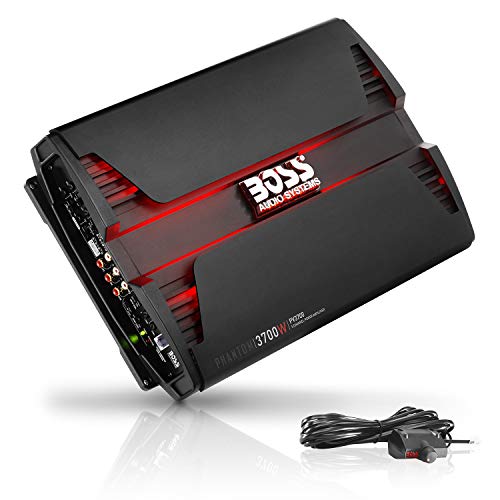
- Five-channel design for speakers and subwoofers
- Full-range operation with variable bass boost
- Includes remote subwoofer control and three-year warranty
Best For: One-amplifier speaker and subwoofer systems
Clean Two-Channel Drive

- Class AB two-channel amplifier
- 480 watts RMS in bridged mode
- Low-pass filter and adjustable bass boost
Best For: Stereo speakers or one bridged subwoofer
DSP-Controlled Multi-Channel Audio

- Eight-channel Class D DSP amplifier
- Compact chassis with LED display
- Designed for advanced sound processing
Best For: Complex systems needing multiple channels and integrated DSP
High-Output OEM-Friendly Pick

- 4 x 300W RMS at 2 ohms
- High-level OEM stereo inputs
- HPF, LPF, and Full modes
Best For: High-output factory-radio upgrades and custom multi-channel systems
Compact Hi-Fi Choice

- Micro Class D form factor
- RCA and high-level inputs
- Adjustable 50Hz–250Hz crossover
Best For: Compact DIY upgrades and low-noise full-range or bridged setups
Warm-Sounding Tuning Pick

- Class A/B four-channel design
- Variable crossover and gain
- Up to 200W x 2 bridged
Best For: Custom speaker builds requiring hands-on tuning flexibility
Best Hi-Res 5-Channel Value – Alpine S2-A55V
For car amplifier systems for audiophiles, the Alpine S2-A55V is a practical single-chassis solution for powering a complete sound system. Its Class D design is Hi-Res Audio certified, with response up to 40 kHz and rated output of 40 watts x 4 plus 200 watts x 1 at 4 ohms.
Best For: Audiophiles who want one compact amplifier for four speakers and a subwoofer.
Pros:
- Hi-Res Audio certified with frequency response up to 40 kHz
- Five-channel design powers a full system from one chassis
- Selectable remote turn-on circuit helps support reliable system operation
Cons:
- One-year manufacturer warranty is shorter than some competing coverage
- Power output may not suit systems requiring very high speaker or subwoofer output
The S2-A55V emphasizes clean, high-resolution playback and installation convenience. Its five-channel layout makes it a strong choice when simplifying a multi-amplifier setup is a priority.
Best Budget Subwoofer Power – BOSS R1100M
Among car amplifier systems for audiophiles, the BOSS R1100M is a focused option for adding dedicated subwoofer power. This single-channel Class A/B monoblock is rated at 550 watts maximum at 4 ohms and 1,100 watts maximum at 2 ohms, with a low-pass filter and remote subwoofer control.
Best For: Buyers seeking a compact monoblock amplifier with adjustable bass controls.
Pros:
- Monoblock design is dedicated to subwoofer amplification
- Includes low-pass filter, bass boost, and remote subwoofer control
- Accepts both RCA and speaker-level inputs
- Includes thermal, short, and overload protection circuits
Cons:
- Class A/B design may be less compact or efficient than a Class D alternative
- Maximum rated output is specified rather than RMS output
- Six-year warranty applies only when purchased from Amazon.com under the stated conditions
The R1100M makes the most sense when your system needs a dedicated bass amplifier rather than full-range channel expansion. Check installation requirements carefully, and use professional installation as recommended by the manufacturer.
Best Basic Four-Channel Upgrade – BLAUPUNKT AMP1604
The BLAUPUNKT AMP1604 offers a straightforward four-channel approach to car amplifier systems for audiophiles who want more power for the vehicle’s speakers. It is rated at 55 watts RMS x 4 at 4 ohms and 79 watts RMS x 4 at 2 ohms, with a design intended to fit in a trunk.
Best For: Drivers upgrading four full-range speakers with a simple, trunk-mounted amplifier.
Pros:
- Four channels support a front-and-rear speaker setup
- Provides stated RMS output at both 4- and 2-ohm loads
- Aluminum-alloy construction and compact trunk-friendly dimensions
Cons:
- 90-day warranty is relatively limited
- Does not provide a dedicated subwoofer channel
- Listed 1,600-watt maximum output is much higher than its stated RMS rating
This amplifier is best evaluated by its RMS figures rather than its headline maximum rating. It can be a practical choice for powering four speakers, but buyers building a full-range-plus-subwoofer system will need additional amplification.
Best High-Power Hi-Res System Amp – Pioneer GM-DX975
For car amplifier systems for audiophiles that need broad system coverage and substantial headroom, the Pioneer GM-DX975 combines five channels with a Class D design. It offers up to 2,000 watts maximum output, Hi-Res playback support up to 50,000 Hz, gold-plated RCA connections, and a variable 40–240 Hz low-pass filter.
Best For: Full-system builds that need four speaker channels, a subwoofer channel, and flexible bass tuning.
Pros:
- Five-channel layout supports a complete vehicle audio system
- Hi-Res playback support extends to 50,000 Hz
- Variable low-pass filter adjusts from 40 Hz to 240 Hz
- Protection control monitors voltage, current, and temperature
Cons:
- Maximum output figures do not specify RMS power in the supplied details
- One-year warranty is limited compared with some alternatives
- Higher-power installation may require careful system planning
The GM-DX975 is a versatile all-in-one platform for listeners who want high-resolution support and more control over subwoofer integration. Its compact Class D format and protection monitoring add practical advantages for vehicle installations.
Flexible Five-Channel Power – BOSS Audio Systems PV3700
For shoppers comparing car amplifier systems for audiophiles, the BOSS PV3700 offers a flexible five-channel layout for powering speakers and subwoofers from one amplifier. Its full-range design, variable bass boost, and broad frequency response make it a practical choice for building a versatile in-car system.
Best For: Drivers who want one five-channel amplifier for speakers and subwoofers.
Pros:
- Five channels support a mixed speaker-and-subwoofer setup.
- Full-range operation can power both speakers and subwoofers.
- Variable bass boost provides adjustable subwoofer emphasis.
- Includes a remote subwoofer control and a three-year parts-and-labor warranty.
Cons:
- The 17-inch chassis may require careful installation planning.
- At 12.5 pounds, it is heavier than the compact two-channel option in this roundup.
Choose the PV3700 when system flexibility matters more than minimizing amplifier size. Its five-channel architecture and included remote control simplify control over a multi-speaker setup.
Clean Two-Channel Drive – Pioneer GM-A5702
The Pioneer GM-A5702 is a straightforward option for car amplifier systems for audiophiles who need focused two-channel power. Its Class AB design, bridgeable output, variable low-pass filter, and adjustable bass boost suit either stereo speakers or a bridged subwoofer application.
Best For: Listeners seeking a compact two-channel amplifier for speakers or one bridged subwoofer.
Pros:
- Class AB design balances power and efficiency.
- Provides 240 watts RMS per channel at 2 ohms or 480 watts RMS bridged.
- Variable low-pass filtering helps focus bass for subwoofer use.
- Adjustable bass boost allows low-frequency tuning.
Cons:
- Two channels offer less system expansion than five- or eight-channel designs.
- The supplied warranty is one year.
The GM-A5702 makes sense for a simpler build where dependable two-channel amplification is the priority. Its bridgeable design also gives you the option to redirect power toward a single subwoofer.
DSP-Controlled Multi-Channel Audio – BLAUPUNKT BPA-HX80DSP
For advanced car amplifier systems for audiophiles, the BLAUPUNKT BPA-HX80DSP combines eight channels with Class D amplification and built-in DSP sound processing. Its compact chassis, intuitive controls, LED display, and claimed 120-watt output make it suited to installations that need multiple channels and processing in one unit.
Best For: Multi-channel installations that benefit from integrated DSP and a compact Class D design.
Pros:
- Eight-channel architecture supports complex car audio systems.
- Integrated DSP provides advanced sound-processing capability.
- Compact 12.24-by-5.71-by-2.01-inch design helps with installation flexibility.
- Includes intuitive controls and a clear LED display.
Cons:
- The supplied notes do not specify RMS output ratings or detailed DSP adjustment options.
- Its eight-channel feature set may be more than needed for a basic system.
The BPA-HX80DSP is the most feature-oriented choice here for builders who want channel count and processing in a compact package. Confirm the amplifier’s detailed output specifications and compatibility with your planned installation before buying.
High-Output OEM-Friendly Pick – Taramps TS 1200×4
For car amplifier systems for audiophiles that need substantial multi-channel power, the Taramps TS 1200×4 combines four-channel flexibility with high-level inputs for factory-radio integration. Its Class D design and built-in crossover modes make it suitable for speakers, subwoofers, tweeters, and component systems.
Best For: High-output custom systems and factory-radio upgrades in cars, trucks, and SUVs.
Pros:
- Delivers 4 x 300W RMS at 2 ohms or 2 x 600W bridged at 4 ohms.
- High-level inputs and automatic turn-on support OEM stereo installations without adapters.
- HPF, LPF, and Full modes allow practical system tuning.
- Reinforced terminals and bridgeable channels support demanding builds.
Cons:
- Professional installation is recommended.
- Its high power may be more than a modest factory-speaker upgrade requires.
The TS 1200×4 is a strong choice when power and installation flexibility matter most. Verify speaker impedance, available space, and wiring requirements before purchase.
Compact Hi-Fi Choice – Fosi Audio CA30
The Fosi Audio CA30 is designed for car amplifier systems for audiophiles who prioritize low noise, compact installation, and flexible channel use. It supports full-range operation, bridge mode for subwoofers, RCA or high-level input, and adjustable HPF/LPF crossover control.
Best For: Space-constrained 12V vehicles, DIY installations, and listeners seeking measured low-noise performance.
Pros:
- Compact 186 x 101 x 44.2 mm design fits under seats or in trunks.
- Supports 200W x 4 and 400W x 2 bridged at 4 ohms, according to the supplied specifications.
- Claims THD+N of ≤0.006%, 104dB SNR, and a noise floor of ≤140μV.
- RCA and high-level inputs, adjustable 50Hz–250Hz HPF/LPF, and full-pass mode provide setup flexibility.
Cons:
- The listed power figures vary by impedance and operating mode, so system matching is important.
- It is intended for 12V DC vehicles rather than non-automotive applications.
With its micro footprint and extensive integration options, the CA30 is particularly appealing where installation space is limited. Confirm the vehicle’s electrical system and speaker impedance before wiring.
Warm-Sounding Tuning Pick – DS18 SXE-1200.4/RD
For car amplifier systems for audiophiles who want hands-on tuning and a traditional amplifier design, the DS18 SXE-1200.4/RD uses a Class A/B topology with variable crossover and adjustable gain. Its four channels can drive speakers directly or be bridged for additional output.
Best For: Custom speaker systems where adjustable gain, crossover control, and flexible channel configuration are priorities.
Pros:
- Provides 60W x 4 at 4 ohms, 100W x 4 at 2 ohms, or 200W x 2 bridged at 4 ohms.
- Variable crossover and gain input sensitivity support personalized system tuning.
- Four-channel configuration suits a range of custom vehicle builds.
- Aluminum construction and a compact design support surface mounting in custom installations.
Cons:
- Class A/B operation may be less power-efficient than a comparable Class D amplifier.
- The supplied specifications list a maximum output figure, so continuous power should be matched using the channel ratings.
The SXE-1200.4/RD makes sense for buyers who prefer adjustable analog-style system control and straightforward four-channel flexibility. Match its rated output to the speakers and allow suitable mounting space.
How We Picked the Best Car Amplifier Systems for Audiophiles
We compared these amplifiers by their channel configuration, stated power ratings, impedance compatibility, amplifier topology, input flexibility, and practical installation requirements. We also considered whether each model is better suited to powering full-range speakers, a subwoofer, or an entire system. Because published “maximum” and “peak” figures are not directly comparable with RMS output, buyers should treat headline wattage as only one part of the evaluation.
Models from this selection cover Class D, Class A/B, monoblock, five-channel, and DSP-equipped designs. That variety makes it easier to match an amplifier to an existing factory system or a purpose-built audiophile installation.
Quick Comparison
- Best premium five-channel approach: Alpine S2-A55V, with Hi-Res certification and balanced multi-channel/subwoofer power.
- Best advanced tuning option: BLAUPUNKT BPA-HX80DSP, which combines multiple channels with DSP functionality.
- Best compact installation: Fosi Audio CA30, designed for space-constrained systems.
- Best dedicated subwoofer choice: BOSS Audio Systems R1100M, a monoblock amplifier intended for bass duty.
- Best traditional full-range design: Pioneer GM-A5702 or DS18 SXE-1200.4/RD, depending on channel needs.
Key Buying Factors for Car Amplifier Systems for Audiophiles
RMS Power and Speaker Impedance
Match the amplifier’s RMS output at the speaker’s impedance rather than relying on maximum wattage. An amplifier should provide appropriate power for the speakers without forcing them beyond their thermal or mechanical limits. Check whether the system is stable at 4 or 2 ohms before wiring multiple speakers together.
Channel Count and System Layout
A two-channel amplifier can power a front stage or run bridged to a subwoofer. Four-channel models suit front and rear speakers, while five-channel units can run four speakers plus one subwoofer from a single chassis. A monoblock is generally the simplest choice when bass is the main upgrade.
Class, Size, and Installation
Class D amplifiers are often efficient and compact, making them practical for modern vehicles with limited space. Class A/B models can be attractive for conventional full-range applications but may require more ventilation. Confirm chassis dimensions, cable routing, fuse requirements, and available battery or alternator capacity before buying.
Inputs, Crossovers, and DSP
RCA and high-level inputs affect compatibility with aftermarket or factory head units. Adjustable filters help separate bass from midrange and treble, while DSP adds more precise control over equalization, time alignment, and system tuning. If the source signal is factory-integrated, high-level compatibility may simplify installation.
Who Should Buy Which Car Amplifier Systems for Audiophiles?
Choose a five-channel amplifier if you want one chassis for a complete speaker-and-subwoofer system. Pick a four-channel model for upgrading multiple speakers, or select a two-channel unit when you only need a front-stage amplifier or bridged subwoofer channel. Buyers focused primarily on bass should consider a monoblock, while listeners pursuing detailed system correction should prioritize a DSP-equipped design. For small vehicles, compact Class D models can provide a cleaner installation, provided their real-world output matches the speakers and subwoofer being used.