A reliable hygrometer can help you spot rising basement humidity before condensation, musty odors, or mold become serious problems. The best models pair readable displays with useful temperature data and dependable humidity readings.
We compared 10 digital hygrometers for basements, including compact single sensors, multipacks, touchscreen designs, and Bluetooth-connected options, to help you choose the right monitoring setup.
Best 10 Digital Hygrometers for Basements Picks for 2026
Best Value

- Dry/comfort/wet humidity indicator
- ±2–3% RH and ±1°F accuracy
- Magnetic or tabletop placement
Best For: Simple, affordable basement humidity checks
Best Smart Monitoring
Govee H5075 Bluetooth Hygrometer
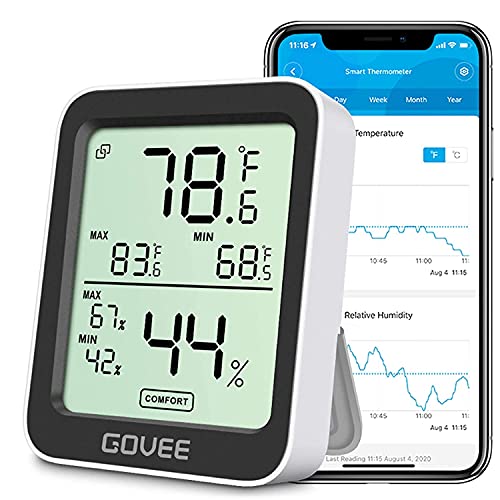
- App alerts for preset conditions
- 20-day graphs and two years of exportable data
- Large 3-inch LCD display
Best For: Remote basement alerts and humidity history
Best Large Display
TempPro TP55 Touchscreen Hygrometer

- Large 4-inch LCD with bold digits
- ±2% RH and ±1°F accuracy
- Tabletop, wall, or magnetic placement
Best For: Readable no-app monitoring in basement rooms
Best Multi-Location Set
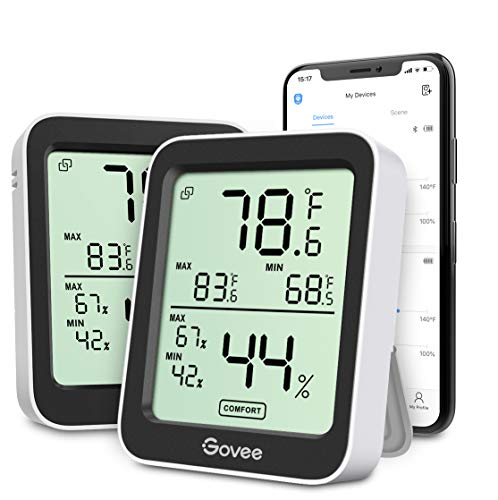
- Two monitors for separate areas
- Bluetooth alerts within 164 feet
- Two years of CSV data export
Best For: Comparing humidity across two indoor locations
Most Precise Pick
SMARTRO SC42 Professional Digital Hygrometer
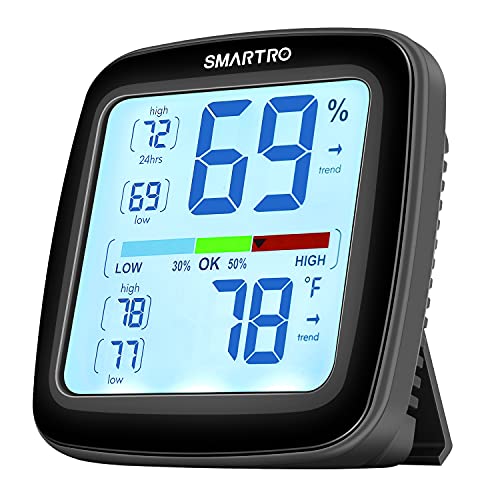
- ±2%RH humidity and ±0.5°F temperature accuracy
- 24-hour and all-time high/low records
- Backlit display with wall, magnetic, and tabletop placement
Best For: Detailed basement monitoring and calibration flexibility
Best Multi-Location Value
TempPro TP49 3-Pack Hygrometers

- Three compact monitors for multiple rooms
- 10-second refresh rate with comfort icons
- Tabletop, magnetic, or hanging placement
Best For: Tracking basement and adjacent areas simultaneously
Best Budget 2-Pack
Antonki Room Thermometers 2-Pack

- Two monitors with included CR2032 batteries
- Large LCD digits and flexible placement
- 10%–99% humidity and -58°F to 158°F temperature ranges
Best For: Simple, low-cost monitoring in two locations
Best Compact Comfort Monitor

- Comfort icons show dry, comfortable, or wet air
- ±1°F/°C temperature accuracy and ±2% to 3% RH accuracy
- Tabletop, magnetic, and hanging placement options
Best For: Small basements and flexible placement
Best Fast-Refresh Value

- Updates temperature and humidity every five seconds
- 2.3-inch LCD with large, readable numbers
- Hanging, tabletop, and magnetic mounting
Best For: Fast basement checks and flexible installation
Best Trend-Tracking Display

- Includes a one-hour humidity trend indicator
- Five-second refresh rate with automatic calibration
- Pre-installed AAA battery for ready-to-use setup
Best For: Tabletop basement monitoring with trend information
Best Value – TempPro TP50 Hygrometer
For shoppers comparing digital hygrometers for basements, the TempPro TP50 is a straightforward option for checking temperature and humidity at a glance. Its dry/comfort/wet indicator, high/low records, and quick updates make it useful for routine indoor monitoring.
Best For: Simple, affordable basement humidity checks with flexible placement.
Pros:
- Displays humidity comfort levels with dry, comfort, and wet icons.
- Provides temperature accuracy of ±1°F and humidity accuracy of ±2–3% RH.
- Updates readings every 10 seconds and stores high/low records.
- Works on a tabletop or magnetic surface, with a °F/°C selector.
Cons:
- Indoor use only.
- Its display is more compact than the larger-screen alternatives.
The TP50 suits homeowners who want essential readings without app connectivity. The magnetic back can be particularly convenient near a basement refrigerator or other metal surface.
Best Smart Monitoring – Govee H5075 Bluetooth Hygrometer
The Govee H5075 adds Bluetooth monitoring to the essentials expected from digital hygrometers for basements. It combines a large LCD display with app alerts, historical graphs, and exportable data for tracking conditions even when you are away from the room.
Best For: Homeowners who want remote basement alerts and humidity history.
Pros:
- Provides alerts when temperature or humidity leaves a preset range.
- Stores 20-day curve graphs and allows data export from the past two years.
- Offers temperature accuracy up to ±0.54°F and humidity accuracy of ±3% RH.
- Uses a bright 3-inch LCD with large numbers and comfort indicators.
Cons:
- Bluetooth monitoring is limited to a stated 164-foot connection range.
- Requires the Govee app for smart monitoring features.
Choose this model if basement conditions need ongoing observation rather than occasional checks. Its combination of local readings and app-based alerts is useful for spotting changes over time.
Best Large Display – TempPro TP55 Touchscreen Hygrometer
For basement users who prefer easy-to-read information, the TempPro TP55 pairs a large 4-inch display with responsive readings and front-touch controls. It tracks temperature, humidity, and maximum/minimum records while offering several placement options.
Best For: Readable, no-app monitoring from across a basement room.
Pros:
- Large 4-inch LCD uses bold digits for quick viewing.
- Offers ±1°F temperature and ±2% RH humidity accuracy.
- Refreshes readings every 10 seconds and includes comfort icons.
- Supports tabletop, wall-mounted, or magnetic placement.
Cons:
- Does not include app-based remote alerts or data export.
- Designed for indoor use rather than outdoor monitoring.
The TP55 is a practical choice when visibility and placement flexibility matter most. Its touchscreen controls and included batteries make it ready for straightforward basement monitoring.
Best Multi-Location Set – Govee H5075 Two-Pack
The two-pack Govee H5075 is a useful approach to digital hygrometers for basements when you want to compare conditions in separate areas. Each unit provides local readings, while Bluetooth app alerts and stored data help you follow changes across the monitored spaces.
Best For: Monitoring two basement zones or a basement plus another indoor area.
Pros:
- Includes two hygrometer thermometers for monitoring multiple locations.
- Provides app notifications within a stated 164-foot Bluetooth range.
- Uses Swiss-made sensors with ±3% RH and up to ±0.54°F accuracy.
- Offers large LCD numbers, comfort indicators, and two years of CSV data export.
Cons:
- Smart features depend on Bluetooth range and the Govee app.
- Historical online storage is described as 20 days, despite longer export availability.
This set makes sense when one sensor cannot show the full picture. Placing the units in different basement areas can help identify uneven humidity conditions and support more informed adjustments.
Most Precise Pick – SMARTRO SC42 Professional Digital Hygrometer
For shoppers comparing digital hygrometers for basements, the SMARTRO SC42 stands out for its stated sensor accuracy and calibration support. It refreshes readings every 10 seconds, shows 24-hour and all-time highs and lows, and offers several mounting options.
Best For: Basement owners who want detailed readings, broad humidity coverage, and manual calibration.
Pros:
- Swiss sensors provide humidity accuracy of ±2%RH and temperature accuracy of ±0.5°F.
- Large 3.5-inch backlit display is easier to read in weak light.
- Tracks 24-hour and all-time maximum and minimum readings.
- Can sit on a table, attach magnetically, or mount on a wall.
Cons:
- AAA batteries are required but not included.
- Backlight turns on temporarily rather than remaining on.
- Does not connect to phones.
The SC42 is a strong choice when basement humidity monitoring calls for more precision and historical context than a basic display. Its calibration feature adds flexibility if placement affects readings.
Best Multi-Location Value – TempPro TP49 3-Pack Hygrometers
The TempPro TP49 3-pack is a practical option for anyone needing digital hygrometers for basements and nearby rooms. Each compact unit refreshes every 10 seconds, uses large digits, and provides a simple face icon indicating dry, comfortable, or wet conditions.
Best For: Monitoring a basement plus other areas such as a living room, cellar, greenhouse, or office.
Pros:
- Three units make it easy to compare conditions in multiple locations.
- Humidity accuracy is rated at ±2% to 3%RH, with temperature accuracy of ±1°F/°C.
- Comfort icons quickly indicate dry, comfortable, or wet air.
- Tabletop, magnetic, and hanging placement options add flexibility.
Cons:
- AAA batteries are required.
- It does not provide the higher stated temperature precision of the SMARTRO SC42.
- The compact display may show less information at once than a larger monitor.
Choose the TP49 when coverage matters more than advanced logging. Its three-unit format is useful for checking the basement, stairs, and another problem area at the same time.
Best Budget 2-Pack – Antonki Room Thermometers 2-Pack
The Antonki 2-pack offers a straightforward way to monitor humidity in a basement and another room. Its larger LCD digits are easy to view, while the built-in magnets, kickstands, and hanging holes make placement simple in homes, garages, cellars, and similar spaces.
Best For: Budget-conscious shoppers who want two basic monitors with included batteries.
Pros:
- Two units support monitoring in separate locations.
- Includes CR2032 batteries, so they are ready to use out of the box.
- Temperature range spans -58°F to 158°F, with humidity readings from 10% to 99%.
- Large digits and three placement methods improve everyday usability.
Cons:
- Humidity accuracy is ±5%RH, less precise than the other listed options.
- Temperature accuracy is ±2°F.
- Readings may fluctuate for 3–5 minutes after startup before stabilizing.
The Antonki pair is a sensible basic pick for observing general basement conditions without buying separate units. Consider a more precise model if tight humidity control is especially important.
Best Compact Comfort Monitor – TempPro TempAir Hygrometer
For shoppers comparing digital hygrometers for basements, the TempPro TempAir offers a compact way to monitor temperature and humidity at a glance. Its comfort icons, large digits, and 10-second refresh rate make it easy to spot changing conditions and decide when to use a humidifier or dehumidifier.
Best For: Small basements, cellars, and other spaces where flexible placement and quick comfort-status checks matter.
Pros:
- Face icons identify dry, comfortable, and wet air conditions.
- Temperature accuracy is rated at ±1°F/°C, with humidity accuracy of ±2% to 3% RH.
- Can sit on a tabletop, attach magnetically, or hang on a wall.
- Large, bold digits are easy to read from different angles.
Cons:
- Its compact display may show less information at once than a larger monitor.
- Updates every 10 seconds, rather than providing an instantaneous refresh.
The TempPro is a practical choice when you want straightforward readings and multiple mounting options without taking up much space. Its visual comfort indicator is especially useful for routine basement checks.
Best Fast-Refresh Value – DOQAUS Digital Hygrometer
The DOQAUS is a convenient option for shoppers seeking digital hygrometers for basements with frequent updates and a readable display. It refreshes temperature and humidity readings every five seconds and uses simple face icons to help you recognize dry or damp conditions quickly.
Best For: Basement users who want fast updates, a clear 2.3-inch display, and several installation choices.
Pros:
- Refreshes readings every five seconds.
- Measures temperature to ±1°F and humidity to ±5% RH.
- Offers hanging, tabletop, and magnetic mounting options.
- Switches between Fahrenheit and Celsius with a button.
Cons:
- Humidity accuracy is less precise than the TempPro’s stated specification.
- It is a single compact monitor, so multiple basement areas require additional units.
With its fast refresh rate and versatile mounting, the DOQAUS works well for monitoring a changing basement environment. The large digits and comfort icons keep the information easy to interpret during routine checks.
Best Trend-Tracking Display – Room Thermometer Hygrometer
For monitoring digital hygrometers for basements, this room thermometer combines large digits with wet, OK, and dry icons plus a one-hour humidity trend. Its five-second refresh rate and automatic calibration provide a convenient snapshot of changing basement conditions.
Best For: Homeowners who want a tabletop basement monitor with humidity trends and out-of-box battery readiness.
Pros:
- Shows a one-hour humidity trend alongside wet, OK, and dry indicators.
- Refreshes readings every five seconds.
- Measures temperatures from -58°F to 158°F and humidity from 10% to 99% RH.
- Includes a pre-installed AAA battery and automatic calibration after power-on.
Cons:
- Tabletop mounting is the only listed placement option.
- Temperature accuracy is rated at ±1.8°F, less precise than some competing models.
This model stands out when a simple current reading is not enough and you also want a short-term humidity trend. Its compact tabletop design suits a shelf, workbench, or other stable basement surface.
How We Picked the Best Digital Hygrometers for Basements
We focused on the features that matter most in below-grade rooms: humidity-reading usefulness, temperature monitoring, display readability, placement flexibility, and ease of checking data. We also considered whether each unit suits a single basement room or a wider monitoring setup with multiple locations.
Basements often have changing conditions near floors, exterior walls, laundry areas, sump pumps, and storage spaces. Models that are simple to read and easy to relocate earned preference, while Bluetooth connectivity and multipacks received consideration for buyers who want alerts or broader coverage.
Quick Comparison
| Type | Best For | Why Consider It |
|---|---|---|
| Single basic hygrometer | One-room monitoring | Simple, affordable humidity and temperature checks |
| Bluetooth model | Remote tracking | App-based readings and convenient history |
| Two- or three-pack | Multiple areas | Compare conditions around the basement |
| Touchscreen model | Easy daily use | Intuitive controls and quick visual checks |
Key Buying Factors for Digital Hygrometers for Basements
Humidity Accuracy and Useful Range
Look for a sensor with a clearly stated accuracy range and a display that shows relative humidity in easy-to-read increments. For most homes, the goal is to identify persistent moisture trends rather than chase a single percentage point.
Temperature Readings
Basement temperature affects condensation risk. A built-in thermometer helps you understand whether cool walls, pipes, or floors may cause moisture to collect even when average humidity appears moderate.
Display and Placement
Choose a large, high-contrast screen if the unit will sit across the room or in a dim utility area. Compact designs work well on shelves, while magnetic backs, stands, or wall-mount options make placement easier.
Bluetooth, Alerts, and History
Bluetooth models are useful when you want to check readings without entering the basement or review changes over time. They may be especially helpful for vacation homes, storage rooms, and spaces where humidity changes quickly.
How Many Sensors You Need
One device can provide a general reading, but multiple sensors reveal differences between finished rooms, laundry areas, storage corners, and locations near exterior walls. Multipacks can be more practical than moving one sensor around.
Who Should Buy Which Digital Hygrometers for Basements?
- Choose a basic single unit if you want an inexpensive way to monitor one finished basement or utility room.
- Choose a Bluetooth hygrometer if remote access, app history, or fewer manual checks matters to you.
- Choose a two- or three-pack if your basement has several zones or you want to compare readings near potential moisture sources.
- Choose a touchscreen model if quick, direct operation and a highly visible interface are your priorities.
- Choose the simplest readable model for renters, occasional checks, or anyone who does not need app features.
Whichever model you select, place it away from direct sunlight, vents, heaters, and active dehumidifier airflow. Monitor readings over several days, and investigate persistent high humidity rather than relying on one isolated measurement.