A motorized projection screen can make movie nights feel more polished while keeping the screen neatly hidden when it is not in use. The right model depends on more than diagonal size: screen material, mounting method, viewing environment, and control options all affect the experience.
We selected 10 motorized screens spanning common 16:9 sizes, ceiling- and wall-mounted designs, floor-rising formats, tensioned surfaces, and options suited to indoor or occasional outdoor use.
Best 10 Motorized Projection Screens for Home Theaters Picks for 2026
Best for Large Screens
Elite Screens Spectrum RC1 125-Inch

- 125-inch 16:9 MaxWhite 2 screen
- IR/RF remotes and 12V trigger support
- Not compatible with short-throw projectors
Best For: Large standard-throw home theater setups
Best Flexible Budget Pick
WASJOYE 100-Inch Motorized Screen

- 100-inch 16:9 matte PVC surface
- Quiet RF-controlled motor with inching mode
- Dual-side power interfaces aid installation
Best For: Medium-to-long-throw projector setups
Best for Extra Drop
Elite Screens Spectrum2 120-Inch
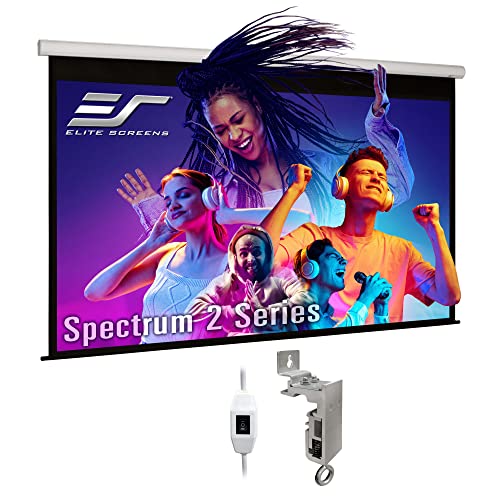
- 120-inch 16:9 screen with 12-inch extra drop
- Supports 4K/8K, HDR, and active 3D
- Remote kit is optional, not included
Best For: Standard-throw theaters needing flexible vertical placement
Best for Ambient Light
SilverMagic 100-Inch ALR Screen

- Gray ALR material targets better contrast
- Tab-tensioned surface supports UST projectors
- Three-year warranty with US-based support
Best For: Rooms with ambient light and UST projector installations
Best Large-Screen Pick
Kayle 120-Inch Motorized Screen

- 120-inch 16:9 widescreen format
- 1.2-gain, black-backed material supports 4K and 3D
- RF remote, wall switch, and wall/ceiling mounting
Best For: Large home theaters and spacious movie rooms
Best Flexible-Mount Value
YODOLLA 100-Inch Motorized Screen

- 100-inch 16:9 matte PVC screen
- Wired and wireless remote controls
- Wall- or ceiling-mount installation with self-locking adjustment
Best For: Multipurpose rooms, gaming, classrooms, and home theaters
Best Floor-Rising Design
NothingProjector 120-Inch Floor-Rising Screen
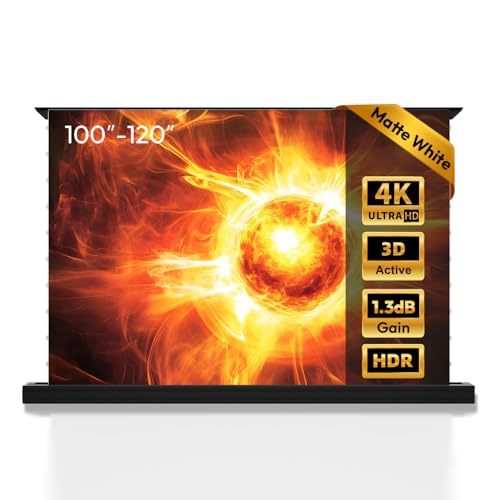
- 1.3-gain black-backed matte PVC surface
- USB projector sync automates raising and lowering
- Compatible with UST, short-throw, and standard projectors
Best For: Floor-mounted home theaters and flexible projector setups
Best Overall 100-Inch Pick
ZUEDA 100-Inch Motorized Projector Screen
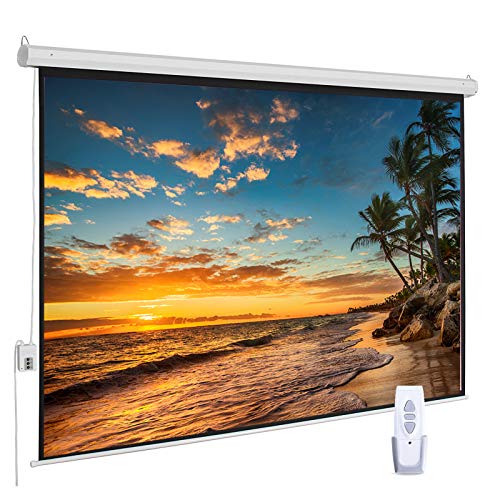
- 100-inch 16:9 viewing area
- RF remote plus inline switch
- Wall or ceiling installation
Best For: Living-room home theaters needing a large, flexible electric screen
Best Compact Option
SiliBamb 94-Inch Electric Projector Screen
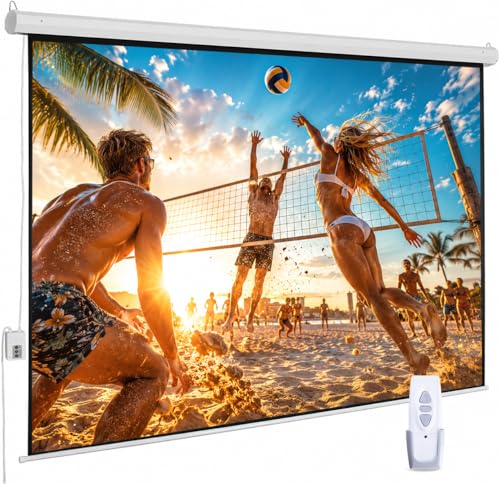
- 94-inch 16:9 display
- RF remote and integrated switch
- Indoor and outdoor use noted
Best For: Smaller theaters, offices, classrooms, and multipurpose rooms
Best for Long-Range Control
VIVOHOME 100-Inch Motorized Screen
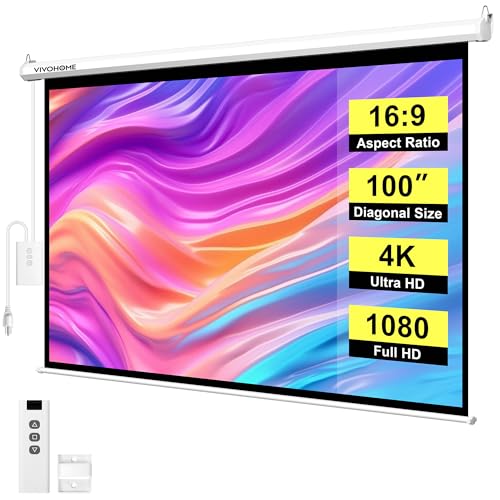
- Remote range listed up to 82 feet
- Supports 4K, 1080P, and 3D content
- Waterproof multilayer PVC fabric
Best For: Large rooms needing convenient long-distance screen control
Best for Large Screens – Elite Screens Spectrum RC1 125-Inch
For viewers who want a particularly large image, this Elite Screens Spectrum RC1 is a strong option among motorized projection screens for home theaters. Its 125-inch, 16:9 MaxWhite 2 surface is designed for standard-throw projection and supports 4K, 8K, and active 3D content.
Best For: Large dedicated home theaters using standard-throw projectors.
Pros:
- Large 125-inch diagonal image with a 180-degree viewing angle.
- Includes both IR and RF remotes, plus a wall box controller.
- Supports wired and wireless 12V triggers and programmable drop positioning.
- Includes wall/ceiling installation hardware and a manufacturer warranty.
Cons:
- Not compatible with short-throw or ultra-short-throw projectors.
- Its large overall dimensions require substantial wall or ceiling space.
This is a practical pick when screen size and flexible control options matter most. Confirm your projector type and available installation area before buying.
Best Flexible Budget Pick – WASJOYE 100-Inch Motorized Screen
The WASJOYE 100-inch model offers straightforward electric operation and installation flexibility for home theaters, offices, and other viewing spaces. Its 16:9 matte PVC surface provides a 178-degree viewing angle, while dual-side power interfaces can simplify wiring.
Best For: Buyers seeking a versatile 100-inch motorized screen for medium-to-long-throw projectors.
Pros:
- 100-inch 16:9 screen with a 1.2 gain, four-layer matte PVC surface.
- Quiet motor rated below 42 dB with RF remote and wall control panel.
- Inching mode allows shorter raising or lowering movements.
- Power connections on both sides support more flexible installation planning.
Cons:
- AAA batteries for the remote are not included.
- Installation requires two people.
- The product notes recommend a medium-to-long focal-length projector.
Its combination of remote control, inching operation, and dual-side power access makes this a convenient general-purpose choice. Plan for two-person installation and verify projector compatibility.
Best for Extra Drop – Elite Screens Spectrum2 120-Inch
For installations that need additional vertical flexibility, the Elite Screens Spectrum2 combines a 120-inch 16:9 image with a 12-inch extra drop. Its fiberglass-backed MaxWhite FG material is built for standard-throw projectors and supports 4K, 8K, HDR, and active 3D content.
Best For: Home theaters needing extra drop for projector or seating alignment.
Pros:
- 120-inch widescreen image with 12 inches of extra drop.
- 1.1-gain material offers a 180-degree viewing angle and black backing.
- Supports 4K/8K Ultra HD, HDR, and active 3D content.
- Includes floating wall/ceiling brackets and a three-way wall switch.
Cons:
- Remote control kit is optional and sold separately.
- Not compatible with short-throw or ultra-short-throw projectors.
- The 112.3-inch overall width requires ample installation space.
This screen is especially useful when ceiling height or projector placement calls for more vertical adjustment. Its included wall switch keeps operation simple, but remote control requires an additional kit.
Best for Ambient Light – SilverMagic 100-Inch ALR Screen
The SilverMagic 100-inch screen is designed for rooms where ambient light can reduce perceived contrast. Its gray ALR material uses a tab-tensioned design to keep the surface flat and is specified for standard, short-throw, and ultra-short-throw projectors.
Best For: Living rooms, patios, offices, and home theaters with some ambient light.
Pros:
- Gray ALR surface is intended to improve contrast and black levels in ambient light.
- Tab-tensioned construction helps maintain a flat viewing surface, including with UST projectors.
- White aluminum case offers a modern appearance.
- Includes a three-year warranty and US-based support.
Cons:
- Its 160-degree viewing angle is narrower than some competing screens in this roundup.
- The product details list operation mode as manual despite the motorized product title.
- The screen is recommended for projectors producing over 1,000 lumens.
This is the most specialized option here for controlling the effects of ambient light and supporting UST placement. Before ordering, clarify the operating controls and ensure your projector meets the stated brightness guidance.
Best Large-Screen Pick – Kayle 120-Inch Motorized Screen
For shoppers comparing motorized projection screens for home theaters, the Kayle stands out with its spacious 120-inch, 16:9 format. Its black-backed, 1.2-gain material supports 4K Ultra HD and active 3D projection, while the included RF remote and wall switch make daily operation convenient.
Best For: Large home theaters, movie rooms, and users who want flexible wall- or ceiling-mount installation.
Pros:
- Large 120-inch widescreen format suits most movie content.
- 180-degree viewing angle and 1.2 gain support broad seating arrangements.
- Quiet, energy-efficient motor includes RF remote and detachable three-way wall switch.
- Arrives assembled with installation hardware and a metal casing.
Cons:
- The larger screen requires substantial wall or ceiling space.
- Its listed dimensions are relatively substantial for smaller rooms.
The Kayle is a practical choice when screen size is the priority. Its retractable design, broad viewing angle, and included controls make it well suited to a dedicated theater or multipurpose viewing space.
Best Flexible-Mount Value – YODOLLA 100-Inch Motorized Screen
The YODOLLA is a versatile option among motorized projection screens for home theaters, with a 100-inch, 16:9 matte PVC surface and both wired and wireless controls. Its relatively lightweight design, self-locking adjustment, and wall- or ceiling-mount options also make it suitable for multipurpose spaces.
Best For: Home theaters, gaming setups, classrooms, offices, and occasional outdoor movie use.
Pros:
- 160-degree viewing angle and 1.2 gain support broad seating positions.
- Three-layer PVC material is designed for 4K, 3D, and 1080p projection.
- Self-locking mechanism lets users set the screen at a preferred length.
- Includes wired and wireless remotes plus wall- and ceiling-mount hardware.
Cons:
- Buyers should carefully check the viewable, frame, and overall dimensions before installation.
- The screen weighs more than the lightweight design description may initially suggest, with details listing 18.7 pounds.
With multiple control methods and flexible mounting, the YODOLLA is a balanced pick for rooms that serve more than one purpose. Confirm the full housing dimensions first, especially when fitting it into a compact installation area.
Best Floor-Rising Design – NothingProjector 120-Inch Floor-Rising Screen
The NothingProjector floor-rising model offers a different approach to motorized projection screens for home theaters by deploying from the floor instead of hanging from a wall or ceiling. Its 1.3-gain black-backed matte white PVC surface is designed for 4K/8K UHD and active 3D content, while USB projector synchronization can automate setup.
Best For: Home theaters that need a floor-mounted screen compatible with standard, short-throw, or ultra-short-throw projectors.
Pros:
- 1.3 peak gain is designed to produce brighter, sharper images.
- Black backing helps block light penetration, while the PVC surface is designed to remain wrinkle-free.
- USB trigger can raise and retract the screen automatically with projector power.
- 170-degree viewing angle and compatibility with multiple projector types support flexible seating and placement.
Cons:
- Floor mounting requires clear space in front of or below the projection area.
- The listed screen dimensions are smaller than the 120-inch diagonal product designation may lead some buyers to expect.
- Its feature set may be more than needed for simple manual or ceiling-mounted setups.
This screen is particularly compelling when wall or ceiling mounting is inconvenient. The quiet motor, position memory, automatic synchronization, and broad projector compatibility give it a more integrated home-theater setup.
Best Overall 100-Inch Pick – ZUEDA 100-Inch Motorized Projector Screen
For shoppers comparing motorized projection screens for home theaters, the ZUEDA 100-inch model combines a large 16:9 viewing area with RF remote operation and flexible wall-or-ceiling installation. Its matte white PVC surface is designed for wide-angle viewing and wrinkle-free presentation.
Best For: Living-room home theaters and buyers who want a full-size screen with both remote and wired control.
Pros:
- 100-inch 16:9 display with an 87-by-48.8-inch viewing area and 9.8-inch upper black drop.
- RF remote and prewired inline switch support convenient electric operation.
- 1.1-gain matte white PVC surface, 160-degree viewing angle, and wrinkle-free construction.
- Steel casing supports wall or ceiling mounting.
Cons:
- The overall product size is approximately 97 by 60 inches, so installation space should be measured carefully.
- Its 6.8-kilogram weight may require secure mounting hardware.
The ZUEDA is a well-rounded choice when screen size, broad seating coverage, and straightforward controls matter most. Verify the casing dimensions and mounting location before ordering.
Best Compact Option – SiliBamb 94-Inch Electric Projector Screen
The SiliBamb 94-inch screen is a practical option among motorized projection screens for home theaters when you want a slightly smaller footprint. It offers 16:9 formatting, RF remote control, and a matte white PVC surface for indoor or occasional outdoor viewing.
Best For: Home offices, smaller theaters, classrooms, and multipurpose spaces that benefit from a 94-inch display.
Pros:
- 94-inch diagonal 16:9 screen with an 81.89-by-46.06-inch viewing area.
- RF remote and integrated switch provide electric drop-and-rise control.
- 1.1-gain matte white PVC material is wrinkle-free and supports a 160-degree viewing angle.
- Metal casing allows wall or ceiling installation.
Cons:
- The viewing area is smaller than the 100-inch models in this roundup.
- Its listed item dimensions and screen dimensions differ, so measure the full casing and mounting area before installation.
Choose the SiliBamb when room proportions or seating distance make a 94-inch screen more suitable than a larger format. Its control options and multipurpose design add flexibility beyond movie nights.
Best for Long-Range Control – VIVOHOME 100-Inch Motorized Screen
VIVOHOME’s 100-inch model stands out among motorized projection screens for home theaters with its claimed 82-foot remote range and flexible mounting approach. The 16:9 matte white screen supports 3D, 1080P, 4K, and Full HD content while its multilayer PVC fabric is designed to resist creasing.
Best For: Larger rooms where long-distance remote control, broad viewing angles, and durable screen construction are priorities.
Pros:
- 100-inch 16:9 display with an 87-by-48.8-inch screen area.
- Pre-paired remote supports control from up to 82 feet and can be wall-mounted.
- 160-degree matte white viewing surface supports 3D, 1080P, 4K, and Full HD images.
- Three-layer waterproof PVC fabric and metal casing are designed for durability.
Cons:
- The 95.7-by-58.9-inch overall size requires sufficient installation clearance.
- The remote’s 23A 12V battery is not included.
- A slight initial odor may be noticeable and requires airing out.
The VIVOHOME is appealing for users who want a large screen without needing to aim a remote nearby. Measure carefully, account for the power-cord placement, and plan for initial ventilation after unpacking.
How We Picked These Motorized Projection Screens for Home Theaters
We focused on practical features that influence setup and viewing rather than relying on screen size alone. The roundup includes several 100- to 120-inch 16:9 screens, plus a 125-inch option and a smaller 94-inch model. We also considered motorized operation, remote-control convenience, mounting flexibility, screen-surface design, advertised HD or 4K/8K compatibility, and whether a product is positioned for indoor, outdoor, or mixed use.
“4K-ready” or “8K-ready” generally describes the screen’s ability to display a detailed projected image; it does not improve a projector’s native resolution. Installation requirements and the projector itself remain important.
Quick Comparison
- Best for a traditional home theater: A wall- or ceiling-mounted 16:9 screen with a clean case and reliable remote operation.
- Best for a larger image: The 120- or 125-inch models, provided your room has enough throw distance and viewing space.
- Best for contrast in brighter rooms: An ambient-light-rejecting, gray, or tab-tensioned screen, carefully matched to the projector and seating angle.
- Best for flexible placement: A floor-rising screen that avoids permanent ceiling or wall mounting.
- Best for occasional outdoor viewing: A portable or easy-to-install screen, with the understanding that wind, moisture, and uneven surfaces can affect performance.
Key Buying Factors
Screen Size and Aspect Ratio
Most selections use a 16:9 format, which suits modern movies, streaming content, and gaming. Measure the available wall width and seating distance before choosing 100, 120, or 125 inches. A larger screen is not automatically better if viewers sit too close or the projector cannot produce a bright, sharp image at that size.
Screen Material and Viewing Conditions
Matte white surfaces are versatile and typically provide broad viewing angles. Gray or ALR materials may help preserve perceived contrast in rooms with some ambient light, but they can have narrower viewing angles and work best when projector placement and seating are planned carefully. Tab tensioning helps keep the surface flatter, which matters for image uniformity.
Installation and Controls
Check whether the case supports wall, ceiling, or both mounting methods, and confirm the required clearance for the drop. Measure outlet access and cable routing before installation. Remote control, RF operation, wired controls, and memory-stop features can make daily use easier; compatibility with your existing automation system should be verified rather than assumed.
Build Quality and Maintenance
Look for a sturdy housing, a smooth motor, a straight lower bar, and a screen that retracts evenly. Keep the material free from dust and avoid folding or sharply creasing it. For outdoor use, retract the screen after viewing and protect the motor and fabric from weather.
Who Should Buy Which Motorized Projection Screens for Home Theaters?
Choose a conventional wall- or ceiling-mounted model if you are building a dedicated media room and want the cleanest permanent installation. Pick a larger 120- or 125-inch screen for immersive viewing when room dimensions and projector brightness support it. An ALR or tensioned model is better suited to buyers who need improved contrast or a particularly flat surface and are willing to plan placement carefully. A floor-rising design fits renters, multipurpose rooms, or setups where drilling is undesirable. Finally, choose a simpler 94- or 100-inch screen for compact rooms, casual movie nights, or buyers who prefer easier installation over maximum image size.