Wireless Microphones review for buyers is mostly about range, delay, battery life, and whether the receiver actually fits the gear you already own.
This Wireless set stands out for its one-to-one chip connection, 200-foot range claim, and long runtime.
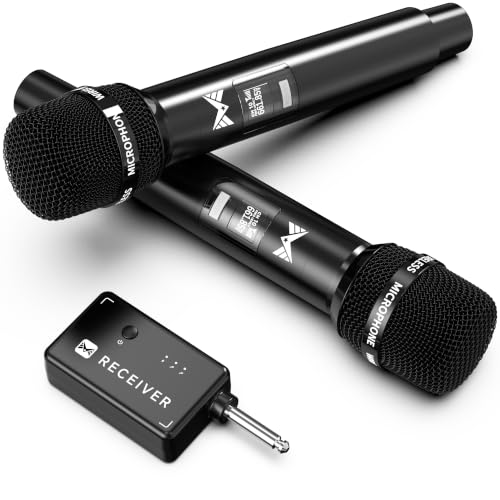
Wireless Microphones Review Summary
If you want a simple wireless mic set for karaoke, speeches, parties, or casual live use, this model is aimed at exactly that job.
The listing emphasizes plug-and-play setup, low-latency transmission, and a receiver designed for standard microphone jacks, which makes it a practical buy for people who want fewer setup headaches and more time actually using the microphone.
Best fit: buyers who want an easy wireless mic solution for home entertainment, small events, and portable performance use.
Less ideal: anyone who needs a professional stage system with advanced mixing, interchangeable capsules, or broad connector support.
Review Scorecard
| Category | Score | Buyer rationale |
|---|---|---|
| Setup simplicity | 9/10 | Plug-and-play operation is a major strength for karaoke machines, powered speakers, and amplifiers. |
| Wireless stability | 8/10 | The one-to-one connection chip is built around stable transmission and lower latency. |
| Range | 8/10 | The listed 200-foot range gives it strong flexibility for rooms, patios, and event spaces. |
| Battery convenience | 9/10 | The 1200mAh battery and claimed 40-hour runtime are useful for long sessions. |
| Sound handling | 7/10 | DSP support, anti-howling, and high-fidelity claims are promising for this category. |
| Compatibility | 6/10 | The AUX jack warning matters; it is designed for 6.35mm and 3.5mm microphone inputs, not every audio input. |
| Overall value for use case | 8/10 | Strong feature set for casual and semi-regular singing or speaking, with clear limits. |
Key Features and Specifications of Wireless Microphones
The core appeal here is straightforward: a wireless microphone set built for fast setup, long use, and less delay.
The listing points to a metal microphone head, DSP-based noise suppression, one-to-one chip connection technology, and a receiver that translates 6.35mm to 3.5mm for compatible microphone jacks.
Key listed details:
| Feature | What the listing says |
|---|---|
| Product type | Wireless microphone set |
| Use cases | Singing, speaker use, party use, karaoke, live performance, speeches |
| Connection | One-to-one chip connection |
| Latency | Low-latency transmission |
| Range | Up to 200 feet |
| Battery | Built-in 1200mAh battery |
| Runtime | Up to 40 hours |
| Mic head | Metal microphone head |
| Sound processing | DSP support, anti-howling, high-fidelity audio |
| Compatibility note | Not compatible with AUX jack; intended for 6.35mm and 3.5mm microphone jacks |
The metal microphone head is a sensible detail because it suggests the product is not trying to win on ultra-light construction alone.
The listing also repeatedly stresses clarity and stability, which tells you the product is tuned for everyday use rather than studio specialization.
The most useful practical note is the compatibility warning.
If your speaker or amplifier only exposes an AUX input, this is not the right model.
If your setup includes a microphone jack, the included adapter path is part of what makes it easier to integrate.
Pros and Cons of Wireless Microphones
Pros
- Easy to use: plug-and-play operation reduces setup friction.
- Good venue flexibility: the listed 200-foot range is useful for rooms and open areas.
- Long battery claim: the 40-hour runtime is attractive for long events or repeated use.
- Lower-delay design: the one-to-one chip connection is positioned to reduce timing lag.
- Better speech and karaoke fit: DSP, anti-howling, and high-fidelity claims line up with common home-entertainment needs.
Cons
- Not universal: the AUX warning is important and may rule out some speakers.
- Not a pro stage system: the listing supports casual and semi-regular use more than advanced production workflows.
- Claims are listing-based: range, runtime, and sound quality should be treated as manufacturer claims unless you verify them in your own setup.
The biggest strength is convenience.
The biggest weakness is that convenience comes with boundaries, especially around input compatibility.
Who Should Buy Wireless Microphones?
This is a good fit for people who want a wireless microphone set for karaoke nights, birthday parties, home speeches, classroom-style presentations, or informal performances.
It also makes sense for buyers who value a simple setup more than they value deep audio controls.
It should also appeal to anyone trying to avoid the usual frustrations of budget wireless audio gear: obvious lag, short battery life, and fiddly pairing.
The one-to-one chip connection and plug-and-play positioning suggest the product is trying to solve exactly those pain points.
You should probably skip it if you need:
- a microphone system for AUX-only speakers or devices,
- a more advanced live sound rig with flexible routing,
- a studio-oriented mic with specialized pickup or recording features,
- or a system where you need guaranteed professional-grade compatibility across many venues.
In short, this is for practical entertainment use, not for a full audio-production toolkit.
Wireless Microphone Performance in Real-World Use
Setup and Compatibility
The setup story is the main reason to consider this model.
The listing says it works with karaoke machines, powered speakers, and amplifiers, and it specifically calls out the receiver connection path.
That is exactly what buyers want in a wireless mic: fewer adapters, fewer delays, and fewer steps before sound comes out.
The compatibility warning changes the picture, though.
If your equipment only offers AUX input, this is not a safe buy.
The listing is clear that the microphone is designed for microphone jacks, so the right decision here depends on checking your actual gear before ordering.
Range and Mobility
The 200-foot range claim makes this set attractive for buyers who want freedom to move while speaking or singing.
That matters for parties, casual events, outdoor use, and situations where you do not want to stay close to the speaker.
For most buyers, the bigger point is not the exact number but the flexibility it implies.
A microphone like this is meant to let the performer move around without feeling tethered.
If your use case involves a living room, backyard, classroom, or meeting room, that is a meaningful benefit.
Battery Life and Session Length
Battery life is one of the product’s strongest reported advantages.
The listing claims a 1200mAh battery and up to 40 hours of continuous use, which is a compelling combination for long events or repeated sessions.
That kind of runtime is especially useful if you do not want to think about charging every time you use the mic.
For buyers who host parties or use a microphone intermittently over several days, fewer charging interruptions can matter more than fancy extras.
Sound Quality and Feedback Control
The listing frames the sound as high-fidelity with anti-howling support and DSP-based noise suppression.
Those are sensible features for a karaoke-style microphone, because the main problems in this category are usually feedback, harshness, and muddy speech.
I would read these claims as a strong indicator of intended use rather than as proof of studio-quality sound.
Still, for a home karaoke setup or a speech-focused wireless mic, those features are the right ones to emphasize.
Alternatives to Wireless Microphones
If you want a different path, consider searching Amazon for these well-known options:
- Shure wireless microphone systems
- FIFINE wireless microphone sets
- JBL wireless microphones
- TONOR wireless microphone systems
Shure is the safer brand name if you care more about reputation and more serious live-use expectations.
FIFINE and TONOR are common Amazon alternatives for buyers looking for value-oriented karaoke and speaking setups.
JBL is worth a look if you want a more consumer-friendly audio ecosystem.
Is Wireless Microphones Worth It?
Yes, if you want a straightforward wireless microphone set for karaoke, speaking, and casual event use, and your gear has a compatible microphone input.
The combination of plug-and-play setup, one-to-one chip connection, long battery claim, and 200-foot range makes this a sensible option for practical buyers.
No, if you need universal input support or a more advanced pro-audio tool.
The AUX warning is the main reason to be careful.
Buy it when convenience and mobility matter more than studio features, and skip it if your setup is input-limited.