When you’re on stage, having the right tools can make all the difference in your performance. Wireless in-ear monitors not only enhance sound quality but also provide the freedom to move around without being tethered. With so many options available, you might wonder which ones stand out for reliability and clarity. Let’s explore the top picks that can elevate your stage experience and help you deliver your best.
LEKATO Wireless in Ear Monitor System MS-02

The LEKATO Wireless In-Ear Monitor System MS-02 is perfect for musicians who need a reliable, high-quality sound solution during live performances or rehearsals. With less than 4.5ms latency and a 24bit/48KHz high sampling rate, you’ll enjoy exceptional sound clarity. Its compact design and clip-on structure make it portable, while the 100-foot wireless range gives you freedom to move. You’ll appreciate the 6-8 hour battery life and the one-key mute function for quick adjustments. Compatible with various devices, this system includes all essential components for easy setup. Rated 4.4 stars, it’s favored by both beginners and seasoned pros.
Best For: Musicians and performers seeking a reliable, high-quality in-ear monitoring system for live performances and rehearsals.
Pros:
- Exceptional sound clarity with less than 4.5ms latency and a 24bit/48KHz sampling rate.
- Compact and portable design with a 100-foot wireless range for freedom of movement.
- Long battery life of 6-8 hours and a convenient one-key mute function for quick adjustments.
Cons:
- Occasional audio crackling reported by some users.
- Battery life could be improved for longer sessions.
- May require additional setup time for beginners unfamiliar with in-ear monitors.
LEKATO Wireless In Ear Monitor System (MS-1)
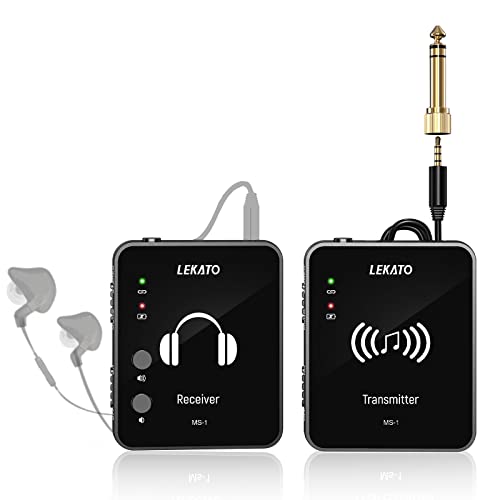
For musicians seeking reliable performance during gigs and practices, the LEKATO Wireless In Ear Monitor System (MS-1) stands out with its impressive low latency of less than 12ms. Operating on a 2.4GHz frequency, it delivers lossless sound quality and supports true stereo audio with a frequency response of 20Hz-20KHz. You can connect one transmitter to multiple receivers, making it ideal for small to medium gigs. The auto-pairing feature simplifies setup, while the built-in rechargeable battery lasts over 5 hours. With a wireless range of up to 90 feet, you’ll enjoy freedom on stage without compromising audio quality.
Best For: Musicians performing in small to medium venues who require reliable, high-quality audio monitoring.
Pros:
- Low latency of less than 12ms, ensuring minimal delay in audio transmission.
- Supports true stereo audio with a wide frequency response of 20Hz-20KHz.
- Auto-pairing feature simplifies setup, allowing for quick connections between devices.
Cons:
- Limited battery life of around 5 hours may require recharging during extended gigs.
- Wireless range of 90 feet may be insufficient in larger venues.
- Only supports up to 6 receivers per transmitter, which may not be enough for larger bands.
Phenyx Pro UHF Wireless In-Ear Monitor System
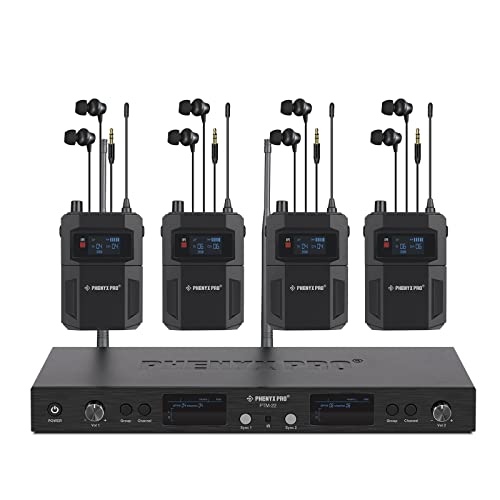
Offering a robust UHF wireless communication technology, the Phenyx Pro UHF Wireless In-Ear Monitor System is perfect for musicians seeking clear audio during live performances. This lightweight system features a frequency range of 902-928MHz and delivers crisp sound with a 16 kHz frequency response. With dual-channel monitoring and a 164 ft operating range, you can enjoy less stage clutter while sharing audio seamlessly among bandmates. Its durable metal design and easy setup make it user-friendly, and the included bodypack receivers guarantee reliability. Rated 4.5 stars, it’s a valuable tool for any performing artist. Upgrade your experience with quality earphones!
Best For: Musicians and live performers seeking a reliable and high-quality wireless in-ear monitoring system for clear audio during performances.
Pros:
- Clear Audio Quality: Delivers crisp sound with minimal interference, ensuring an optimal listening experience.
- User-Friendly Setup: Simple installation and syncing with bodypack receivers, making it easy to use even for beginners.
- Durable Design: Constructed from metal with a lightweight structure, providing durability and ease of transport.
Cons:
- Limited Operating Range: While effective within 164 ft, it may not be sufficient for larger stages or venues.
- Earphones Upgrade Suggested: Users may need to invest in higher-quality earphones for an enhanced audio experience.
- Potential for Interference: As with any wireless system, there is a possibility of encountering interference in crowded frequency environments.
Stereo Wireless In Ear Monitor System M6S

Designed specifically for live performances, the Stereo Wireless In Ear Monitor System M6S stands out with its automatic pairing feature that eliminates the hassle of manual setup. With a frequency range of 20 Hz to 20,000 Hz and a 24-bit/48KHz audio processor, you’ll enjoy clear sound and rich bass. Plus, its adaptive noise cancellation guarantees you stay focused on your performance. The system allows up to six receivers to connect simultaneously, and the built-in rechargeable battery lasts up to 10 hours. Weighing just 5.6 ounces, it’s lightweight and comfortable, making it an excellent choice for any musician on stage.
Best For: The Stereo Wireless In Ear Monitor System M6S is best for musicians and performers who need a reliable and high-quality audio monitoring solution during live events.
Pros:
- Easy setup with automatic pairing, eliminating the need for manual configuration.
- High-quality sound with good bass and low latency, enhancing the live performance experience.
- Lightweight design and comfortable fit, making it suitable for extended use on stage.
Cons:
- Some users report difficulty understanding the instructions provided.
- Minor latency issues have been noted by a few users, though generally considered acceptable.
- Limited to a one-year warranty, which may be short for some customers.
Xvive U4 Wireless in-Ear Monitor System

The Xvive U4 Wireless In-Ear Monitor System stands out as an excellent choice for musicians seeking reliable performance during live shows or rehearsals. Weighing just 0.46 kg, this professional IEM system features a rechargeable lithium-ion battery that lasts up to 5 hours. With latency under 5ms and high-resolution audio quality, you’ll enjoy clear sound and minimal interference. The simple setup makes it easy to plug in, turn on, and connect. Although it’s mono output, the durable construction and affordability make it a solid option for any performer. Don’t forget to take into account a charging station for multiple units!
Best For: Musicians and performers looking for an affordable and reliable in-ear monitoring solution during live performances or rehearsals.
Pros:
- Affordable price point without compromising sound quality.
- Easy to set up and use, making it accessible for all levels of performers.
- Durable metal housing ensures stability and longevity in various environments.
Cons:
- Mono output may limit audio experience compared to stereo options.
- Potential interference issues in the crowded 2.4GHz frequency band.
- Some users have experienced signal dropout at lower volumes.
8 Bodypacks Wireless in Ear Monitor System for Musicians

For musicians seeking reliable performance during live events, the 8 Bodypacks Wireless In-Ear Monitor System stands out as an excellent choice. With a robust range of 338 feet, you’ll enjoy stable, clear sound in any venue. The durable brushed metal design and centralized LCD display make it user-friendly. Each receiver runs on two AA batteries, ensuring you’re always powered up. Its advanced digital signal processing and dual-antenna receiver minimize interference, allowing you to focus on your performance. Plus, with 40 preset frequencies, it adapts easily to various environments, replacing traditional monitoring for an outstanding listening experience.
Best For: Musicians performing live, in studio recordings, or involved in band exhibitions who need reliable and clear audio monitoring.
Pros:
- Durable design with high-quality brushed metal ensures longevity and resistance to wear and tear.
- Advanced signal processing with dual antennas minimizes interference and enhances sound quality.
- Versatile usage with 40 preset frequencies allows easy adaptation to various environments.
Cons:
- Battery-dependent receivers require two AA batteries each, which are not included.
- Limited to MONO sound, which may not suit all musicians’ preferences for stereo monitoring.
- Range may vary depending on environmental factors, potentially affecting performance in larger venues.
Stereo Wireless in-Ear Monitor System with Transmitter and Receiver

Musicians looking for a reliable way to monitor their sound on stage will appreciate the Stereo Wireless In-Ear Monitor System. This 2.4G wireless IEM system offers a 164 ft. receiving distance and supports 10 channels simultaneously, ensuring clear audio without interference. With less than 5 ms latency and a 107 dB signal-to-noise ratio, you’ll enjoy hi-fi 24-bit audio quality. The plug-and-play functionality makes setup effortless, while the rechargeable battery lasts 10-12 hours. Lightweight and portable, it comes with a one-year warranty, making it a smart choice for musicians seeking quality and convenience in their monitoring system.
Best For: Musicians and performers seeking a reliable, high-quality wireless in-ear monitoring solution for live stage performances.
Pros:
- Supports 10 channels simultaneously, allowing multiple users to operate without interference.
- Plug-and-play functionality ensures quick and easy setup, perfect for live performances.
- Lightweight and portable, making it convenient to transport and use compared to traditional monitoring systems.
Cons:
- Limited battery life of 10-12 hours may require frequent recharging during extended events.
- Requires compatible audio outputs, which may not be available on all devices.
- Wireless range may be affected by environmental factors, potentially limiting usability in larger venues.
Wireless in Ear Monitor System 2.4G Stereo IEM System

Offering an impressive effective range of 164 feet, the Wireless In-Ear Monitor System 2.4G Stereo IEM System is perfect for bands and DJs who need reliable audio during live performances. Weighing only 0.14 kg, it’s lightweight and easy to set up. Its rechargeable battery lasts 10-12 hours, guaranteeing you won’t miss a beat. With less than 5 ms audio latency and a signal-to-noise ratio of up to 107 dB, you’ll enjoy crystal-clear sound quality. Plus, the auto-pairing feature simplifies your setup, while the durable design assures it withstands regular use. It’s a budget-friendly choice for any musician.
Best For: Musicians, DJs, and performers seeking a reliable and budget-friendly in-ear monitoring solution for live events.
Pros:
- Easy setup and operation for quick deployment during performances.
- Crystal-clear audio quality with minimal latency for an enhanced listening experience.
- Excellent battery life lasting 10-12 hours, allowing for extended use without interruptions.
Cons:
- Users may need to manually adjust volume levels between the source and receiver.
- Some reports of durability issues with the headphone jack over time.
- Instructions may lack clarity, posing a challenge for beginners in setup.
JOYO Wireless In Ear Monitor System (JW-07)

The JOYO Wireless In Ear Monitor System (JW-07) stands out as an ideal choice for guitarists and DJs seeking seamless audio clarity during performances. With 48kHz/16bit audio quality, you’ll enjoy crisp sound that enhances your practice sessions. The low latency technology guarantees less than 5ms delay, providing real-time feedback for peak performance. Plus, its high anti-interference technology maintains stable signal transmission, allowing you to move freely within a 40-60 feet range without distortion. The built-in battery lasts over 8 hours, making it perfect for long gigs. Automatic pairing makes setup a breeze, so you can focus on your music.
Best For: The JOYO Wireless In Ear Monitor System (JW-07) is best for guitarists and DJs looking for high-quality sound and reliable performance during live shows.
Pros:
- 48kHz/16bit audio quality ensures crisp and clear sound for enhanced practice and performance.
- Low latency technology provides real-time feedback with less than 5ms delay, essential for effective play.
- Wide operating range of 40-60 feet with stable signal transmission allows for freedom of movement on stage.
Cons:
- One transmitter cannot connect to multiple receivers, limiting usage for larger setups.
- May experience interference in crowded wireless environments despite high anti-interference technology.
- Battery life of over 8 hours may not be sufficient for extended or multiple performances without recharging.
D Debra Audio PRO Mono ER-202 UHF Wireless in Ear Monitor System

Designed with versatility in mind, the D Debra Audio PRO Mono ER-202 UHF Wireless In-Ear Monitor System is perfect for performers seeking reliable and high-quality audio during live shows. With a frequency range of 510 MHz – 580 MHz and an impressive audio latency of just 3 milliseconds, you’ll enjoy seamless sound. The system includes a transmitter, four bodypack receivers, and two antennas, ensuring clear communication on stage. Users appreciate its affordability and performance, even if they suggest upgrading the included earbuds. Weighing only 100 grams, this system is a great starter setup for any musician or audio professional.
Best For: Musicians and audio professionals seeking an affordable and reliable wireless in-ear monitoring system for live performances.
Pros:
- High-quality audio with a low latency of just 3 milliseconds ensures seamless sound during performances.
- Lightweight design at only 100 grams makes it easy to wear for extended periods.
- Affordable pricing offers great value for a starter setup compared to more expensive options.
Cons:
- Included earbuds may not meet the quality expectations of some users, prompting recommendations for upgrades.
- Limited range (effective up to 300 meters) may not be sufficient for larger venues or outdoor events.
- User feedback suggests that some features could be improved for professional-grade applications.
Factors to Consider When Choosing Wireless in Ear Monitors for Stage
When choosing wireless in-ear monitors for the stage, you need to evaluate several key factors that can impact your performance. Audio quality, latency, and signal stability are essential for an immersive experience, while range and connectivity options determine how well your setup will function in different venues. Don’t forget about battery life and ease of setup, as these can make or break your live show.
Audio Quality Performance
Choosing the right wireless in-ear monitors can greatly impact your performance, especially regarding audio quality. Look for monitors that offer a frequency response range of 20Hz to 20kHz, guaranteeing you capture the full spectrum of sound. A high signal-to-noise ratio (SNR) is essential; systems achieving up to 107 dB provide clearer audio and minimize background noise. Consider monitors with high-resolution audio processing, like 24-bit/48kHz sampling, for enhanced clarity and detail. Additionally, adaptive noise cancellation technology can help eliminate unwanted ambient sounds, allowing you to focus on your music. By prioritizing these audio quality features, you can guarantee a peak listening experience that elevates your stage presence and performance.
Latency and Signal Stability
Audio quality isn’t the only factor to evaluate; latency and signal stability play an essential role in the performance of wireless in-ear monitors. Latency can make or break your performance, with systems offering as low as 3 milliseconds ensuring real-time audio feedback. This is critical for musicians during live shows. Signal stability is enhanced by advanced technologies like phase-locked loop (PLL) and frequency hopping, reducing interference. Most systems operate on the 2.4GHz frequency band, providing a range of up to 164 feet, but be mindful of potential interference from other devices. A high signal-to-noise ratio, exceeding 107 dB, guarantees clear audio. Systems with dual antennas or advanced processing improve reliability, especially in challenging environments.
Range and Connectivity Options
While selecting wireless in-ear monitors, considering range and connectivity options is essential for ensuring a seamless performance on stage. The wireless range can vary, with some systems reaching up to 300 feet, while others may only cover 164 feet. It’s vital to choose a system that meets your performance space needs. Many in-ear monitors operate on the 2.4GHz frequency band, allowing multiple devices to connect simultaneously, but check for potential interference. Automatic pairing features simplify setup, ensuring a quick connection when powered on. If you’re in a band, opt for systems that support multiple receivers to a single transmitter, accommodating larger groups. Finally, look for low latency rates below 5 ms for real-time audio feedback during performances.
Battery Life and Charging
When it comes to wireless in-ear monitors, battery life and charging are essential aspects that can make or break your performance. Most systems provide between 5 to 12 hours of use after a full charge, so consider how long your rehearsals or shows typically last. Charging times can range from 3 to 8 hours, meaning you’ll want to plan accordingly to guarantee your devices are ready. Look for systems with dual USB charging cables for convenient simultaneous charging of both transmitter and receiver. Some models even feature battery life indicators, giving you real-time feedback on power levels to avoid any unexpected shutdowns. Opting for rechargeable lithium-ion batteries can also save you money in the long run compared to disposables.
Ease of Setup
Setting up your wireless in-ear monitors shouldn’t feel like a challenging task, and choosing the right system can make all the difference. Look for systems with automatic pairing capabilities—this feature lets the transmitter and receiver connect seamlessly without manual adjustments. Plug-and-play functionality is essential too, allowing for quick connections to mixers or audio sources without complex configurations. User-friendly controls, like one-key buttons for switching between mono and stereo modes, enhance your operation during live performances. Clear LED indicators for battery levels and connection status help you quickly assess your setup before hitting the stage. Finally, opt for models with simple setup instructions or intuitive designs to guarantee a hassle-free experience, especially if you’re not tech-savvy.
Compatibility With Equipment
Choosing the right wireless in-ear monitors goes beyond just ease of setup; compatibility with your existing equipment is vital for a smooth performance. Confirm the monitor system works with your audio sources—mixers, instruments, laptops, or smartphones—for seamless integration. Check if it supports various input types, like mono balanced XLR or unbalanced TS, to match your gear. The frequency range is important too; it should align with your audio devices to prevent interference and guarantee clear sound. Opt for systems that allow multiple receivers to connect to one transmitter, giving flexibility for band members sharing audio feeds. Finally, verify the battery life and charging options, as they need to meet your performance schedule for extended use.