The best home security systems for remote monitoring make it easier to check your home, receive instant alerts, and respond to activity while you are away. This roundup compares 10 wireless kits with different combinations of sensors, sirens, cameras, cellular connectivity, and professional monitoring.
Whether you want a simple no-subscription alarm or a more established system with optional 24/7 monitoring, use the guide below to match features, coverage, setup requirements, and ongoing costs to your home.
Best 10 Home Security Systems for Remote Monitoring Picks for 2026
Flexible Ring Protection

- Core kit for 1- to 2-bedroom homes
- App notifications and expandable sensors
- Optional professional monitoring and Alexa support
Best For: Smaller homes already using or considering Ring devices
Broad Sensor Coverage
TUGARD 22-Piece WiFi/GSM Alarm
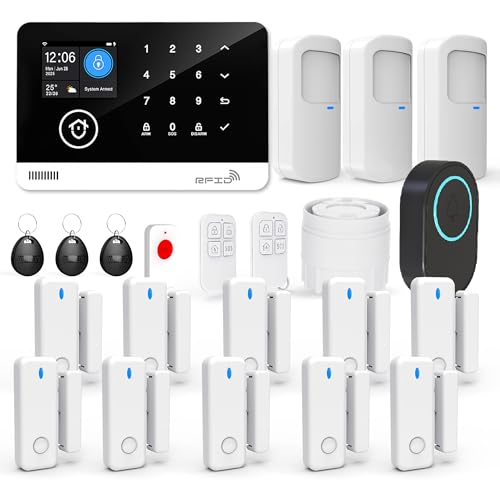
- Large package with entry and motion sensors
- 2.4GHz Wi-Fi plus 2G GSM backup
- App alerts, calls, messages, and voice control
Best For: Properties needing many sensors and cellular fallback
Subscription-Free DIY Alerting
Tolviviov 15-Piece WiFi System

- No monthly fees required
- 10 door sensors with app alerts
- Expandable and Alexa compatible
Best For: DIY users prioritizing low ongoing costs and entry coverage
Monitored Peace of Mind

- Simple no-wiring DIY installation
- Optional 24/7 monitoring without a long-term contract
- App control, panic button, and smart-home compatibility
Best For: U.S. households seeking easy setup with optional professional monitoring
Best Complete Monitoring Kit
22-Piece WiFi and 4G Alarm System

- 2K camera enables remote visual monitoring
- WiFi plus optional 4G calls and SMS
- 22-piece kit with no monthly fees after activation
Best For: Families wanting camera monitoring and multiple alert methods
Best Loud Siren for Outbuildings

- 120dB siren for strong local deterrence
- App alerts and door-status monitoring
- Expandable to 30 detectors and 20 remotes
Best For: Garages, sheds, and storage areas needing loud sensor alerts
Best Dual-Network Coverage

- WiFi and 4G backup connectivity
- 15 sensors for broad coverage
- 48-hour hub battery backup
Best For: Larger homes and apartments needing extensive coverage
Best for 2–3 Bedrooms

- Includes keypad, remotes, and sensors
- WiFi plus automatic 4G fallback
- Expandable with extra sensors
Best For: Small to mid-size homes wanting a starter system
Flexible Ring Protection – Ring Alarm 8-Piece Kit
Ring Alarm 8-piece kit (2nd Gen) - home security system with optional 24/7 professional monitoring
Check Price On AmazonFor smaller homes seeking home security systems for remote monitoring, the Ring Alarm 8-piece kit combines core entry and motion detection with app notifications. The system can be expanded with additional Ring sensors and accessories as your needs change.
Best For: 1- to 2-bedroom homes that want app alerts and optional professional monitoring.
Pros:
- Includes a base station, keypad, four contact sensors, motion detector, and range extender.
- Ring app notifications help you monitor triggered alarms and connected Ring devices.
- Optional Ring Protect features can support remote arming, Wi-Fi backup, and 24/7 professional monitoring.
- Works with Alexa for voice arming and disarming when paired with a Ring Protect subscription.
Cons:
- Several remote-management and professional-monitoring features require a separately sold compatible Ring Protect Plan.
- Additional sensors and accessories are sold separately.
This is a practical starting point for a smaller property, especially if you already use Ring devices. Factor the optional subscription and expansion costs into the total price.
Broad Sensor Coverage – TUGARD 22-Piece WiFi/GSM Alarm
The TUGARD alarm system offers extensive sensor coverage and remote controls for shoppers comparing home security systems for remote monitoring. It uses a 2.4GHz Wi-Fi connection with 2G GSM backup and sends app alerts when the system is triggered.
Best For: Larger coverage needs where many entry sensors, motion detectors, and GSM backup are useful.
Pros:
- Package includes door/window sensors, motion detectors, RFID cards, remote controls, an SOS button, siren, and doorbell button.
- Tuya or Smart Life app notifications can be paired with calls or messages to preset phone numbers.
- Dual Wi-Fi and GSM connectivity can keep the system connected when Wi-Fi is unavailable.
- Supports app, keypad, remote, voice, and intercom control, with Alexa and Google compatibility.
Cons:
- Wi-Fi operation is limited to 2.4GHz, and GSM backup requires a 2G SIM card.
- The supplied notes specify a 220-volt system, so shoppers should confirm electrical compatibility before buying.
- No subscription is required, but cellular operation may involve separate SIM-related costs.
With its unusually large sensor package and cellular fallback, this kit is appealing for broad DIY coverage. Verify 2G availability and power compatibility in your area first.
Subscription-Free DIY Alerting – Tolviviov 15-Piece WiFi System
The Tolviviov 15-piece kit is a straightforward option for home security systems for remote monitoring without monthly fees. Its app provides smartphone alerts and remote control, while the included sensors and 120dB siren cover common entry points.
Best For: Budget-conscious DIY users who want many door sensors and no required subscription.
Pros:
- Includes a Wi-Fi base station, keypad, 10 door sensors, motion sensor, and two remote controls.
- App-based remote control and real-time smartphone alerts support monitoring while away.
- Supports expansion to up to 20 sensors and five remote controls or keypads.
- Includes a 120dB siren and works with Alexa for voice control.
Cons:
- Works only with 2.4GHz Wi-Fi and does not support 5GHz networks.
- The kit is Wi-Fi based, so the supplied notes do not describe cellular backup.
- Its included motion coverage is limited to one motion sensor.
This kit makes sense when low ongoing cost and extensive door coverage matter most. Check your router’s band settings and consider whether one motion sensor is enough for your layout.
Monitored Peace of Mind – SimpliSafe 8-Piece System
The SimpliSafe 8-piece system is designed for simple DIY setup and app-based control, making it a strong candidate among home security systems for remote monitoring. Optional professional monitoring can alert emergency responders when you cannot respond yourself.
Best For: Households wanting easy installation, optional no-contract monitoring, and broad entry-point protection.
Pros:
- Includes a base station, keypad, four entry sensors, motion sensor, and panic button.
- DIY installation requires no wiring or drilling, and the app supports arming and disarming from anywhere.
- Optional 24/7 professional monitoring is offered without a long-term contract or hidden fees.
- Works with Alexa and Google Assistant, while motion sensors are designed to accommodate pets under 60 pounds.
Cons:
- Professional monitoring and features such as monitored panic-button dispatch require a subscription.
- Products and monitoring services are offered and supported only in the United States.
- The supplied system includes one motion sensor, which may limit room coverage in larger homes.
SimpliSafe is a well-rounded choice for users who want uncomplicated setup with the option to add professional oversight. Confirm service availability and include monitoring fees in your budget.
Best Budget DIY Pick – 8-Piece WiFi Door Alarm Kit
For shoppers comparing home security systems for remote monitoring, this tolviviov kit offers app alerts, remote controls, and voice control in a compact DIY package. It connects through 2.4GHz WiFi and requires no subscription fee.
Best For: Apartments and smaller homes wanting straightforward door and window monitoring without contracts.
Pros:
- Smartphone notifications and app control for alarm events.
- Includes five door/window sensors, two remote controls, and an alarm station.
- Tool-free, self-adhesive installation with support for expansion up to 20 sensors.
- Supports Away, Disarm, and Home voice-control modes.
Cons:
- Works only with 2.4GHz WiFi, not 5GHz networks.
- The alarm station must remain connected to AC power; backup battery life is limited to eight hours.
- It does not include a camera for visual monitoring.
This is a practical entry-level choice when remote phone alerts and perimeter sensors matter more than video. Its expandable design is useful, but confirm your WiFi compatibility and power arrangement before buying.
Best Complete Monitoring Kit – 22-Piece WiFi and 4G Alarm System
This PGST system stands out among home security systems for remote monitoring by combining app access, a 2K camera, WiFi connectivity, and optional 4G calling and SMS alerts. It also provides a broad collection of sensors and emergency controls without monthly fees after activation.
Best For: Apartments and families wanting camera-based monitoring plus multiple alert channels.
Pros:
- Includes a 2K camera for remote visual monitoring through the Smart Life or Tuya app.
- Supports 2.4GHz WiFi and 4G SIM-based phone calls and SMS alerts.
- Provides app notifications, phone alerts, and SMS alerts when sensors are triggered.
- Includes a color-screen control panel, SOS device, remote control, and 22 total pieces.
Cons:
- 5GHz WiFi is not supported.
- The camera’s microSD card is sold separately.
- Using 4G calling and SMS functions requires a compatible SIM card.
With visual monitoring and cellular backup-style alerting, this is the most feature-rich option in the group. It is a stronger fit for users who want more than local siren alerts, provided they are comfortable setting up the app, camera storage, and optional SIM service.
Best Loud Siren for Outbuildings – WiFi Garage and Shed Alarm
For garages, sheds, and other secondary spaces, this TOWODE system pairs smartphone alerts with a prominent 120dB siren. As one of the home security systems for remote monitoring, it also lets you check door status in the app and add more detectors as needs grow.
Best For: Garages, sheds, storage areas, and entry points where a loud local deterrent is especially valuable.
Pros:
- 120dB siren provides a strong audible deterrent and local alert.
- Tuya app sends instant phone notifications and displays whether doors are open or closed.
- DIY installation uses adhesive pads or screws, with no professional setup required.
- Supports up to 30 wireless detectors and 20 remote controls.
Cons:
- Requires 2.4GHz WiFi and does not indicate support for 5GHz networks.
- The siren must be plugged into an outlet.
- It is focused on sensor and siren alerts rather than camera-based monitoring.
This system makes sense when you want a loud alarm for a detached or less frequently occupied area while still receiving phone alerts. Its detector capacity adds flexibility, but it is better suited to intrusion sensing than remote video verification.
Best Dual-Network Coverage – 24-Piece WiFi+4G Alarm System
For shoppers comparing home security systems for remote monitoring, this kit stands out for its WiFi and 4G backup connection. It combines a large sensor package with app control, a 120dB siren, and battery backup for broader coverage during internet or power interruptions.
Best For: Larger homes or apartments needing extensive sensor coverage and a backup cellular connection.
Pros:
- WiFi automatically switches to 4G with a compatible SIM card when WiFi disconnects.
- Includes 10 door/window sensors and 5 motion detectors for whole-home coverage.
- Offers app-based remote arm/disarm, Alexa support, and push or SMS alerts.
- Built-in battery backup is rated for up to 48 hours, and the hub has an anti-tamper alarm.
Cons:
- A 4G SIM card is not included.
- Requires 2.4GHz WiFi for initial pairing.
- The larger kit may provide more sensors than smaller apartments need.
This is the most coverage-oriented option in the group. Its dual-network design and substantial sensor count make it a practical choice when maintaining remote alerts is a priority, though cellular backup requires an additional SIM card.
Best for 2–3 Bedrooms – PGST 9-Piece Smart Alarm Kit
This PGST kit is a compact option for home security systems for remote monitoring, with app alerts, keypad and remote controls, and automatic 4G fallback when WiFi disconnects. Its included components are sized for a typical two- or three-bedroom home.
Best For: Households wanting a manageable starter system with Alexa control and room to expand.
Pros:
- Includes a base station, keypad, four door/window sensors, two motion detectors, and two remotes.
- Supports Smart Life or Tuya app control with mobile notifications and no monthly charges.
- Automatically switches between 2.4GHz WiFi and 4G networks.
- Supports Alexa voice commands and additional sensors for expanded coverage.
Cons:
- The kit is specifically positioned for two- to three-bedroom homes, so larger properties may need expansion.
- PGST cameras for visual monitoring are sold separately.
- 4G fallback requires compatible cellular service.
With a balanced sensor selection and two remote controls, this is a practical starter package rather than an oversized whole-home kit. It offers useful expansion flexibility and connectivity redundancy without subscription charges.
Best Expandable DIY Option – YISEELE Smart WiFi Alarm Kit
For straightforward home security systems for remote monitoring, this YISEELE kit offers app alerts, voice control, and self-adhesive installation without wiring. The hub includes a rechargeable backup battery, while the system can grow to support up to 100 accessories.
Best For: Homes, apartments, garages, or small businesses that want an easy-to-expand alarm setup.
Pros:
- Smart Life app supports remote arm/disarm, event records, and instant push notifications.
- Works with Alexa and Google Home for voice-controlled security modes.
- Supports up to 100 accessories, including motion, smoke, water-leak, and additional door sensors.
- Includes a 120dB siren, four door/window sensors, remote SOS, and a two-year replacement warranty.
Cons:
- Connects to 2.4GHz WiFi only; 5GHz WiFi is not supported.
- The included kit has four door/window sensors and one remote, with other accessories sold separately.
- The listed wireless range is up to 10 meters.
This system is a good fit for buyers who prefer a simple DIY starting point with significant expansion potential. Its lack of monthly fees and broad accessory compatibility help keep the initial setup flexible, but larger properties may need extra components.
How We Picked the Best Home Security Systems for Remote Monitoring
We selected systems across several common buying priorities: app-based remote access, wireless installation, sensor count, alarm volume, camera availability, cellular or Wi-Fi connectivity, smart-home compatibility, and monitoring flexibility. The list includes established options such as Ring Alarm and SimpliSafe alongside larger DIY kits designed for buyers who want more sensors without a monthly fee.
Because product bundles and service terms can change, check the current listing for included components, supported networks, app requirements, battery details, and any monitoring costs before ordering.
Quick Comparison
| Best For | Look For | Potential Trade-Off |
|---|---|---|
| Professional support | Optional 24/7 monitoring and emergency dispatch | Recurring subscription cost |
| Low ongoing cost | No-monthly-fee operation and local siren alerts | More reliance on self-monitoring |
| Larger homes | More door, window, and motion sensors | More setup and battery maintenance |
| Visual verification | Included camera, live view, or image alerts | Privacy, storage, and connectivity considerations |
| Smart-home integration | Alexa or Google Assistant compatibility | Features may depend on app and platform support |
Key Buying Factors for Home Security Systems for Remote Monitoring
Connectivity and Backup
Wi-Fi is convenient, but an internet outage can interrupt alerts. Systems with cellular or 4G backup may provide a stronger connection when broadband service fails. Confirm network compatibility in your area, particularly with kits described as GSM, 2G, or 4G.
Monitoring and Total Cost
Decide whether you want self-monitoring, optional professional monitoring, or a combination of both. Compare equipment price with activation fees, monthly plans, cloud video storage, replacement batteries, and cancellation terms. No-subscription systems can reduce recurring costs but typically require you to respond to alerts yourself.
Coverage and Installation
Count every exterior door, accessible window, garage entry, and frequently used interior area. A larger kit may offer better coverage, but only if sensors can be mounted within the system’s range. Check whether the kit is fully wireless, battery powered, expandable, and suitable for renters.
Alerts, Cameras, and Privacy
Look for reliable push notifications, adjustable entry delays, useful motion detection, and a loud enough siren for your layout. If a camera is included, review resolution, night vision, recording options, storage fees, and privacy controls rather than choosing on megapixels alone.
Who Should Buy Which Home Security Systems for Remote Monitoring?
Choose Ring Alarm if you want a recognizable ecosystem, optional professional monitoring, and compatibility with other Ring devices. Choose SimpliSafe if no-contract professional monitoring and straightforward setup are priorities. Choose a larger Wi-Fi or Wi-Fi-plus-cellular kit if you need many sensors, app alerts, and low recurring costs. Choose a camera-equipped bundle if visual confirmation matters, but verify video storage and network requirements first. For a small apartment or basic entry protection, a compact door-and-window kit may be easier to install and manage than a 22- or 24-piece package.