Finding the right angle is easier when your measuring tool is simple to read, steady on the workpiece, and accurate enough for the job. The best digital angle finders for beginners combine a clear display with intuitive controls and useful features such as magnetic bases, zero resets, and compact designs.
We compared 10 popular models for everyday woodworking, home improvement, welding, installation, and layout work. This guide explains which features matter most and how to choose a digital angle finder that fits your projects and experience level.
Best 10 Digital Angle Finders for Beginners Picks for 2026
Best All-Around Pick
Klein Tools 935DAG Digital Level and Angle Gauge
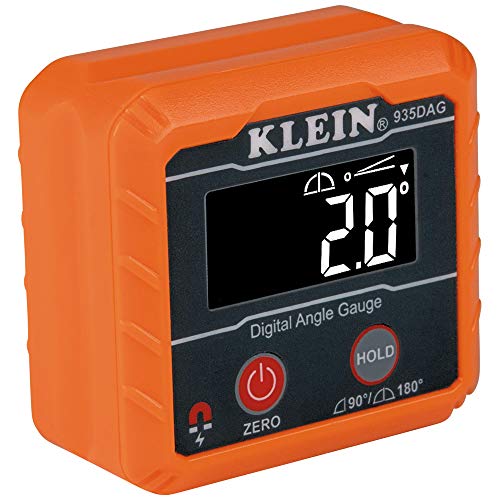
- Measures 0–90 and 0–180 degrees
- Magnetic base with V-groove edges
- Auto-rotating high-visibility display
Best For: General leveling, angle checks, and conduit alignment
Best Ruler-Style Option
GemRed 82305 Digital Angle Finder Protractor

- Stainless steel ruler arms
- Measures inside and outside angles
- Locks at any angle
Best For: Woodworking, crown molding, and layout tasks
Best for Slope Conversions
Klein Tools 935DGGP Digital Angle Finder

- Displays four angle or slope units
- Magnetic base and V-groove edges
- High-contrast display for dim areas
Best For: Framing, landscaping, slope finding, and conduit work
Best Full-Range Gauge
GemRed DAG-V1 Digital Angle Gauge

- Measures across a 0–360-degree range
- True-level and relative-angle modes
- Backlit reversible display with error indicator
Best For: Woodworking, construction, and broad angle coverage
Versatile Precision Pick
Klein Tools 935DAF Digital Angle Finder

- Measures angles, lengths, and miter-saw cut angles
- Stated +/- 0.2-degree accuracy
- Bright LED display and etched ruler markings
Best For: Beginners learning layout and miter-saw angle work
Large-Display Learning Pick
LEXIVON LX-DAF7 Digital Angle Finder

- Simple four-button operation
- 360-degree inside, outside, and reverse measurements
- Extra-large LCD with 0.05-degree resolution
Best For: Beginners wanting clear readings and a storage pouch
All-Around Workshop Pick
WORKPRO 7-Inch Digital Angle Finder

- Measures 360 degrees and extends as a 400 mm ruler
- Lock, hold, and unit-switch functions
- Stainless-steel rulers with etched scales
Best For: Beginners needing angle and basic length measurements
Best with Extra Features

- Combines angle, level, and dual laser functions
- Four-sided magnets and automatic display rotation
- ±0.2° accuracy with hold, zero, and backlit LCD
Best For: Beginners seeking a versatile tool for woodworking and home projects
Best for Long Layouts
Neoteck 225° Laser Angle Finder

- Wide 0–225° range with 0.1° increments
- Integrated laser supports direct visual marking
- Aluminum body, bubble levels, and locking knob
Best For: Beginners handling trim, tile, framing, and furniture layout
Best Compact Option

- Lightweight 3.84-ounce pocket-sized design
- ±0.2° accuracy with 0.05° resolution
- Backlit display, IP54 protection, and angle/tilt modes
Best For: Beginners needing a portable gauge for compatible metal surfaces
Best All-Around Pick – Klein Tools 935DAG Digital Level and Angle Gauge
For beginners comparing digital angle finders for beginners, the Klein Tools 935DAG is a practical combination of angle gauge and digital level. Its magnetic base, clear display, and simple zero-calibration feature make it useful for checking surfaces, setting relative angles, and aligning conduit or pipe.
Best For: Beginners who want one compact tool for general angle measurement, leveling, and hands-free work on metal surfaces.
Pros:
- Measures 0–90 and 0–180 degrees.
- Strong magnetic base supports hands-free operation.
- V-groove edges help align conduit and pipes.
- Auto-rotating, reverse-contrast display improves viewing flexibility.
Cons:
- Its ABS plastic housing may not appeal to shoppers seeking an all-metal frame.
- The supplied notes do not specify a numerical accuracy rating.
The 935DAG stands out as a straightforward starter option, especially for users who value magnetic attachment and both level and angle functions in one small tool.
Best Ruler-Style Option – GemRed 82305 Digital Angle Finder Protractor
GemRed 82305 Digital Angle Finder Protractor Stainless Steel 7inch 200mm | Black Button
Check Price On AmazonThe GemRed 82305 takes a familiar ruler-and-protractor approach, making it an approachable choice among digital angle finders for beginners. Its stainless steel arms, etched measurements, locking function, and stated ±0.3-degree accuracy suit woodworking, crown molding, and everyday angle work.
Best For: Beginners who prefer a folding ruler-style tool for measuring inside and outside angles.
Pros:
- Combines a ruler and protractor for inside and outside angles.
- Stainless steel rulers have laser-etched measurements.
- Stated accuracy is ±0.3 degree.
- Locks at any angle for easier reading.
Cons:
- No reverse-angle or reverse-display function.
- Its folded length is about 7.5 inches, so it is less compact than a small gauge.
- It uses a CR2032 battery rather than a readily available AAA battery.
Choose this model if physical ruler arms and direct inside/outside angle measurement feel more intuitive than a compact electronic block-style gauge.
Best for Slope Conversions – Klein Tools 935DGGP Digital Angle Finder
For beginners who need more than degree readings, the Klein Tools 935DGGP adds practical unit conversions to a compact digital angle finder. It can display degrees, percent grade, millimeters per meter, or inches per foot, while its magnetic base and V-groove edges support hands-free positioning.
Best For: Beginners working with framing, landscaping, slopes, conduit, pipes, or saw blades.
Pros:
- Converts between degrees, percent grade, mm/m, and in/ft.
- Functions as an angle gauge, relative-angle checker, and digital level.
- Strong magnetic base enables hands-free operation.
- High-contrast display is suited to dim work areas.
Cons:
- The supplied notes do not list a numerical accuracy specification.
- It is designed around a compact gauge format rather than extended ruler arms for layout.
The 935DGGP is the more versatile pick when slope units matter. Its conversion options can reduce manual calculations for construction and landscaping projects.
Best Full-Range Gauge – GemRed DAG-V1 Digital Angle Gauge
The GemRed DAG-V1 is a beginner-friendly choice among digital angle finders for beginners when a full 360-degree measuring range is useful. It offers true-level and relative-angle modes, a reversible backlit display, an aluminum framework, and an error indicator to flag incorrect positioning.
Best For: Beginners who want broad angle coverage, repeatable readings, and a backlit display for woodworking or general construction.
Pros:
- Measures 0–360 degrees across four 90-degree sections.
- Offers true-level and relative-angle modes.
- Stated accuracy is ±0.2 degree with 0.1-degree resolution.
- Uses an aluminum framework and magnetic flat base.
Cons:
- Displays degrees only, without alternate slope units.
- The notes specify manual operation rather than an automatic mode.
- It may show an error when tilted diagonally beyond 30 degrees.
With its wide range, stated repeatability, and positioning warning, the DAG-V1 is a strong fit for beginners who want more coverage than a basic 90-degree gauge provides.
Versatile Precision Pick – Klein Tools 935DAF Digital Angle Finder
For beginners comparing digital angle finders for beginners, the Klein Tools 935DAF offers a practical combination of angle measurement, length measurement, and miter-saw calculations. Its machined ruler edges, bright display, and simple rectangular design make it useful for learning accurate layout work.
Best For: Beginners who want one tool for basic angle measurements, length checks, and miter-saw setup.
Pros:
- Measures inside and outside angles, lengths, and miter-saw cut angles.
- Provides stated accuracy of +/- 0.2 degrees.
- Bright white LED display improves visibility in different lighting.
- Metallic ruler has deeply etched, rust-resistant markings.
Cons:
- The included tool is battery powered and requires one AAA battery.
- Its one-size design may offer fewer specialized features than a larger gauge.
The 935DAF is a strong starting point for beginners who want straightforward digital readings plus miter-saw guidance. Choose it when versatility and a bright display matter more than an extra-large screen or included storage case.
Large-Display Learning Pick – LEXIVON LX-DAF7 Digital Angle Finder
The LEXIVON LX-DAF7 is a beginner-friendly option among digital angle finders for beginners because its four-button interface keeps core functions easy to access. The extra-large display, 360-degree range, and included zippered pouch support measuring, recording, and storing the tool during woodworking, flooring, or tiling projects.
Best For: Beginners who prefer a large display, simple controls, and a protective carrying pouch.
Pros:
- Four-button interface includes zero, hold/flip, reverse, and power controls.
- Measures inside, outside, and reverse angles across a 360-degree range.
- Extra-large LCD provides 0.05-degree resolution.
- Includes a heavy-duty zippered pouch for protection and storage.
Cons:
- Its stated accuracy is +/- 0.3 degrees, slightly less precise than some options.
- The 7-inch aluminum rule and pouch make it a relatively substantial kit.
The LX-DAF7 balances approachable controls with useful professional-style features. Its large screen and protective case are especially helpful for new users who want clear readings and organized storage between projects.
All-Around Workshop Pick – WORKPRO 7-Inch Digital Angle Finder
For beginners shopping for digital angle finders for beginners, the WORKPRO combines angle measurement with a ruler function and convenient lock and hold controls. Its stainless-steel construction, clear LCD, and included pouch make it a practical choice for repeated measuring and marking tasks.
Best For: Beginners who want a durable multi-purpose tool for measuring, marking, and checking angles.
Pros:
- Measures inside and outside angles through 360 degrees with stated +/- 0.3-degree accuracy.
- Extends to 400 mm as a straight ruler for basic length measurement and marking.
- Lock and hold functions help with stable marking and recording readings.
- Includes a pre-installed battery, spare battery, and Oxford storage pouch.
Cons:
- The tool should be handled carefully during use because its machined edges are intended for exact alignment.
- Its display resolution and stated accuracy may be more than needed for very basic tasks.
The WORKPRO is a versatile introduction to digital angle measurement, particularly for users who also need a straight ruler. Unit switching, auto shutoff, and replaceable batteries add convenience for ongoing workshop use.
Best with Extra Features – Coobeast Digital Angle Finder
For beginners comparing digital angle finders for beginners, the Coobeast is a versatile choice that combines an angle gauge, digital level, and dual laser lines. Its four-sided magnets, automatic display rotation, and simple three-button controls make it practical for woodworking, home maintenance, and decoration projects.
Best For: Beginners who want one compact tool for angle measurements, leveling, and laser-guided alignment.
Pros:
- Four-sided magnets help it stay attached to measuring surfaces.
- Combines digital level, angle finder, and two laser lines.
- Offers ±0.2° accuracy, 0.05° resolution, hold, zeroing, and a backlit display.
- Rechargeable 400mAh battery, IP54 protection, and included storage pouch support portable use.
Cons:
- The laser is a Class II device, so users should avoid direct eye exposure.
- Magnetic attachment is intended for ferromagnetic surfaces.
The Coobeast stands out when a beginner wants more than a basic digital protractor. Its laser functions add alignment capability, while the hold and automatic flip features make awkward measurements easier.
Best for Long Layouts – Neoteck 225° Laser Angle Finder
Among digital angle finders for beginners, the Neoteck offers a familiar ruler-style layout with a wide 0–225° range and an integrated laser for direct visual marking. Its aluminum body, bubble levels, lock knob, and hold function make it suitable for learning accurate angle transfer on larger projects.
Best For: Beginners working on trim, tile, framing, picture hanging, furniture assembly, or other projects that benefit from a longer angle ruler.
Pros:
- 0–225° measuring range with ±0.5° precision and 0.1° increments.
- Class 2 laser projects a visible line up to 3 meters for marking.
- Built-in horizontal and vertical bubble levels provide level and plumb checks.
- Aluminum construction, mechanical lock, hold button, and blue backlight improve usability.
Cons:
- Its ruler-style format is less compact than a small pocket angle gauge.
- The laser is rated below 1mW and should not be viewed directly.
The Neoteck is a strong option for beginners who need to transfer angles rather than simply read them. The physical lock and long ruler format can make repeatable layout work more straightforward, while the bubble vials reduce the need for a separate level.
Best Compact Option – Magnetic Digital Angle Finder
For beginners choosing digital angle finders for beginners, this compact magnetic model keeps the controls and readout simple while adding useful features such as a backlit, automatically reversing display. It measures through 360°/4×90° and includes absolute and relative modes for common woodworking, maintenance, and decorating tasks.
Best For: Beginners who prioritize a lightweight, portable angle gauge for pipes, conduits, saw blades, and other ferromagnetic surfaces.
Pros:
- Compact 3.84-ounce design is easy to carry.
- Strong magnet helps attach it to compatible metal surfaces.
- Provides ±0.2° accuracy and 0.05° resolution across 360°/4×90° measurement.
- Backlit, auto-reversing display, IP54 protection, and angle/tilt modes support practical use.
Cons:
- Magnetic mounting works only on ferromagnetic surfaces.
- Automatic shutoff occurs after 3 minutes of inactivity, which may interrupt longer pauses.
This is a straightforward choice when portability matters more than extra functions. The two AAA batteries, included storage bag, simple hold/tilt control, and compact body make it approachable for occasional home and workshop measurements.
How We Picked the Best Digital Angle Finders for Beginners
We focused on the features that make angle measurement straightforward for first-time users: readable displays, simple controls, dependable construction, practical measuring ranges, and stable positioning. We also considered magnetic bases, calibration and zeroing functions, display orientation, battery convenience, included storage, and whether each tool is suitable for common DIY or workshop tasks.
Accuracy matters, but usability matters just as much. A tool that is difficult to hold, slow to read, or awkward to reset can create more mistakes than a slightly less feature-packed model. The products in this roundup cover compact digital levels, folding protractors, aluminum gauges, and models with lasers or magnetic assistance.
Quick Comparison
Choose a compact digital level or angle gauge for checking slopes, shelves, appliances, and machinery. Folding stainless-steel protractors are better for transferring angles and measuring between two surfaces. Models with strong magnetic bases are useful for metalwork, ductwork, and hands-free positioning, while laser-equipped tools can help project a reference line over a larger area.
Key Buying Factors for Digital Angle Finders for Beginners
Display and Controls
Look for large, high-contrast numbers and buttons that are easy to understand. Hold, absolute/relative angle, and automatic shutoff functions can make measurements faster. A reversible or backlit display is particularly helpful when working in tight or dim spaces.
Accuracy and Calibration
Check the stated accuracy and resolution, but also look for a simple calibration procedure. A zero function lets you establish a reference from any surface, which is useful for comparing slopes or setting a custom angle.
Range and Physical Design
A 180-degree folding design is versatile for transferring angles, while a 225-degree or similar range can help with inside and outside measurements. Aluminum and stainless-steel bodies generally offer better durability than lightweight plastic. Make sure the tool is long enough to bridge the surfaces you need to measure.
Magnetic Base and Extra Features
Magnets help keep the gauge steady on steel framing, saws, pipes, and other ferrous surfaces. They are not essential for every beginner, however, and can add weight. Lasers may help with alignment, but they should be treated as a layout aid rather than a substitute for a precise reading.
Who Should Buy Which Digital Angle Finders for Beginners?
For general home repairs and beginner woodworking, choose a straightforward digital level with a clear display and easy zeroing. If you frequently transfer angles between boards or trim, select a folding protractor with a locking hinge. Metalworkers and installers should prioritize a strong magnetic base, durable housing, and stable contact edges. Buyers who work in larger spaces may appreciate a laser-equipped model, while occasional users can save money with a compact gauge that covers basic slope and angle checks.
Before buying, match the tool’s measurement range and size to your projects, confirm the battery requirements, and read the accuracy specifications carefully. The best choice is the model that makes your most common measurements quick, repeatable, and easy to verify.