Humidity can quietly damage camera bodies, lenses, and electronic accessories—especially in compact studios where gear is stored close together and used frequently. A dedicated dry cabinet provides more consistent protection than ordinary shelves, cases, or disposable desiccant packs.
These 10 camera dry cabinets for small studios cover practical capacities from 30L to 125L, with options for adjustable humidity control, lockable storage, quiet operation, and different studio footprints. Use the guide below to match cabinet size and features to your equipment collection.
Best 10 Camera Dry Cabinets for Small Studios Picks for 2026
Compact Pick
RUGGARD 50L Electronic Dry Cabinet

- 35–60% adjustable humidity range
- Padded adjustable shelves and interior LED
- Locking, virtually silent compact design
Best For: Small studios with modest camera and lens collections
Large-Capacity Choice
FORSPARK 125L Camera Dry Cabinet

- 125L capacity with four adjustable shelves
- 25–60% RH control and live monitoring
- Quiet 15W operation with locking glass door
Best For: Studios storing extensive camera, lens, and drone collections
Wide-Format Pick
RUGGARD 80L Electronic Dry Cabinet

- 80L capacity with adjustable steel shelves
- 35–60% humidity control and LCD display
- Foam liners, LED lighting, and locking door
Best For: Studios wanting moderate capacity in a wider layout
Organization Pick
SLINGER 125L Digital Dry Cabinet

- Five padded shelves in a 125L cabinet
- 30–60% humidity control with dual LED display
- Quiet, under-15W thermoelectric operation
Best For: Studios prioritizing organized storage and digital monitoring
Secure 55L Studio Storage
Slinger 55L Electronic Dry Cabinet
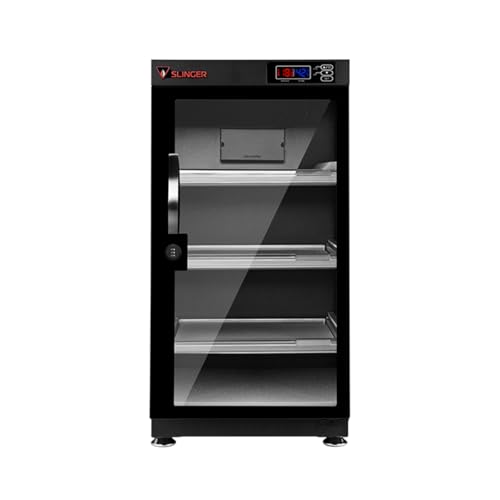
- 55L capacity with three adjustable padded shelves
- 30–60% humidity range and less than 8W usage
- Combination lock with 110–240V AC compatibility
Best For: Small studios needing spacious, lockable gear storage
High-Capacity Digital Control
AUTENS 80L Digital Dry Cabinet

- 25–60% adjustable humidity range
- Dual temperature and humidity LED display
- 8W operation with lockable glass door
Best For: Studios wanting visible controls and generous storage
Compact Lockable Storage
Slinger 35L Electronic Dry Cabinet

- 35L capacity with adjustable padded shelf
- 25–60% humidity control with ±3% stated accuracy
- Combination lock and less than 8W power use
Best For: Photographers with compact kits and limited studio space
Quiet 50L Studio Guardian
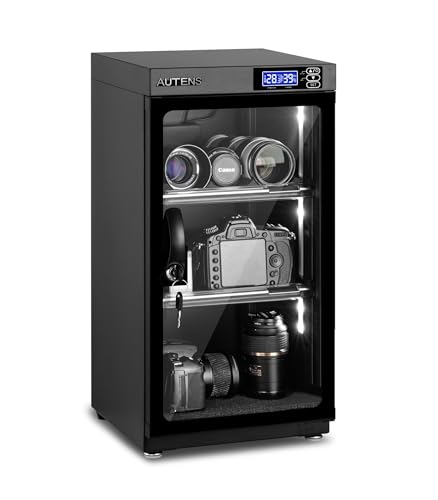
- 50L storage with adjustable sliding shelves
- 25%–60% humidity range with ±1%RH claimed accuracy
- Quiet 8W operation with lockable glass door
Best For: Small studios storing several lenses and camera bodies
Four-Shelf Studio Organizer
INTBUYING 50L Camera Dry Cabinet
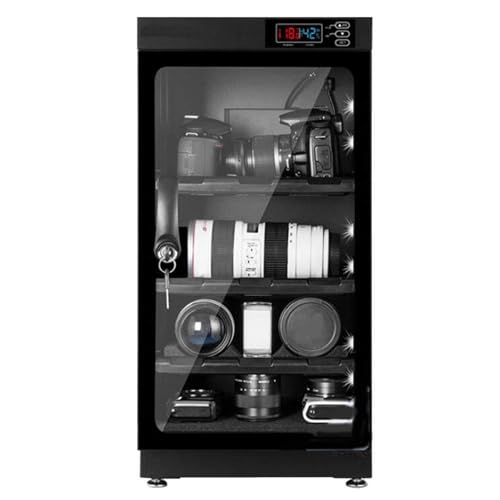
- Four levels for organized camera gear storage
- Touchscreen controls with adjustable 25%–60% humidity
- Quiet 8W TE cooling and lockable glass door
Best For: Studios that want neatly separated shelves for lenses and cameras
Compact 30L Gear Keeper

- Compact 30L design for limited studio space
- 25%–60% humidity control with ±1%RH claimed accuracy
- Quiet 8W operation with adjustable shelving and LED display
Best For: Small kits and studios with limited storage space
Compact Pick – RUGGARD 50L Electronic Dry Cabinet
For small studios seeking camera dry cabinets for small studios, the RUGGARD 50L offers compact, electronically controlled humidity storage for cameras, lenses, and other optical equipment. Its adjustable 35–60% relative-humidity range, padded shelves, interior lighting, and locking door make it practical for organized everyday storage.
Best For: Small studios needing a compact cabinet for camera bodies, lenses, and mobile electronics.
Pros:
- Adjustable humidity control from 35–60% with an easy-to-read LCD.
- Includes two adjustable shelves, padded liners, interior LED lighting, and a lock.
- Virtually silent operation and a multi-voltage power supply support flexible placement.
Cons:
- 50-liter capacity may be limiting for larger collections or long lenses.
- Its plastic shelves may feel less substantial than steel-shelf alternatives.
The RUGGARD 50L is a sensible space-saving choice when you want controlled storage without moving up to a larger floor cabinet. Check the interior dimensions against your largest equipment before buying.
Large-Capacity Choice – FORSPARK 125L Camera Dry Cabinet
The FORSPARK 125L is a strong option for studios that need camera dry cabinets for small studios with room to grow. Its 125-liter interior, four adjustable shelves, real-time humidity monitoring, tempered-glass door, and full-length LED lighting are suited to storing multiple camera bodies, lenses, drones, and collectibles.
Best For: Equipment-heavy studios needing modular storage for cameras, telephoto lenses, drones, and accessories.
Pros:
- Large 125-liter capacity with four adjustable shelves creating five storage zones.
- Maintains a stated 25–60% RH range with real-time monitoring and automatic activation.
- Quiet operation under 30dB, 15W power use, tempered glass, magnetic sealing, and a child-safe lock.
Cons:
- The tall 35.43-inch profile requires more vertical space than compact cabinets.
- It is not water resistant.
- The listed 19 kg weight may make repositioning less convenient.
Choose the FORSPARK when capacity and compartmental organization matter more than a small footprint. Its quiet, low-power design also suits studios where the cabinet will operate continuously.
Wide-Format Pick – RUGGARD 80L Electronic Dry Cabinet
The RUGGARD 80L provides a wider storage layout for photographers who need camera dry cabinets for small studios without choosing a tall cabinet. Its electronically controlled 35–60% humidity range, adjustable steel shelves, foam liners, locking door, and interior LED make it suitable for organized photographic equipment storage.
Best For: Small studios that prefer a wider cabinet for cameras, lenses, and other valuable electronics.
Pros:
- 80-liter capacity with two adjustable steel shelves and padded liners.
- Electronic humidity adjustment from 35–60% with LCD readout.
- Includes automatic moisture removal, interior lighting, a locking door, and multi-voltage power.
Cons:
- Its 29.5-pound weight is greater than the 50L RUGGARD model.
- Only two shelves are included, so organization may be less compartmentalized than five-shelf designs.
The 80L RUGGARD strikes a useful middle ground between compact and high-capacity cabinets. Its relatively wide footprint and steel shelves make it a practical fit for studios with a moderate equipment inventory.
Organization Pick – SLINGER 125L Digital Dry Cabinet
The SLINGER 125L combines high capacity with five padded shelves, making it a compelling option among camera dry cabinets for small studios. Its thermoelectric dehumidification, 30–60% humidity setting, dual temperature-and-humidity display, combination lock, and quiet operation provide an organized storage setup for DSLR and mirrorless equipment.
Best For: Studios wanting five-level organization, digital monitoring, and combination-lock access.
Pros:
- 125-liter capacity with five foam-padded shelves for flexible organization.
- Customizable 30–60% humidity control with dual LED temperature and humidity screens.
- Thermoelectric operation is designed to be quiet, energy efficient, and under 15W.
Cons:
- The supplied details do not specify the cabinet’s exterior or interior dimensions.
- Its two-door configuration may require more front clearance than a single-door model.
- The combination lock differs from the keyed-lock designs of the other cabinets.
The SLINGER is a good match when shelf count and at-a-glance monitoring are priorities. Confirm available floor space and door clearance before selecting this full-sized 125L cabinet.
Secure 55L Studio Storage – Slinger 55L Electronic Dry Cabinet
For small studios needing camera dry cabinets for small studios, the Slinger 55L combines adjustable storage with humidity control and a built-in combination lock. Its three padded shelves and floor-standing design make it practical for organizing cameras, lenses, and accessories.
Best For: Small studios that want spacious, lockable gear storage with low-power humidity control.
Pros:
- 55L capacity with three adjustable, padded shelves
- Maintains humidity between 30% and 60%
- Integrated combination lock adds security
- Uses less than 8W and supports 110–240V AC power
Cons:
- At 26.4 pounds, it is less convenient to move frequently
- Its 15.25-inch square footprint and 27.25-inch height require dedicated floor space
The 55L Slinger is a strong choice when capacity, organization, and access control matter more than compact portability. Its adjustable padded shelving should suit varied studio kits, while low power use supports continuous operation.
High-Capacity Digital Control – AUTENS 80L Digital Dry Cabinet
The AUTENS dry cabinet is a high-capacity option for camera dry cabinets for small studios, offering digital temperature and humidity displays, four-layer storage, and automatic dehumidification. Its stated 25%–60% humidity range gives users flexibility for cameras, lenses, and other sensitive equipment.
Best For: Studios that prioritize visible humidity monitoring, adjustable settings, and large equipment capacity.
Pros:
- Digital dual display shows temperature and humidity
- Humidity can be set from 25% to 60%
- Uses 8W and is described as noiseless and heatless
- Lockable tempered-glass door and adjustable sliding shelves
Cons:
- The listing provides both 80L and 105-liter capacity references, so buyers should verify the exact usable capacity
- Its listed dimensions may require careful placement planning
With automatic humidity cycling and a clear dual display, this cabinet is appealing for users who want more control feedback than a basic storage box. Confirm the capacity and dimensions before purchase, especially where studio space is limited.
Compact Lockable Storage – Slinger 35L Electronic Dry Cabinet
The Slinger 35L is a compact choice among camera dry cabinets for small studios, combining thermoelectric humidity control with a combination lock. Its adjustable padded shelf and lens cradle pad help keep a smaller collection of cameras and lenses organized.
Best For: Small studios or individual photographers with limited gear and limited storage space.
Pros:
- Compact 35L capacity for smaller equipment collections
- Controls humidity from 25% to 60% with ±3% stated accuracy
- Combination lock provides added security
- Uses less than 8W and includes a padded shelf and lens cradle pad
Cons:
- Less capacity than the 55L and 80L options in this roundup
- Only one adjustable shelf is specified
The 35L Slinger makes sense when footprint and security are more important than maximum capacity. It offers focused protection for a modest kit, though larger studios may outgrow its single-shelf layout.
Quiet 50L Studio Guardian – 50L Dehumidifying Dry Cabinet
For small studios that need substantial gear storage without distracting noise, this 50L cabinet is a practical option among camera dry cabinets for small studios. Its digital humidity control, lockable glass door, and adjustable shelving are designed for organized camera and electronics storage.
Best For: Small studios with multiple lenses, cameras, or other moisture-sensitive equipment that need quiet, controlled storage.
Pros:
- 50L capacity with adjustable, sliding shelves for larger or heavier lenses.
- Controls relative humidity from 25% to 60%, with claimed accuracy of ±1%RH.
- Uses 8W of power and operates quietly without heat.
- Dual temperature-and-humidity display, lockable tempered-glass door, and switchable interior LEDs.
Cons:
- The larger footprint may be more than needed for a very compact studio setup.
- The supplied details list both a 50L tank volume and a separate 105-liter capacity specification, so buyers should verify the listing measurements.
This cabinet stands out for combining relatively generous storage with quiet, low-power operation. It is a strong fit when a small studio needs room to grow, provided its listed dimensions work with the available workspace.
Four-Shelf Studio Organizer – INTBUYING 50L Camera Dry Cabinet
The INTBUYING 50L cabinet is a straightforward choice for photographers who want tiered organization in a small studio. Among camera dry cabinets for small studios, its four-level interior, touchscreen controls, and quiet 8W operation make it suited to keeping lenses and camera equipment accessible while managing humidity.
Best For: Small studios that prioritize separated, easy-to-reach storage for photographic equipment.
Pros:
- Four levels provide organized storage within a 50L cabinet.
- Adjustable shelves and a touchscreen control panel support flexible setup and retrieval.
- Humidity can be set from 25% to 60%, with claimed ±1%RH accuracy.
- Quiet, heatless TE cooling and 8W power use help suit studio environments.
Cons:
- The supplied details do not specify the cabinet’s exact external dimensions.
- Its 50L capacity may be limiting for studios with a large collection of oversized gear.
Choose this model when internal organization matters as much as humidity control. The four-level layout is particularly useful for separating lenses and bodies, while the lockable magnetic glass door adds a layer of practical storage security.
Compact 30L Gear Keeper – 30L Dehumidifying Dry Cabinet
When floor and desk space are tight, this 30L model offers a more compact approach to camera protection. It is one of the camera dry cabinets for small studios built for essential storage, with digital humidity and temperature displays, adjustable shelving, and quiet 8W operation.
Best For: Compact studios or photographers storing a smaller set of lenses, camera bodies, and electronic accessories.
Pros:
- 30L storage offers a smaller alternative for space-conscious setups.
- Provides a 25%–60% humidity setting range with claimed ±1%RH accuracy.
- Uses 8W and is described as noiseless, heatless, and energy saving.
- Includes adjustable sliding shelving, dual display, interior LED lighting, and a lockable glass door.
Cons:
- Its smaller capacity may not accommodate a growing studio collection.
- The supplied specifications include a conflicting 105-liter capacity entry, so buyers should confirm the product dimensions and capacity before ordering.
This is the most space-conscious choice in the group. It makes sense for a focused kit or a secondary storage cabinet, but photographers planning to expand their equipment may prefer a larger cabinet from the outset.
How We Picked These Camera Dry Cabinets for Small Studios
We focused on cabinets that suit the space, workflow, and equipment needs of small photography and video studios. The selection spans 30L, 35L, 50L, 55L, 80L, and 125L capacities, so shoppers can compare compact storage with room for future expansion. We also considered practical features such as electronic humidity control, digital displays, adjustable shelving, locks, noise, energy use, and overall access to stored gear.
Capacity labels are not perfectly comparable across brands because shelf layouts and usable interior dimensions vary. Treat the listed liters as a starting point, then check the cabinet’s internal measurements against your largest lens, camera body, or boxed accessory.
Quick Comparison
- Best for a compact kit: 30L or 35L cabinets are suitable for a camera body, several lenses, and smaller accessories.
- Best all-around size: 50L to 55L models offer a useful balance of footprint and capacity for many small studios.
- Best for growing collections: 80L cabinets provide more flexible shelf space without the footprint of the largest options.
- Best for extensive gear: 125L models are better suited to multiple camera systems, long lenses, and shared studio storage.
Key Buying Factors for Camera Dry Cabinets for Small Studios
Capacity and Shelf Layout
Choose enough room to separate bodies, lenses, batteries, and accessories rather than packing everything tightly. Adjustable or multiple shelves help you use vertical space efficiently, while a lock can add basic protection in shared workspaces.
Humidity Control
Look for electronic controls and a readable digital display when you want consistent monitoring. A cabinet should make it easy to set and check the target humidity without opening the door repeatedly. Avoid choosing solely by the lowest advertised humidity figure; stable control and dependable operation matter more for everyday storage.
Noise, Power, and Placement
Small studios often double as editing rooms, so noiseless or low-noise designs are valuable. Check power requirements, ventilation clearance, and whether the unit can fit near your work area without blocking drawers or walkways. Energy-saving operation is useful for a cabinet that runs continuously.
Security and Access
Combination locks or keyed locks can discourage casual handling, though they are not a substitute for room security. Consider how often you need access: a larger cabinet is useful only if shelves remain organized and the door can open fully in its intended location.
Who Should Buy Which Camera Dry Cabinets for Small Studios?
Choose 30L or 35L if you have one primary camera system and limited shelf space. Choose 50L or 55L for a typical small studio kit with several lenses and accessories. Choose 80L if you expect your collection to grow or need more separation between equipment. Choose 125L for multiple shooters, extensive lens collections, or a studio that stores gear for frequent production work.
Before ordering, measure the available floor or shelf area, confirm interior dimensions, and decide whether a lock, adjustable shelves, or the quietest possible operation is most important. The best cabinet is the one that protects your equipment while remaining convenient enough to use consistently.