The best QLED televisions for 4K viewing combine sharper detail, richer color, and stronger brightness than many standard LED TVs. This roundup includes practical options for streaming, sports, gaming, and bright rooms.
We compare screen sizes, smart platforms, HDR support, refresh rates, and Mini-LED performance so you can choose a television that fits both your room and your budget.
Best 10 QLED Televisions for 4K Viewing Picks for 2026
Best Simplified Streaming Pick
Roku Plus Series 55-Inch QLED Mini-LED TV

- QLED, Mini-LED, and Dolby Vision picture features
- Simple Roku interface with personalized streaming access
- Dolby Atmos, built-in subwoofer, and voice-control support
Best For: Easy everyday streaming and flexible smart-home control
Best for Fast-Motion Viewing
TCL T7 65-Inch 144Hz QLED Google TV

- Native 144Hz panel for smoother action
- QLED color with broad HDR format support
- Four HDMI inputs, including eARC
Best For: Gaming, sports, and action-heavy 4K content
Best Fire TV Value Option
Insignia QF Series 65-Inch QLED Fire TV

- 65-inch QLED display with direct LED backlight
- Dolby Vision and HDR10 support
- Fire TV and Alexa voice remote integration
Best For: Amazon-centered streaming households
Compact Color Specialist

- 43-inch Neo QLED with Quantum Mini LED backlighting
- Quantum Dot color with 100% color volume
- AI processing and 4K upscaling for varied sources
Best For: Smaller rooms and compact 4K entertainment setups
Value Gaming Pick
TCL Q6 55-Inch QLED 4K Smart TV

- 55-inch QLED with over a billion colors
- Dolby Vision and HDR10+ support
- Game Accelerator 120 with VRR and AMD FreeSync
Best For: Streaming and responsive gaming on a larger screen
Balanced Everyday Pick

- Quantum Dot color with broad HDR support
- Dolby Atmos and DTS:X compatibility
- Voice, AirPlay 2, and HomeKit features
Best For: Everyday streaming and casual gaming in a compact 50-inch size
Premium Bright-Room Choice

- Mini LED backlighting with AI-enhanced 4K
- Glare-free screen finish for bright rooms
- VRR gaming support up to 4K 165Hz
Best For: Bright-room viewing, sports, streaming, and advanced gaming
Fast-Action Value Pick
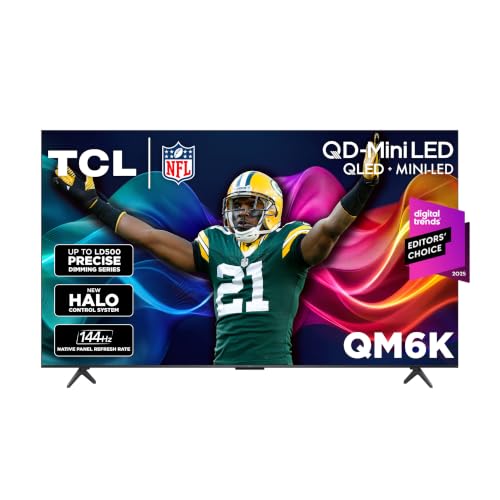
- Mini LED and Quantum Dot color
- 144Hz refresh with high-motion features
- Wide HDR support and Onkyo 2.1 audio
Best For: Sports, gaming, and bright, high-contrast 4K viewing
Best Simplified Streaming Pick – Roku Plus Series 55-Inch QLED Mini-LED TV
For shoppers comparing QLED televisions for 4K viewing, the 55-inch Roku Plus Series combines QLED color with Mini-LED backlighting, Dolby Vision, and full-array local dimming. Its straightforward Roku interface, voice remote, and broad free-content selection make it particularly easy to use.
Best For: Viewers who want an easy-to-navigate smart TV with enhanced picture technology and flexible voice-control options.
Pros:
- QLED, Mini-LED, and Dolby Vision support target rich color, contrast, and vivid highlights.
- Roku’s simple home screen, personalized picks, and unified search reduce streaming friction.
- Includes Dolby Atmos, a built-in subwoofer, Bluetooth Headphone Mode, and a lost-remote finder.
- Supports Roku Voice, Siri, Alexa, Google Assistant, Apple AirPlay, and multiple streaming services.
Cons:
- The 60Hz refresh rate is less specialized for very fast gaming than higher-refresh alternatives.
- The 55-inch size may not suit shoppers seeking a larger screen.
This is a practical all-around choice when simple streaming access matters as much as picture quality. Its Mini-LED and QLED combination adds visual impact, while Roku’s software and remote keep everyday operation approachable.
Best for Fast-Motion Viewing – TCL T7 65-Inch 144Hz QLED Google TV
Among QLED televisions for 4K viewing, TCL’s 65-inch T7 stands out for motion handling. Its native 144Hz refresh rate, Motion Rate 480 processing, QLED color, and broad HDR support suit fast games, sports, and action-heavy films.
Best For: Gamers and sports viewers who prioritize smooth motion, a large screen, and extensive connection options.
Pros:
- Native 144Hz refresh and Motion Rate 480 with MEMC aim to reduce motion blur.
- QLED technology covers nearly the entire DCI-P3 color space, according to the supplied notes.
- Supports Dolby Vision, HDR10+, HDR10, HLG, Dolby Atmos, and TCL AIPQ Pro processing.
- Four HDMI inputs, including eARC, provide room for consoles, receivers, and other devices.
Cons:
- The glossy screen finish can be less forgiving in rooms with strong reflections.
- Wi-Fi 5 is included rather than a newer listed wireless standard.
The T7 is the most motion-focused option in this group. Its 144Hz panel and gaming-oriented processing give it a clear advantage for rapid on-screen action, while Google TV features and four HDMI inputs keep it versatile.
Best Fire TV Value Option – Insignia QF Series 65-Inch QLED Fire TV
INSIGNIA 65-inch Class QF Series LED 4K UHD QLED Smart Fire TV with Alexa Voice Remote (NS65-UQFL26)
Check Price On AmazonFor buyers seeking QLED televisions for 4K viewing with familiar Amazon integration, the 65-inch Insignia QF Series pairs Quantum Dot color with a direct LED backlight, Dolby Vision HDR, and Fire TV. Its Alexa voice remote also simplifies hands-free control.
Best For: Amazon-oriented households that want a large 4K QLED screen with Fire TV apps and Alexa control.
Pros:
- Quantum Dot Color is designed to enhance brightness and produce vibrant, lifelike images.
- Supports Dolby Vision and HDR10 for enhanced contrast and detail.
- Fire TV brings streaming apps, channels, and Alexa skills together in one interface.
- Includes Dolby Atmos audio, Apple AirPlay, and three HDMI inputs with eARC.
Cons:
- The 60Hz refresh rate is less suited to shoppers specifically seeking high-refresh gaming.
- There are three HDMI inputs, fewer than the TCL T7 provides.
This model makes sense if Fire TV and Alexa are central to your viewing setup. It offers a large QLED display, useful HDR support, and eARC without shifting away from Amazon’s familiar smart-TV ecosystem.
Best Compact Smart-TV Pick – Samsung Q7F 43-Inch QLED Vision AI TV
Samsung’s 43-inch Q7F is a compact choice among QLED televisions for 4K viewing. It combines Quantum Dot color, a Q4 AI processor, 4K upscaling, HDR10+, and Samsung Vision AI features in a smaller format suited to bedrooms, offices, and space-limited entertainment areas.
Best For: Smaller rooms and viewers who want Samsung’s smart-TV platform, AI-assisted picture processing, and gaming features in a 43-inch size.
Pros:
- Quantum Dots are designed to display a broad range of colors, including billions of shades.
- Q4 AI processing supports 4K upscaling and AI-optimized picture and audio adjustments.
- Offers HDR10+, Motion Xcelerator, Game Mode, Gaming Hub, Alexa built-in, and Tizen.
- Samsung TV Plus provides access to more than 2,700 free channels, according to the supplied notes.
Cons:
- The 43-inch screen and 60Hz refresh rate are less suitable for large-room or high-refresh viewing.
- The supplied notes list edge LED backlighting rather than Mini-LED technology.
- Audio output is listed as a 2-channel, 20-watt speaker system.
The Q7F is best evaluated as a feature-rich compact TV rather than a large-screen home-theater display. Its AI processing, free Samsung TV Plus content, and gaming-oriented features make the smaller size more versatile.
Compact Color Specialist – Samsung QN70H Neo QLED 4K TV
For shoppers comparing QLED televisions for 4K viewing in a smaller room, this 43-inch Samsung combines Quantum Mini LED backlighting with Quantum Dot color. Its AI processing and 4K upscaling are designed to improve both native 4K content and lower-resolution sources.
Best For: Bedrooms, offices, apartments, and viewers who want a compact 4K QLED display with strong color and contrast features.
Pros:
- Quantum Mini LED helps improve contrast, dark-scene clarity, and bright highlights.
- Quantum Dot technology supports 100% color volume and billions of shades.
- NQ4 AI processing and 4K upscaling enhance compatible picture and audio content.
- Matte screen finish may help reduce distracting reflections.
Cons:
- The 43-inch screen may feel small for a large living room.
- Its listed 60Hz refresh rate is less suited to high-refresh gaming than faster alternatives.
- There are three HDMI ports and one USB port, which may limit connected devices.
This model is a practical choice when size matters more than maximum refresh rate. Its Mini LED contrast, broad color capability, and AI-assisted upscaling make it a well-rounded compact option for everyday entertainment.
Value Gaming Pick – TCL Q6 55-Inch QLED 4K Smart TV
This TCL Q6 is a strong contender among QLED televisions for 4K viewing if you want a larger screen with gaming-oriented motion features. Its Quantum Dot display, HDR Pro+ support, Google TV platform, and Game Accelerator 120 target both streaming and responsive gameplay.
Best For: Budget-conscious living rooms, streaming households, and gamers who want a 55-inch 4K QLED TV with enhanced motion features.
Pros:
- Quantum Dot technology provides over a billion colors and an UltraWide Color Gamut.
- HDR Pro+ supports Dolby Vision, HDR10, HDR10+, and HLG.
- Game Accelerator 120 includes variable refresh rate powered by AMD FreeSync.
- Google TV and Google Cast bring streaming and mobile casting together.
Cons:
- As a 2023 model, it is older than the other listed options.
- The supplied details list only one USB port.
- Its 500-nit maximum brightness may be less impactful than brighter premium displays.
The Q6 emphasizes versatility: it offers broad HDR format support, a 55-inch screen, and gaming features without moving beyond the mainstream category. It is especially appealing when price and gaming responsiveness are priorities.
Premium Motion Choice – Samsung QN80F Neo QLED 4K TV
For viewers seeking high-performance QLED televisions for 4K viewing, the 55-inch Samsung QN80F pairs Mini LED control with a 144Hz refresh rate. Its NQ4 AI Gen2 processor, HDR-like enhancement, and Dolby Atmos support are aimed at detailed picture quality and immersive entertainment.
Best For: Movie fans, sports viewers, and gamers who want a 55-inch Neo QLED with advanced processing and high-refresh performance.
Pros:
- Mini LED backlighting uses precision-controlled zones for improved contrast and brightness.
- NQ4 AI Gen2 processing uses 20 neural networks to enhance content up to 4K.
- Supports VRR gaming up to 4K 144Hz with Motion Xcelerator 144Hz.
- Object Tracking Sound Lite and Dolby Atmos provide spatial-audio features.
Cons:
- The 37.9-pound weight makes installation more demanding than smaller models.
- The supplied HDR details list HDR10+ rather than the broader HDR format range offered by the TCL.
- Its glossy screen finish may be more prone to visible reflections.
The QN80F is the most performance-focused option in this group. Its Mini LED system and AI processing support cinematic detail, while the 144Hz capability gives it a clear advantage for fast sports and compatible gaming setups.
Balanced Everyday Pick – TCL F7D Series QLED 4K TV
The TCL F7D is a practical choice among QLED televisions for 4K viewing, combining Quantum Dot color with broad HDR format support in a compact 50-inch size. Its smart features, voice remote, and automatic game mode make it well suited to everyday streaming and casual gaming.
Best For: Viewers wanting vibrant 4K color, flexible streaming features, and a smaller-screen TV for mixed entertainment.
Pros:
- Quantum Dot technology delivers over a billion stated color shades.
- Supports Dolby Vision, HDR10+, HDR10, and HLG.
- Includes Dolby Atmos and DTS:X/DTS Virtual:X support.
- Auto Game Mode, Game Bar, Alexa, AirPlay 2, and HomeKit add useful convenience.
Cons:
- The display refresh rate is listed as 60Hz, so it is less specialized for high-refresh gaming than the other options.
- It has three HDMI ports and one USB port.
The F7D emphasizes versatility rather than premium panel hardware. It is a sensible fit for general viewing when strong HDR compatibility and smart-home integration matter more than Mini-LED contrast or advanced refresh rates.
Premium Bright-Room Choice – Samsung QN90F Neo QLED 4K TV
The Samsung QN90F is a premium option among QLED televisions for 4K viewing, pairing Mini LED backlighting with AI-assisted processing and a glare-free screen finish. Its high refresh capability and gaming features also make it a strong choice for fast-moving content.
Best For: Viewers seeking strong brightness, reduced reflections, AI-enhanced 4K processing, and advanced gaming performance.
Pros:
- NQ4 AI processing uses 128 neural networks for upscaling and picture optimization.
- Mini LED backlighting and Ultimate UHD Dimming support brightness and contrast.
- Glare-free design helps limit distracting reflections.
- Supports VRR gaming up to 4K 165Hz and includes Gaming Hub.
Cons:
- The supplied HDR listing specifies HDR10+ rather than the broader HDR format range listed for the TCL models.
- At 45.4 pounds with the stand, it is comparatively substantial for wall mounting or setup.
The QN90F is built for demanding viewing environments, particularly rooms with reflections or lots of daylight. Its AI processing, Mini LED system, and high-refresh gaming support place it above a basic QLED in features, though it may be more TV than casual viewers need.
Fast-Action Value Pick – TCL QM6K Mini LED QLED 4K TV
The TCL QM6K combines Mini LED backlighting and Quantum Dot color for a high-brightness 55-inch display. For shoppers comparing QLED televisions for 4K viewing, its 144Hz native refresh rate, local dimming, and wide HDR support make it especially appealing for sports and gaming.
Best For: Sports fans and gamers who want smooth motion, strong HDR compatibility, and Mini LED contrast at a value-oriented position.
Pros:
- QD-Mini LED combines precise lighting with Quantum Dot color.
- Halo Control and local dimming are designed to improve dark-scene detail and reduce blooming.
- Supports Dolby Vision, HDR10+, HDR10, and HLG.
- Offers 144Hz native refresh, Motion Rate 480, and Game Accelerator 240 VRR.
Cons:
- The supplied specifications list an edge LED backlight configuration alongside Mini LED and full-array local dimming, so the implementation details may warrant verification.
- The glossy screen finish may be less suitable for rooms with direct reflections.
The QM6K is the most motion-focused model in this group, with unusually strong stated refresh and gaming specifications. Its Onkyo 2.1 audio system with a built-in subwoofer further supports an action-oriented setup, while Google TV handles streaming and smart-TV duties.
How We Picked the Best QLED Televisions for 4K Viewing
We evaluated these televisions by looking at the features that most affect everyday 4K viewing: panel technology, brightness, contrast, HDR compatibility, motion handling, gaming support, smart-TV software, sound features, and available screen sizes. The selection covers affordable QLED sets as well as premium Neo QLED and Mini-LED models.
We also considered practical use cases. A television intended for daytime sports needs different strengths from one used for nighttime movies, while console and PC gamers benefit from higher refresh rates, low-latency modes, and compatible HDMI features.
Quick Comparison
| Best For | Look For | Models In This Roundup |
|---|---|---|
| Affordable 4K streaming | QLED color, Dolby Vision, built-in smart platform | TCL Q6, TCL F7D, Insignia QF |
| Bright rooms and sports | High brightness, effective reflection handling, Mini-LED backlighting | Roku Plus, TCL QM6K, Samsung QN80F |
| Gaming | 120Hz or higher refresh rate, low input lag, HDMI 2.1 features | TCL T7, TCL QM6K, Samsung QN90F |
| Premium picture quality | Mini-LED contrast, advanced HDR, image processing | Samsung QN70H, QN80F, QN90F |
Key Buying Factors for QLED Televisions for 4K Viewing
Panel and Backlight Technology
QLED televisions use a quantum-dot layer to improve color volume and brightness. Mini-LED versions add much finer backlight control, which can improve contrast and reduce blooming around bright objects. They generally cost more, but the difference is most noticeable in HDR movies, dark scenes, and bright rooms.
HDR and Picture Processing
Check for HDR formats such as HDR10, HDR10+, and Dolby Vision, but do not judge picture quality by format support alone. Peak brightness, local dimming, tone mapping, and the television’s processing also affect how HDR content looks. Strong upscaling is useful when watching HD broadcasts or older streaming content.
Refresh Rate and Gaming Features
A native 120Hz or higher panel can make fast sports and games look smoother than a 60Hz set. Gamers should also check for variable refresh rate, automatic low-latency mode, suitable HDMI inputs, and support for the resolution and frame rate their console or PC can produce.
Size, Viewing Distance, and Sound
Choose a screen size that suits your seating distance rather than simply buying the largest model. A 43- or 50-inch set can work well in a bedroom or compact room, while 55- to 65-inch televisions are common living-room choices. Dolby Atmos support can help with compatible content, but a soundbar remains the best upgrade for fuller dialogue and bass.
Who Should Buy Which QLED Televisions for 4K Viewing?
Choose an entry-level TCL, Insignia, or similar QLED model if you want better color than a basic LED TV at a controlled price. Select a Roku or Google TV model if simple streaming access and an intuitive interface are priorities.
For bright rooms, sports, and mixed daytime viewing, prioritize a high-brightness Mini-LED set such as the TCL QM6K or a Samsung Neo QLED model. Gamers should focus on the TCL T7, TCL QM6K, or Samsung QN90F, depending on budget and desired refresh-rate performance.
For the most refined image, deeper contrast, and stronger HDR impact, a premium Samsung Neo QLED television is the better fit. Before buying, confirm the exact model year, dimensions, stand width, HDMI layout, and smart-platform features, since specifications can vary within the same product family.