Dolby Atmos can make movie nights feel bigger, but the right system depends on more than an Atmos logo. Speaker layout, room shape, connections, and where you can place a subwoofer and rear speakers all affect the experience.
These 10 options range from compact 5.1-channel soundbar packages to larger systems with multiple height channels. Use the guide below to narrow your choices before comparing the individual models.
Best 10 Surround Sound Systems with Dolby Atmos 2 Picks for 2026
Best for Wireless Rear Speakers
ULTIMEA Poseidon M100 7.1 Dolby Atmos

- Two wireless rear surround speakers
- 6.5-inch wireless subwoofer
- HDMI eARC and app-based EQ
Best For: Rear surround sound with fewer audio cables
Best Straightforward 5.1 Setup
ULTIMEA Poseidon M80 Dolby Atmos

- Three front channels and two wired surrounds
- 5.25-inch wireless subwoofer
- Six EQ modes with app or remote control
Best For: Adjustable 5.1 sound with wired rear speakers
Best for Dedicated Height Channels

- Dual up-firing Atmos drivers
- Two rear surrounds and 5.25-inch subwoofer
- 10-band EQ and 121 app presets
Best For: Dedicated height effects and detailed sound tuning
Best for Big-Room Bass
Nakamichi Shockwafe Ultra 9.2.4 SSE Max

- Two wireless 10-inch subwoofers
- Four modular, RCA-wired surrounds
- Dolby Atmos, DTS:X, and three HDMI inputs
Best For: Spacious home theaters seeking dual-sub bass
Wireless Theater Pick
ULTIMEA Skywave X40 5.1.2 Sound Bar

- 5.1.2-channel surround layout
- Dual 5GHz wireless transmission
- 4K HDR pass-through
Best For: Wireless placement and bass-focused home theater
LG TV Companion
LG S80TR 5.1.3 Soundbar System

- 5.1.3 channels with Dolby Atmos
- Included rear speakers and wireless subwoofer
- LG TV integration and room calibration
Best For: Compatible LG TV owners seeking rear-speaker surround
Simple Atmos Setup
ULTIMEA Poseidon M60 5.1 Sound Bar

- Dolby Atmos via HDMI eARC
- No separate rear speakers
- 10-band EQ and 121 app presets
Best For: Easy setup with adjustable Dolby Atmos sound
Best for Height Effects
ULTIMEA Skywave X50 5.1.4 System
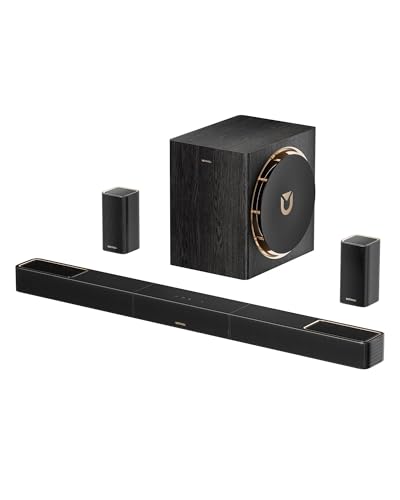
- 5.1.4-channel immersive layout
- Dual-5GHz wireless transmission
- 8-inch subwoofer; 4K HDR pass-through
Best For: Movies with overhead effects and strong bass
Best for Room Calibration

- Dolby Atmos and DTS:X support
- Wireless surrounds and 6.5-inch subwoofer
- AI Sonic auto room calibration
Best For: Easy room-specific tuning with wireless surrounds
Best for EQ Control
ULTIMEA Poseidon D80 7.1 System

- Front and rear surround speakers
- 121 EQ presets and 10-band EQ
- 4K HDMI with eARC; no DTS decoding
Best For: Customizable surround sound with app-based EQ
Best for Wireless Rear Speakers – ULTIMEA Poseidon M100 7.1 Dolby Atmos
Among surround sound systems with Dolby Atmos, the ULTIMEA Poseidon M100 is a practical pick if you want rear effects without running audio cables across the room. Its 7.1 setup pairs a soundbar with two wireless surround speakers and a 6.5-inch wireless subwoofer.
Best For: Viewers who want rear surround sound with fewer audio cables.
Pros:
- Wireless rear speakers offer flexible placement behind or beside your seat.
- 6.5-inch subwoofer and 432W peak power support fuller, room-filling sound.
- HDMI eARC, Bluetooth 6.0, and app-based EQ provide useful connection and tuning options.
Cons:
- The subwoofer and both surround speakers still require power outlets.
- HDMI eARC is recommended for Dolby Atmos playback.
Choose this model for its cleaner rear-speaker layout, but plan where all three wireless components will plug in. If placement flexibility matters more than eliminating power cords, it strikes a sensible balance.
Best Straightforward 5.1 Setup – ULTIMEA Poseidon M80 Dolby Atmos
If you’re comparing surround sound systems with Dolby Atmos and want dedicated rear channels, the ULTIMEA Poseidon M80 offers a 5.1 layout with three front channels, two wired surrounds, and a wireless subwoofer. It’s designed to improve dialogue and place effects around your seating area.
Best For: Buyers comfortable with wired rear speakers who want an adjustable 5.1 system.
Pros:
- Dedicated rear speakers provide surround effects behind or beside the listener.
- 5.25-inch wireless subwoofer and 312W peak power add bass impact.
- App or remote controls adjust bass, surround levels, and six EQ modes.
Cons:
- Rear speakers connect to the subwoofer by cable; the subwoofer also needs power.
- It does not decode DTS.
The M80 makes sense when real rear channels matter more than a cable-free layout. Use HDMI eARC for Dolby Atmos, and check your source’s audio settings if a DTS soundtrack produces no sound.
Best for Dedicated Height Channels – ULTIMEA Skywave F40 5.1.2
For shoppers seeking surround sound systems with Dolby Atmos that include dedicated height effects, the ULTIMEA Skywave F40 uses a 5.1.2-channel layout with dual up-firing drivers. Two rear surrounds and a 5.25-inch subwoofer round out the system for sound around and above the listening position.
Best For: Movie watchers who prioritize up-firing Atmos channels and detailed sound adjustment.
Pros:
- Dual up-firing drivers add dedicated height channels to the surround layout.
- HDMI eARC supports 5.1.2-channel Atmos audio and CEC control.
- App offers a 10-band EQ, 121 presets, and adjustable surround levels.
Cons:
- Not compatible with DTS.
- The subwoofer is wired, and the system includes a rear-surround cable.
The F40 is the more targeted choice here if overhead effects are your priority. Its extensive app controls are useful for tailoring the sound, provided you’re willing to accommodate the wired components.
Best for Big-Room Bass – Nakamichi Shockwafe Ultra 9.2.4 SSE Max
The Nakamichi Shockwafe Ultra is for buyers considering larger surround sound systems with Dolby Atmos rather than a compact soundbar setup. Its 9.2.4 configuration combines a 45.5-inch soundbar, four modular surround speakers, and two wireless 10-inch subwoofers; it also supports DTS:X.
Best For: Home theater setups with space for dual subs and four surround speakers.
Pros:
- Dual 10-inch wireless subwoofers deliver substantial room-filling bass.
- Four modular surrounds offer flexible placement for expansive rear effects.
- HDMI eARC and three HDMI inputs support flexible home theater connections.
Cons:
- Each surround speaker must connect to a subwoofer with an RCA cable.
- The two large subwoofers and four satellites require considerable floor and placement space.
This is the ambitious option for listeners who can accommodate its footprint and wiring. The dual-sub arrangement and four surrounds are compelling for a dedicated movie room, but measure your space before choosing it.
Wireless Theater Pick – ULTIMEA Skywave X40 5.1.2 Sound Bar
If you’re comparing surround sound systems with Dolby Atmos 2, the Skywave X40 is worth considering for its 5.1.2-channel layout and emphasis on wireless connectivity. Its dual 5GHz wireless transmission is designed to keep the system connected without running signal cables across the room.
Best For: Buyers who want a 5.1.2-channel setup with wireless connectivity, strong bass, and 4K HDR pass-through.
Pros:
- 5.1.2-channel configuration adds height effects to surround playback.
- Dual 5GHz wireless transmission is designed for stable connectivity.
- 530W peak output, a 6.5-inch subwoofer, and claimed bass extension to 35Hz suit action-heavy viewing.
- 4K HDR pass-through lets a connected source send video through the soundbar to a TV.
Cons:
- The supplied specifications do not explicitly confirm Dolby Atmos decoding.
- The listed 530W figure is peak power, not continuous output.
The X40 makes the strongest case when wireless placement and impactful bass matter most. If Dolby Atmos support is essential, confirm the supported audio formats before purchasing.
LG TV Companion – LG S80TR 5.1.3 Soundbar System
Among surround sound systems with Dolby Atmos 2, the LG S80TR stands out for its 5.1.3-channel layout, included rear surround speakers, and Dolby Atmos and DTS:X support. It’s an especially practical match for a compatible LG TV, where WOW Orchestra and WOW Interface add integrated sound and control options.
Best For: LG TV owners who want rear speakers, height effects, and convenient TV-soundbar integration.
Pros:
- Includes wireless-connectivity rear speakers and a wireless subwoofer.
- An up-firing center channel is designed to improve dialogue clarity.
- Built-in WOWCAST supports wireless Dolby Atmos with a compatible setup.
- Room calibration adjusts audio settings based on microphone measurements.
Cons:
- WOW Orchestra and unified WOW Interface controls depend on a compatible LG TV.
- Rear speakers and a subwoofer require more placement space than a single soundbar.
Choose the S80TR if you want an included rear-speaker setup rather than relying on a bar alone for surround. Its LG-specific features are a meaningful advantage when your TV supports them.
Simple Atmos Setup – ULTIMEA Poseidon M60 5.1 Sound Bar
For shoppers browsing surround sound systems with Dolby Atmos 2, the ULTIMEA Poseidon M60 offers a simpler 5.1-channel approach: five speakers built into the bar, including two side-firing drivers, plus a wired subwoofer. It supports Dolby Atmos without requiring separate rear speakers.
Best For: Buyers who want Dolby Atmos support, straightforward setup, and adjustable sound without rear-speaker placement.
Pros:
- Side-firing drivers create a wider presentation without separate rear speakers.
- HDMI eARC supports Dolby Atmos audio and CEC-based TV control.
- VoiceMX processing is designed to keep dialogue intelligible during busy scenes.
- The app offers a 10-band EQ, 121 presets, and 13 adjustable surround levels.
Cons:
- No dedicated rear speakers or height channels are specified.
- The subwoofer is wired, which limits placement flexibility.
The M60 is the streamlined choice here: it prioritizes easy placement and extensive sound adjustments over the separate rear speakers or dedicated height-channel layouts of the other options.
Best for Height Effects – ULTIMEA Skywave X50 5.1.4 System
Among surround sound systems with Dolby Atmos, the Skywave X50 is a strong pick if you want a 5.1.4-channel layout with sound designed to reach overhead. Its dual-5GHz wireless transmission also helps reduce speaker-cable clutter.
Best For: Movie watchers who want height effects, substantial bass, and flexible app or remote control.
Pros:
- 5.1.4-channel configuration supports immersive surround and overhead effects.
- Dual-5GHz wireless transmission is designed for stable connectivity.
- 8-inch subwoofer and claimed bass extension to 28Hz.
- Supports 4K HDR pass-through.
Cons:
- 760W is a peak-power figure, not a continuous-power rating.
- Check your furniture space for the separate 8-inch subwoofer.
The X50 makes the most sense when height effects and bass are priorities; check your source connections and available speaker space before buying.
Best for Room Calibration – TCL S65K 5.1 Soundbar System
For shoppers comparing surround sound systems with Dolby Atmos, the TCL S65K pairs a 5.1-channel soundbar package with wireless surrounds, a wireless subwoofer, and AI Sonic auto room calibration. It also supports DTS:X, making it a practical option for households using both formats.
Best For: Viewers who want a surround package that can tune its sound to their room.
Pros:
- Supports Dolby Atmos and DTS:X.
- Wireless surround speakers and a 6.5-inch wireless subwoofer allow flexible placement.
- AI Sonic auto room calibration adjusts sound to the space.
- Dedicated center channel and tweeter prioritize dialogue detail.
Cons:
- Its stated configuration is 5.1 channels, with no dedicated height channels specified.
- Separate surrounds and subwoofer still need places in the room.
The S65K stands out for its combination of format support and automatic calibration, especially if you prefer less manual audio tuning.
Best for EQ Control – ULTIMEA Poseidon D80 7.1 System
If you are weighing surround sound systems with Dolby Atmos and want extensive sound adjustments, consider the ULTIMEA Poseidon D80. Its 7.1-channel package adds front and rear surround speakers, while the companion app offers EQ presets and manual tuning.
Best For: Listeners who want multiple surround speakers and hands-on control over their sound profile.
Pros:
- 7.1-channel setup includes two front and two rear surround speakers.
- Supports Dolby Atmos decoding and uses spatial-positioning processing.
- App offers 121 EQ presets, a 10-band EQ, and listening modes.
- Includes 4K HDMI input/output with eARC, plus optical and AUX inputs.
Cons:
- Does not support DTS decoding.
- Extra speakers require more placement planning than a soundbar alone.
The D80 suits buyers who will use its app controls and can accommodate the added speakers; DTS users should choose a different system.
How We Picked the Best Surround Sound Systems with Dolby Atmos 2
We organized the 10 selected systems around the details that matter most when shopping: channel layout, included subwoofers and surround speakers, advertised Atmos support, and how practical each package is to place in a real room. This is a buying comparison, not a claim that every system was tested side by side. Confirm current specifications and included accessories with the retailer before ordering.
Quick Comparison: Match the Layout to Your Room
For a straightforward starting point, compare the 5.1-channel packages from TCL and ULTIMEA with the larger configurations on this list. The ULTIMEA 5.1.2 and Skywave X40 5.1.2 models add two advertised height channels, while the Skywave X50 5.1.4 lists four. LG’s S80TR has a 5.1.3 layout and included rear speakers. The Nakamichi Shockwafe 9.2.4 is the largest listed configuration, with dual subwoofers; plan for substantially more speaker placement. The two ULTIMEA 7.1 options suit shoppers prioritizing additional surround channels, but check how each model produces height effects rather than relying on the channel count alone.
Key Buying Factors for Surround Sound Systems with Dolby Atmos
Height Effects and Speaker Layout
In a layout such as 5.1.2, the final number denotes height channels. Check whether a system uses upward-firing drivers, dedicated height speakers, or virtual processing. Upward-firing effects depend partly on ceiling height and shape; virtual Atmos may be easier to accommodate but should not be assumed to sound identical.
Connections and Format Support
Check your TV’s HDMI ARC or eARC port and the sound system’s supported inputs. eARC can be important for passing higher-bandwidth audio formats from a compatible TV and source. If you use a game console or disc player, verify the complete signal path—including any HDMI passthrough—rather than assuming an Atmos label guarantees support for every source or format.
Placement, Power, and Everyday Use
“Wireless” rears and subwoofers generally still need power outlets. Measure the soundbar against your TV stand, allow space for the subwoofer, and make sure rear speakers can sit behind or beside the listening position. Also compare dialogue controls, app or remote operation, and any TV-specific integration you intend to use.
Who Should Buy Which Surround Sound Systems with Dolby Atmos 2?
Choose a 5.1 package if you want distinct rear effects without the most elaborate setup. Look at a 5.1.2 model when height effects are a priority and your room can support its speaker design. Consider the Skywave X50 or LG S80TR if their respective layouts and features fit your space; LG TV owners should verify compatibility before counting on brand-specific features. The Nakamichi system makes more sense for buyers with a larger room, room for two subwoofers, and a willingness to manage more speakers. Whatever you choose, prioritize a layout you can place correctly over the biggest number on the box.